FM*** F9 June 2015 Exam was.. Instant Poll and comments ***
how were we suppose take the portability for the NPV question- Q5. were we suppose to calculate the all the rates by inflating 4 % and calculate the sales value for each rate or take an average
We were suppose to calculate the EV of the selling price which was 29 and inflate it using 4%. We had to inflate the fixed costs as well by 10%. They said the fixed costs and sales were in current terms. The variable costs wers in nominal values and the coc was given in nominal.
Question1: was fair but i think i messed up the answers although my workings were correct. I managed to discuss the DVM and Earnings yield.
Question2: pls remind me what it was about
Question 3: this was a fair one. My cost was more than savings.
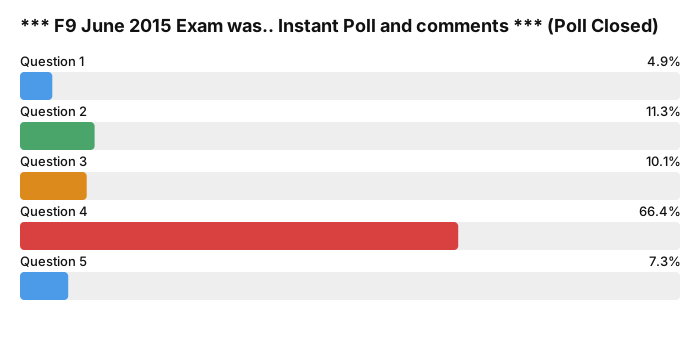
Question 4: disaster i will only get marks for calculates i did. B part... I spoke about gearing and financial sick while A part i spoke about how the wealth of shareholders changed after rights issue.
Question 5: i did npv and got positive npv.. It was 3901something like that. I think part b.. I spoke about senstivity analysis and spoke about senstivity margin.
Guys do u think i did ryt?
Or yes i remember. Question 1 i choice forward hedge...
Probably it was me only but there was something strange in the wording of question 1 section b, that had me thinking. Is this a normal borrow, convert and deposit - money market hedge?
Re mcqs what I can remember is that my first answers were A,B,D,D,D,D
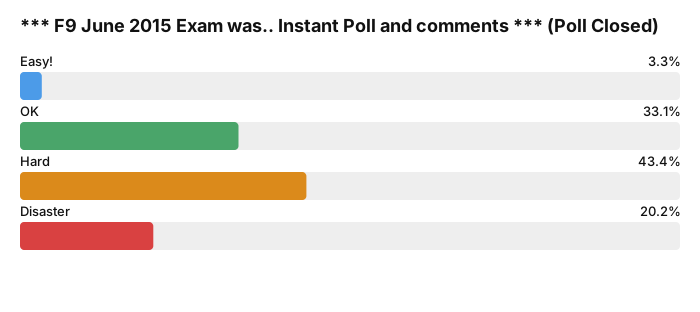
This exam left me feeling so terrible and I went so confident. I can't stop thinking about it!
Mcqs hold too many marks so whether we pass or fail depends on these. Apparently acca won't be publishing these questions so we'll have to wait patiently till the 1 August!!
They usually post it by now so there could be some sort of clarity in your mind by sir John Moffat, but they ain't posting it!
Most mcqs were A and D
well for Q-5 what i did was i inflated all the 3 rates by 4% multiplied by the probably given and added them up to take a single rate that came out to be 30 :)
No, you first have to calculate expected price, only then you inflate.
Guys, part B second question, they asked market value per share, didnt they? Third question, 80% advance was on new receivables of 35 days, wasnt it?
@emo777 said: Guys, part B second question, they asked market value per share, didnt they? Third question, 80% advance was on new receivables of 35 days, wasnt it?We've got to forget about that part of question B for now!!! I'm guessing ACCA will publish the questions tomorrow although it might be Tuesday as they still haven't done F8 which was the day before. Once they're up hopefully John will do his magic and then we'll know. Until then we have no way of knowing as it's down to individual opinion about what was the right approach. I'm feeling a bit more relaxed about it now. I think we're so fired up after the exam we worry about every single mark but after a bit of time out it's worth remembering that we're not going to get every single mark possible - at least, I've never heard of someone getting 100%?
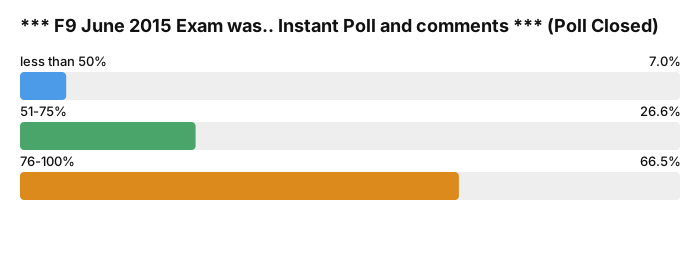
Jenny, everyone cares only about getting at least 50 marks :D
Just spent an hour going through all the comments (what is life?)!
For Q3, did anyone work out the receivable days based on current policy?It said 40 days but also said customers usually take longer - I calculated it and got 60 days!
Then I did how long many days can the factor reduce the days: 60-35 = 25 days. I used this figure to calculate the benefit of using the factor.
Did anyone else do anything similar? I might have got carried away with trying to be too creative!
Dhaval, i can see where you made a small mistake...they already gave you the current receivables, so there was no point in calculating the current days. What you had to do, is just to calculate revised receivables as per 35 days, and find the difference between two receivables values and multiply by 5 to find the saving. To find the cost on advance, what you had to do is: 26500000*0.8*35/360*(0.07-0.05) you calculate advance finance only on new receivables
But, no worries, if im not mistaken, the final answer is almost irrelevant...your method and workings are relevant
Gvtftf ah right, I see what you mean. This was the last of Sec B question that I did so felt rushed.
Sometimes I go over board in exams, for example in the optimal capital structure theory question, I wrote "After coming under much widespread criticisms from all corners of the economic society, in 1963 M&M..." :D
Yeah, the same here:) i messed up part b of question 4 as well
Btw, one mcq claimed that with weak form of efficiency, it is possible to win by using historical data or smth like this...this seems to be wrong, as you can win on historical data in a completely inefficient market.
Also, there was smth regarding the definition of operational efficiency..that one was incorrect.
Jenny?
@emo777 said: Btw, one mcq claimed that with weak form of efficiency, it is possible to win by using historical data or smth like this...this seems to be wrong, as you can win on historical data in a completely inefficient market. Also, there was smth regarding the definition of operational efficiency..that one was incorrect. Jenny?Weak form efficiency means share prices reflect all past price information so you can't win by studying share price movements. The only way that would work would be if the market were completely inefficient. So, yes that was wrong. The one about operational efficiency of markets has been bugging me because I can't remember the rest of the question - whether it was one of the ones where there was only one that was correct/incorrect or whether there were choices (eg 1 & 2, or all of the above). I have a feeling that I choose one and three as correct but that one wrong but I can't be sure unless anyone can remember the rest of the question.
@dhaval10 said: Just spent an hour going through all the comments (what is life?)! For Q3, did anyone work out the receivable days based on current policy?It said 40 days but also said customers usually take longer - I calculated it and got 60 days! Then I did how long many days can the factor reduce the days: 60-35 = 25 days. I used this figure to calculate the benefit of using the factor. Did anyone else do anything similar? I might have got carried away with trying to be too creative!It shouldn't matter as both methods should give the same answer (apart from rounding). Either one is valid.
Yes, Jenny. I think the one with operational efficiency was wrong, and it was second, so that the first and third were the correct ones
guys how much did you write for answer in Q5 (B) ?
Fahad, i believe you were not expected to write five pages essay. I just gave the description of sensitivity analysis in a couple of sentences.
In regards to all the written questions in Sec B, I always tend to write a lot more than required - just in case.
I missed out 10 marks worth of questions but made sure I wrote more than enough for questions on sensitivity, capital structure theories (even drew graphs! ), Q1. B (can't remember the question) etc.
Quality>quantity. They do not give additional marks for lenght, you have to be concise and up to the point.
Someone tell me about boumel model mcqs ans???
Lizphil, yes, but they already gave you the calculated current receivables to save your time. Both methods are trues, as Jenny mentioned