
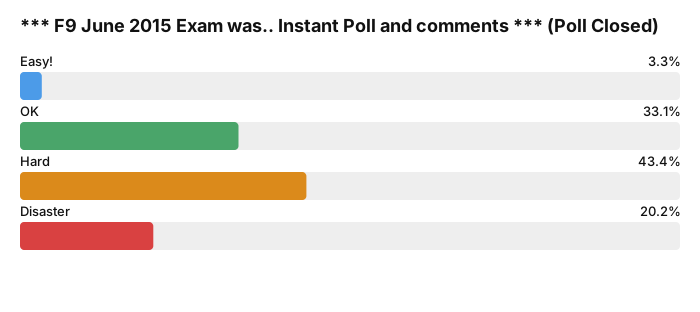
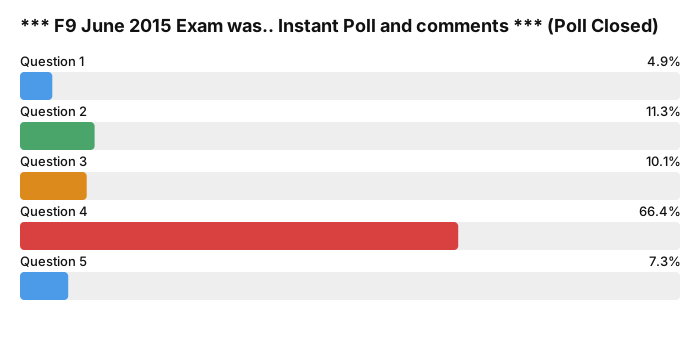
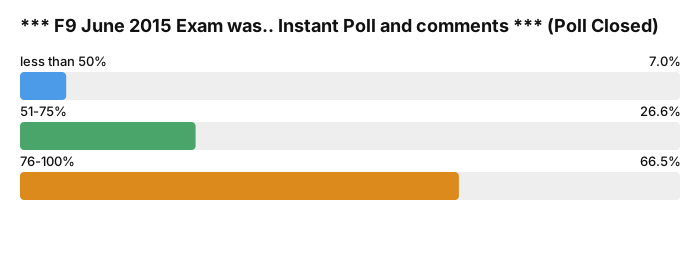
Please vote in our Instant Polls about the F9 June 2015 Exam.
 Please note, the ACCA have asked us to allow posting comments only after 5pm UK time.
 Please note, the ACCA have asked us to allow posting comments only after 5pm UK time.
@emo777 said: Yeah, i divided it by old number of shares :/ then multiplied it by current p/e ration to compare with theoretical ex rights price. Because my new eps was incorrect, the comparison should be wrong as well. But this was the only issueYou'll get follow on marks for your comparison so you'll be ok. Even if the EPS is wrong, if your comparison is right based on your figure, you'll get full marks for that.
@nirjhardey said: guys i think we r just wasting time talking about part b..part b questions was easy enough depending on ones preparation. and it doesnt really matter if we get a few things wrong..as we will still get most of the marks for methods and calculations..having said that i dont know what to expect from acca anymore. so lets talk about part a guys where i think most of us had serious problem as questions were not only tricky some of them were not even in the study text.i would really appreciate if any of u think u done quite alright in sec a then pls come forward and share the answer with us. thnk ulol, read back though the forum - everyone's been discussing the MCQs in Section A. Some of us have also posted our answer choices too.
@mfc2476 said: I completely messed up Q4. Did a few calculations which I'm hoping might pick up a mark or two. I calculated a TERP, was that neccessary? worked out a P/E ratio, was that neccessary? not a clue.Both necessary! So, you didn't do as badly as you thought. Basically, shareholder wealth in this question is based on share price because no information re dividends so we need to figure out how the rights issue affects this. So, calculate TERP to find new value of shares after rights issue - is lower that current MV but shareholder wealth not affected yet overall due to having more shares. But, then need to look at what we do with the money raised. In this case buy back bonds. So, money raised (less issue costs) divided by the price to buy back the bonds (MV x premium of 5% I think) - gave (off the top of my head) the ability to buy back 100,000 bonds so nominal value of bond reduction was $10m. Therefore we will now save interest on the £10m bonds - calculate the post tax interest saving and add to current earnings to get revised earnings. Divide by new number of shares (24m) to get revised EPS. Calculate existing PE ratio and multiply by new EPS to get forecast share price - compare to TERP for capital gain or loss for shareholder - ie effect on wealth - I had loss. That's what I did anyway but have a feeling I may have been missing something since past questions like this have had really long answers.
 Former user11y ago#277
@emo777 said: Really? Didnt know that. Just forgot to add additional 4000000 shares to existing 20000000. So, has 20 in denominator, instead of 24Yep, you'll be fine - we tend to forget they don't penalise us more than once for getting something wrong. It's like the NPV question, if someone had forgotten to inflate the selling price they could still get 8/9 (or even 8.5 depending on the mark for inflation).
@emo777 said: But they asked for the effect of rights issue? What you wrote was general. I talked about 3 possibilities: when shareholders take the rights, when they sell the rights and when they do nothingI said I didn't do great with this question, but just had a stab at what I thought might get some marks.
Former user11y ago#286@emo777 said: I think you messed up with 5% premium :D i think it was given to mislead us. The thing you had to do is to multiply net cash raised after issue costs by 100 and then divide by 104 to find the nominal value of loan to be redeemed. The you calculate the saving on interest. They took it from bpp revision kit, and you need premium only for calculation of cost of redeemable debt, which was not relevant in this case.The premium was relevant. The holders of the bonds said they would allow them to be bought back at market value plus a premium of 5%. You can't force the bond holders to sell so you have to pay what they ask!
@mfc2476 said: That's a bit reassuring Jenny. I also calculated that we could buy back 100,000 bonds @ 109.20? For the second part of the question I spoke about traditional theory and M&M. I mentioned about the tax shield effect when paying interest as opposed to dividends which are not tax deductable. I concluded that paying off the debt will probably not acheive the aim of optimising the WACC as the debt is cheaper?Exactly as I did. Equity costs more than debt so increasing equity and decreasing debt will not optimise structure according to any of the theories.
@emo777 said: But they asked for the effect of rights issue? What you wrote was general. I talked about 3 possibilities: when shareholders take the rights, when they sell the rights and when they do nothingMFC2476 was talking about part b rather than part a which asked about whether buying back the bonds would optimise capital structure - for that part I think his answer is spot on.
@emo777 said: So, to conclude with the hardest mcqs: 1) all three choices were financial intermediaries 2) factoring improves efficiency of trade receivables management in a company 3 market segmentation explains kinks in yield curves 4) money deposits are short term loans between banks, and this option was wrong 5) beta of debt understates financial risk, this was also wrong 6) borrowers buy futures and sell them later, this option was wrong 7) share options always reward good performance, this option was also wring 8) expected net present values are used for projects with several outcomes ONCE, this was incorrect as we know that expected values fo occur during many times, not just onceThe problem with these horrible ones is that there were so many that were four options so the combinations meant they were hard to guess. Even if we settle on one option being right or wrong we still don't know the overall answer if we can't remember the rest of the options - this is why I still haven't a clue how I did with these!
@emo777 said: So, to conclude with the hardest mcqs: 1) all three choices were financial intermediaries 2) factoring improves efficiency of trade receivables management in a company 3 market segmentation explains kinks in yield curves 4) money deposits are short term loans between banks, and this option was wrong 5) beta of debt understates financial risk, this was also wrong 6) borrowers buy futures and sell them later, this option was wrong 7) share options always reward good performance, this option was also wring 8) expected net present values are used for projects with several outcomes ONCE, this was incorrect as we know that expected values fo occur during many times, not just onceQuestion 2 above - I believe I chose the option that said this was untrue. Factoring is the process of outsourcing the credit control department - not sure it will always result in the improving of efficiency, subject to the factoring arrangement = with/without recourse?
@mamaleek said: Question 2 above - I believe I chose the option that said this was untrue. Factoring is the process of outsourcing the credit control department - not sure it will always result in the improving of efficiency, subject to the factoring arrangement = with/without recourse?Because the company benefits from the expertise of the factor - it's their job to collect debts - so receivables may be collected faster, bad debts reduced, hence more efficient for company.
@emo777 said: Jenny, what would you say?About what?