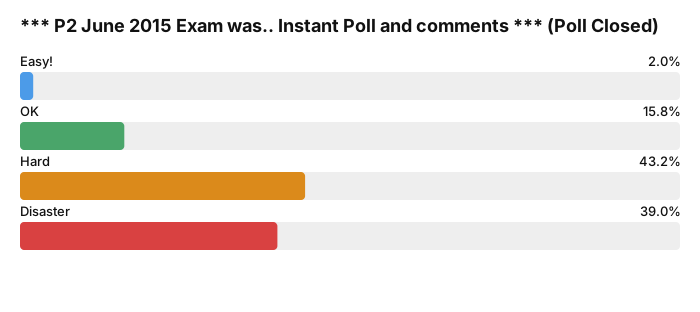
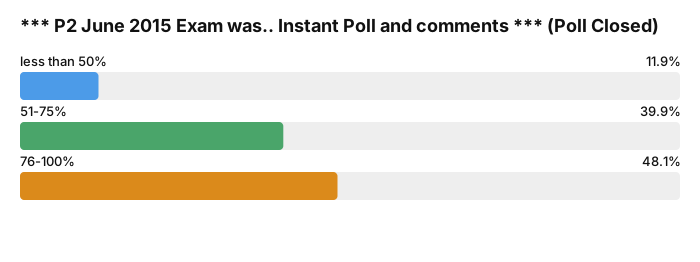
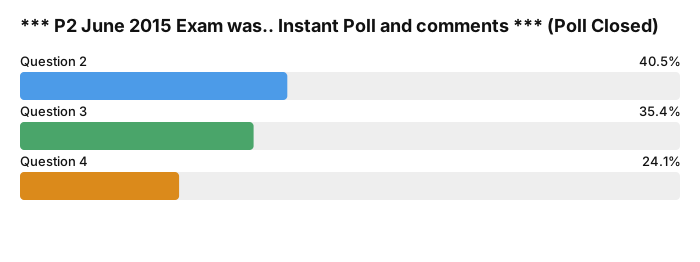
SBR*** P2 June 2015 Exam was.. Instant Poll and comments ***
The first 2 parts to Q1 I was like ok my god, never seen it before and it completely threw me for the rest of the exam as I spent so long at it trying to work it out and then in the end I just had to leave it
@Peshteman. How do u treat that.? Which modules do u use.? Ever watched LSBF videos by Martin Jones.?
in my culture we say " a journey becomes harder towards the end" what an exam i had this June. its like syllabus changed during the exam!
I waste 6 years studing a vey though papares and finlly i feel that i wast my time and money , they are teaching us the 3 E and they don't use it , no effective papers and no efficiency in exams and zero value of money, each term icreacing the fees and now doubling their income by doubling their exam , really i can't find the morality that always the ACCA always talk about, i think of switching to CPA ...
@Ashanti said: @Peshteman. How do u treat that.? Which modules do u use.? Ever watched LSBF videos by Martin Jones.?My understanding is you fair value the contingent consideration regardless of the probability. They provided the quoted share price (level 1 input as per IFRS 13) and multiply by the number of shares. It was a red herring as far as I am aware!
Transport cost i think should be part of the cost of the asset and and not deduct. Kaplan text had figures like transport (500) but this is different from 500.
P2 was very tough. I mess up question 4. instead of discussing sploci I write up an extract n said dat unrealized gains n losses pass through it n dat d cost of investment in d subsidiary on remeasurement to oci n dat on disposal of d sub is recycled to p/l is dis so n will I get any marks for dis?
I think ya hve to deduct d transport cost frm d price to get d fair value price.
profit was $3.6m @ p/e ratio of 19 =$68.4m but I think d nci was at fair value n I did not bother to compute 20% of $68.4m n used d $68.4m in my calculations.
In d consol on restructuring, pension plan of $3m before restructuring n afterward $8m, d difference of $5m I treat as current service n expense to parent r/e.
I read it that the PV of the obligation was $8m and the FV was still $7m, therefore the net liability was $1m - which led to a decrease in the NCL of $2m - in respect of location 1.
This paper is an absolute nightmare. I tried twice before to pass this, and I have attempted it again at this sitting. It seems no matter how well prepared I am the questions still astonish me. I've studied at my local university, kaplan and used opentuition videos.
In my opinion, Graham shouldn't be throwing things in like P/E ratios because the students are under a lot of stress in the exam, and most of us are really just capable of doing questions that we practised for in the previous 3 months or so. Many students panic when they see something like that, and it is not needed!
Anyway, I hope I have passed.
It was annoying, that exam
@fs28 said: I read it that the PV of the obligation was $8m and the FV was still $7m, therefore the net liability was $1m - which led to a decrease in the NCL of $2m - in respect of location 1.I got exactly the same, £2m decrease in the NCL. I basically treated it as a past service cost as I assumed it was, in substance, a curtailment to the pension scheme. I just found it odd that it decreased the NCL and just assumed I'd gone wrong somewhere - left it as a £2m decrease though so fingers crossed!
Thanks Cristina
The whole paper was tough - time pressured as always. Question 1 - there was far too much to do in 90 minutes. There was a lot of information in the consolidation part - P/E ration, so many workings to do, it felt impossible to work out where to start. Seemed quite different to previous paper questions, think it threw a lot of people off track.
Section B was equally hard - I did Question 3 & 4, both were lengthy and I found I was frantically writing. Fingers crossed for a pass, it was a difficult paper all round reading from all the comments.
It was a nightmare for me when i saw the paper.Calculation of goodwill is the most common calculation in consolidation where we can score marks easily and this time examiner trapped us in this calculation.
I was totally blacked out when i saw further adjustments of Employee benefits and Financial Lease.
Section B was also terrible.I was fully confident that i can pass the paper.
But my bad luck i have to attempt again in December 2015.
Hard
@jedians said: It was a nightmare for me when i saw the paper.Calculation of goodwill is the most common calculation in consolidation where we can score marks easily and this time examiner trapped us in this calculation. I was totally blacked out when i saw further adjustments of Employee benefits and Financial Lease. Section B was also terrible.I was fully confident that i can pass the paper. But my bad luck i have to attempt again in December 2015.Hello Colleague!!! Use the time now to build your confidence in the upcoming exam(s) - work the paper(s) with the text - cementing your knowledge. You'll also develop the skills to re-phrase tricky question(s) and master corporate reporting. The consolidation was on a share exchange bases - 25m shares for 70% of 13m shares at the parent quoted market share price ($2.00) and the consideration was $50m - resoulting total GW from both purchase to be $34.06m. The new IFRS require us to consider target profit - it does not matter the probability. It is the wording of the questions throw us off; it was not that difficult, but too much working require in the time allowed!!!!!!!!! Mercy will be shown in marking and we'll get the mark for up-lifting our spirit - 50. Thank you for HELP!!!!!!!!!!!!!!!!!
HARD
A very tough, difficult, hardest & unbelievable exam. Although I study very hard. But the exam paper like this, highly demotivated me. Now I got afraid that whether I will complete the qualification or not & whether I will pass the corporate reporting paper or not.
Question 1 is hardest 2 is harder 3 is hard 4 is tough then what else is remaining to do & pass the paper.
Some guys said that question 4 is easy. But my interpretation is that in comparison to other questions it can be said as easy, however if it is interpretated individually it is also tougher & harder one too.
yup, it is a decrease in the pension liability of $2m and I think it should be a treated as a gain and taken to the P/L.I misinterpreted it and treated the $8m as the net liability.
Journal entry should be :
Debit Defined benefit obligation $2m
Credit P/L $2m
I am keeping my fingers crossed for 50%.
Don't give up Dinaattia, when the going gets tough, the tough gets going! Put in a little more effort, you will make
My preparation was bad.
Does anyone know when the actual exam and answers are released for revision? Is it when we get our results?
Thank you
@alisonc001 said: Does anyone know when the actual exam and answers are released for revision? Is it when we get our results? Thank youPlease do not wait on the results to revise - it begins July 1, 2015 and our results will be publish August 1, 2015. This is the time ACCA will release there answers. Be ahead and use past exams to work on your weak area(s) - strengthen them for your upcoming success!!!!!!!!!
The main problem with this paper is the broad syllabus. It becomes hard to remember and understand everything plus apply it to the tricky questions of exams.
@alisonc001 said: Does anyone know when the actual exam and answers are released for revision? Is it when we get our results? Thank youHi Alison, The answers are now available on the ACCA website, the link is below: https://www.accaglobal.com/content/dam/acca/global/PDF-students/acca/p2/exampapers/uk/P2UK_2015_Jun_A.pdf
Hey Sean, how did it fair out for you?
Topic lockedNew replies are closed.