
Please vote in our Instant Polls about the P2 June 2015 Exam.
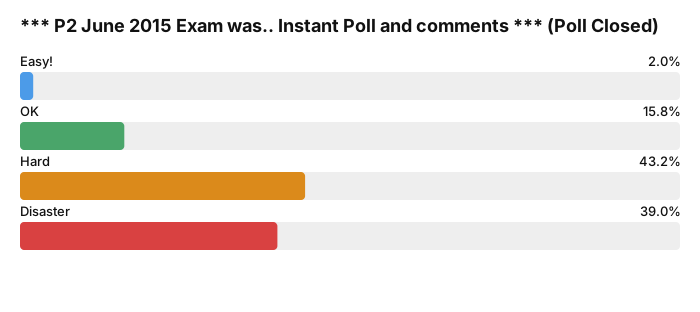
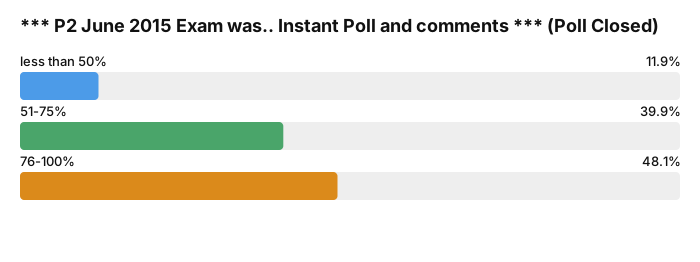
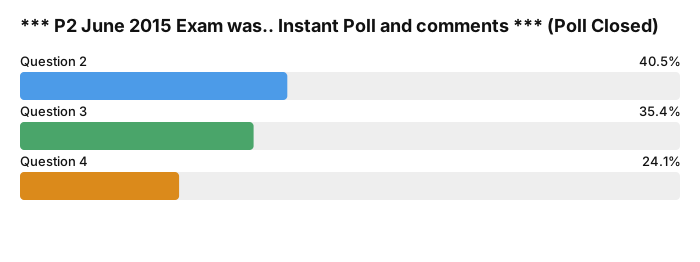 Post your comments about P2 exam below.
 Post your comments about P2 exam below.
@hamsterham said: For Q1 did anyone not ignore the contigent consideration? I thought regardless of probabilty you always include it in goodwill calculation.I thought contingent consideration is brought in at fair value, and the only way to know what the fair value of the CC was is to be given the value by the examiner? In the absence of stated FV of CC or any extra figures that we could use (such as the extra retained earnings and p/e ratio figures for the 80% sub FV of NCI working) to calculate this ourselves, I think (OK hope) we're fine ignoring it? I just put a * and noted the above on my paper.
@toeileaf said: Is it just me not good enough or is the paper is really tough?The paper was really a good one. Regretfully, I did not do justice to it because of poor time management. Missed a great chance to pass!!!!!!
@anilt said: The paper was really a good one. Regretfully, I did not do justice to it because of poor time management. Missed a great chance to pass!!!!!!Share your story with us on or after August 1, 2015. It was too difficult to be properly completed with the time allotted. The wording and punctuation marks - just through me off completely. It was a share exchange for 25m at $2.00 for 70% of 13 million shares. The target profit does not affect 5 x $2.00 to be paid in 2015; business combination IFRS 3 whether proble or not - you have to meet contract agreement. Profit is affected by man's actions and there is a current market value for shares - we; except Anilt missed the point and ask for mercy. I will know how good it was, please do not blame time management.
@mark0 said: The only positive I can give to those reading is: it’s nearly unanimous that people found the paper particularly challenging, however the pass rate is roughly 50%. So with all things being equal, at least half of us strugglers managed to pass. Furthermore, the lowest pass rate since December 09 was 47%, so hopefully some lenient marking will be instituted if the figure looks to be dropping dramatically in this sitting (I can only hope!!). Best of luck :)I genuinely think this June sitting will be around 30% of people passing the exam. I have averaged over 75% in all previous Professional papers that I have sat and am seriously doubting the fact I have passed this exam. The content was obscure (IAS 41 Agriculture combined with IFRS 13, with very little on IFRS 9 which I would have expected to have seen in the exam particularly given the impairment discussions going on around changing from incurred loss to expected loss), the methods to calculate items like the NCI etc have not been seen in prior P2 exam questions nor any P&R kit I revised with. Although I could do these calculations (after some thought) I can easily see how it would throw a candidate in the exam, and those adjustments were significantly more difficult than what I'd come across previously. I simply relied on the remainder of the workings and "easy marks" (if you can call them that) to get a reasonable mark on the consolidation question. Doing the UK variant meant there was going to be some discussion around differences between FRS102 and IFRS, but again, this was terribly specific on consolidation and exemptions for UK subsidiaries. For 8 marks this was ridiculous when I could probably secure 2 at a push here. The only saving grace was question 4, which was a god send to anyone who had read the technical articles on the ACCA website. I actually think that I will need in the region of 20-25 marks on this final question to secure a pass overall. I genuinely think that no matter how much revision I had done I would not have been able to perform any better than I had done on the day. There's knowing the syllabus broadly with half the areas covered in detail and there's knowing every aspect of the syllabus in sufficient detail to pull out treatment on valuing a maize field under IAS 41, which quite frankly is a waste of my time. The portion of people that would use that compared with IFRS 9 and those in the financial service sector astonishes me as to why it was even included, let alone 25 marks. It's fair to say that you'd expect a portion of the exam to be on an obscure area of the syllabus, but multiple areas and to the extent that it has, is simply an unfair test of our knowledge. Lets face it in the real world, you have an awareness of the area or treatment, you crack out your IFRS book and you tackle it without the ridiculous time pressures... not in the exam.
@mark0 said: I thought contingent consideration is brought in at fair value, and the only way to know what the fair value of the CC was is to be given the value by the examiner? In the absence of stated FV of CC or any extra figures that we could use (such as the extra retained earnings and p/e ratio figures for the 80% sub FV of NCI working) to calculate this ourselves, I think (OK hope) we're fine ignoring it? I just put a * and noted the above on my paper.The probability factor was superseded recently I thought. The contingent consideration is brought in at fair value regardless of the likelihood (Assumed the FV included the "weighted probability" of the contingency being met). The fair value was provided as the share price in the question for the subsidiary. Can't remember figures but saw that and assumed immediately it was a red herring to check whether candidates had seen the more recent updates on fair value of contingent consideration. However could be wrong given I am seriously doubting a pass in this.
 Former user11y ago#102
@peshteman said: Ias41 was added to the syllabus for this exam so it was likely to come up, everyone should have looked at it, and most marks were for knowing ifrs13 and how to treat level 3 inputs. For ias41 knowledge it was sufficent to know that biological assets are measured at fair value less cost to sell and after harvest are dealt with by ias2, nothing more was requiredYou are probably correct. IAS 41 came out in 2000, but should have clocked that the amendment last year on bearer plants would have come up over IFRS 9 being finalised in July 2014... oh well at least question 4 had 3 marks on hedge accounting... At least in the resit I now know that I shouldn't focus on hot topics because they're pretty "irrelevant"...
@dontetze said: I didn't calculate EPS, i did like this: P/E=19 hence earnings is given calculate total market capitalization P/3.6 =19 P= 19x3.6 p=68.4 hence NCI will be 20%of 68.4 NCI = 13.68Ye I just did the same... earnings of the whole company of £3.6m*19 (PE ratio) then multiply by the shareholding of 20% so ended up with £13.68m. Thought i'd done it wrong at first look given the weird double decimal place!
@Ashanti said: In a question where there is an x% chance on contingent consideration, u multiply by the x%. In the question 1 you were supposed to multiply by 20%.Not true. Nor was this true at any point in the history of IFRS3.