FM*** F9 December 2014 Exam was.. Instant Poll and comments ***
Do tell me if any one know about this issue i am about to ask
Suppose if someone got 35 marks in MCQs and only 20 marks of all the remaining paper a total of 55,he will get through or not,
with pass status or failed status because i came to know that to pass atleast 50% should be gained in all questions....
MCQ was mega annoying!!
Its 50 overall irrelevant of what you get in each question
Public service should be correct option...
If suppose some one got 40 marks in MCQ part and only 15 in the remaining paper what would be his result>>>>>/??????
@rcc002 said: Do tell me if any one know about this issue i am about to ask Suppose if someone got 35 marks in MCQs and only 20 marks of all the remaining paper a total of 55,he will get through or not, with pass status or failed status because i came to know that to pass atleast 50% should be gained in all questions....not true. I have passed F8 F7 missing one full question....:) so all is not lost if you fail to finish all question
@rcc002 said: If suppose some one got 40 marks in MCQ part and only 15 in the remaining paper what would be his result>>>>>/??????>50 is pass
I notice there is answers for F8 F5 will there be answers for f9 anytime soon?
I have NPV around 25300
WACC 10.4
Did anyone have M n M for one the MCQ answers? Something about Dividend and financing policy.?
@vipulv said: Did anyone have M n M for one the MCQ answers? Something about Dividend and financing policy.?Yes i got 1 MCQs answer M n M The dividend irrelevancy theory related
Just curious, wonder would Acca fiddle the marking standards to reflect the new format, like because of the new format they can't be sure to get their usual pass rate of 40% or whatever. What if say as a result 90% of people pass or fail, would they then try to mark the papers much more harshly or leniently I wonder to get their expected range. Like in schools they just change the pass mark if too many pass or fail lol. I suppose this is why they made the Mcq impossible, as if these were easy everyone would certainly pass and they can't fiddle with a mcq marking but they can a bit on the section b questions.
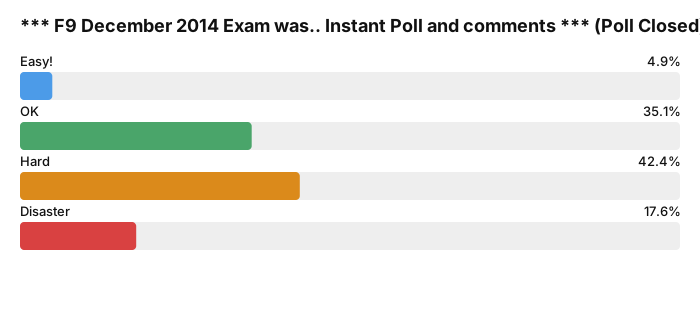
Yes deffo a resit on this one for me really difficult exam :(
@ Opentuition_team
Will you be putting up Dec 14 answers just like you have done for F5 and F8 Dec 14?
If so, when by?
Thanks
Monika
What was your cash flow CB? I got 992k. What about current ratio?
Question 3 part A was misleading, what were we supposed to compare? Spot and forward? or Forward and Hedging?
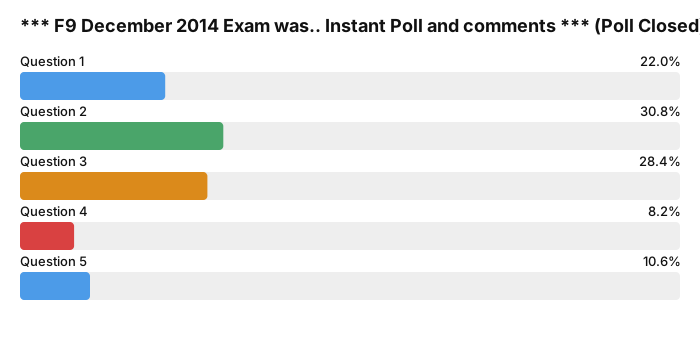
Seriously Investment appraisal and Working Capital? This was the least tested!
Just realised that I deducted capital tax allowance instead of adding it up in NPV calculation. How stupid!!!!
Hi Guys, I wish you all to celebrate by passing in F9 on 8th of February?…
The way I did section B… (As far as I remember my answers)
Q1 part C…
Short term cash surpluses: Short Term cash surpluses tend to be temporary, while investing those management has to look for the three conflicting or say a trade-off between:
i) Liquidity
ii) Risk
iii) Profitability
A bit of discussion on the above points...
My analysis from past papers is that one should rarely go for a straight forward Yes or NO in answer, answer should reflect kind of reasons for Yes or No…
In Question 2, Conversion was likely…It was something around 131.02 I guess…The market value of the Convertible debt was 111 Approx.…What is did interesting here was to find a geometric growth rate, and did made an assumption that the growth is likely to be the same in the future…Then I found the Conversion Value…
For the P/E ratio part what I did was to use EPS * PE Ratio…
To discuss about the P/E:
It is based on one year PAT value…which may be distorted due to one-off transactions…while the share price can reflect the speculation about the future earnings, it is for majority Shareholders etc….
In Forward exchange contract the loss was something like $ 3500….
Invoicing in the dollars should be avoided because:
i) Might not be possible commercially.
ii) Company can win some and lose some.
iii) Need to establish separate Department.
iv) Saves management time.
WACC with market values…6.2 % and book values about 5%
Don’t remember exactly the NPV figure but it was between $1500 to $1700…I did comment on the Inclusion of Interest payments and Tax allowable Depreciation and in revised redrafting excluded both these cash flows which are not relevant…
BEST of Luck to me and you all…
My NPV was $2509
Market value convertibles 110; P/E ratio 7...something
Forward exchange loss 3521
WACC book value 7.89 and WACC market value 10.45
I ignored the interest payment of 150 in my calculation of npv
on question 5 section B. IRR was the tricky part. In year 0 ,(103.50 ) outflow and then on interest I deducted tax, interest was 6 multiply by tax savings (1-25%)=4.5 THEN multiply with annuity factor. redemption was at a premium to the nominal value. I dont remember the redemption rate. then calculate IRR. wacc using market value and using book value. the capm part was straight forward.
on question 3 section b. Part a, was calculate capital loss/ gain and explain why forward exchange contract are better than hedging. I think it was €1,200,000 ÷ by six month forward rate which was lower (LESS BETTER OFF) less €1,200,000 × lower spot rate. I think I found a capital loss. Part b, was find the interest rate of another country having given interest of the home country. the given interest was 4%. I user interest parity to formula. I used forward rate of twelve months lower rate and spot rate which was lower and 1 + ic or 4% at the bottom of the formular. part c was to explain why invoicing in local currency was good or bad to avoid exchange rate risk.
question 2 section b. PArt a. was calculate market value of loan. using Po (1+g)^n R. the trick was on g. I used share price movements rather than EPS within the years. 10.90÷9.15. g was 6%. making conversion value to be $131. market value was then calculated as redemption was unlikely. part b was share price using P/E RATIO. the trick was wether to use industry p/e ratio. I used industry multiplied it 2014 ep. don't know if I was correct.
question 4 I failed. I included interest. stupid me.
question 1 part a was fair. cash budget. though very tricky in wording. will score some marks but not all. it was 5 marks. had no time to complete b and c of question 1.
mcq questions I section A were very difficult. Most of them I guessed.
Overall it was a tricky hard paper.
i ignored interest too, which is correct because its already included in cost of capital
yeah. mcqs were pretty a nightmare!!!!!
Question 5 found wacc of 6 % using market values and wacc of 4.5% using book value. I think market value of debt was 207 million and total value including that of shares was $2,547 I dont remember. found irr of 2.7%. dont know if I am correct. capm was 6.3%. not sure though.
MCQ involves calculations were fine , but others shaaaaaaa!!!!!
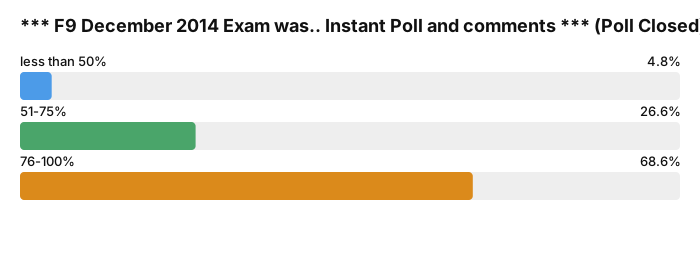
I have no idea how I did. As always I am just hoping for at least 50%, which is what each of us all hope for. I liked Q4 and 5, the MCQ's were a little odd. They covered some things I had no idea on so in the last few moments, I just guessed them! I wish everyone well :)
Hi Marta, I got all those answers aswell! So we must be right :)
@mayalomoz said: on question 5 section B. IRR was the tricky part. In year 0 ,(103.50 ) outflow and then on interest I deducted tax, interest was 6 multiply by tax savings (1-25%)=4.5 THEN multiply with annuity factor. redemption was at a premium to the nominal value. I dont remember the redemption rate. then calculate IRR. wacc using market value and using book value. the capm part was straight forward. on question 3 section b. Part a, was calculate capital loss/ gain and explain why forward exchange contract are better than hedging. I think it was €1,200,000 ÷ by six month forward rate which was lower (LESS BETTER OFF) less €1,200,000 × lower spot rate. I think I found a capital loss. Part b, was find the interest rate of another country having given interest of the home country. the given interest was 4%. I user interest parity to formula. I used forward rate of twelve months lower rate and spot rate which was lower and 1 + ic or 4% at the bottom of the formular. part c was to explain why invoicing in local currency was good or bad to avoid exchange rate risk. question 2 section b. PArt a. was calculate market value of loan. using Po (1+g)^n R. the trick was on g. I used share price movements rather than EPS within the years. 10.90÷9.15. g was 6%. making conversion value to be $131. market value was then calculated as redemption was unlikely. part b was share price using P/E RATIO. the trick was wether to use industry p/e ratio. I used industry multiplied it 2014 ep. don't know if I was correct. question 4 I failed. I included interest. stupid me. question 1 part a was fair. cash budget. though very tricky in wording. will score some marks but not all. it was 5 marks. had no time to complete b and c of question 1. mcq questions I section A were very difficult. Most of them I guessed. Overall it was a tricky hard paper.Why was forward exchange contract better than hedgin exchange rate? I spoke about being fix rate... spoke about u wont know if u receive the money on time in 6 monrths. Went to briefly mention hedging techniques like translate risk etc am i on the right line??
I pray for a pass
you were.
Topic lockedNew replies are closed.