FM*** F9 December 2014 Exam was.. Instant Poll and comments ***
@olgawade said: if i remember correctly after tax cost of capital was 6% and before was 9% so you should use before tax cost - 9%
@olgawade said: if i remember correctly after tax cost of capital was 6% and before was 9% so you should use before tax cost - 9%Pretty sure I used 9% my answer was $107 approx. is that right

Cardine & hklui:
Although some of the MCQ's were indeed a bit strange due to the wording, they were all in the syllabus and both BPP and Kaplan have the answers to all of them somewhere in their books :-)
Shahin: Q5 answer is an error and has now been corrected to B
Q18 answer is correct
@johnmoffat said: Cardine & hklui: Although some of the MCQ's were indeed a bit strange due to the wording, they were all in the syllabus and both BPP and Kaplan have the answers to all of them somewhere in their books :-)Sir John; We should be given those marks - 12 which I believe will be beneficial to ALL students. The wording for some have me crying and wondered what they want to find out. Thank you tutor, you are very objective and fair too. Regards,
Thank you for the answers John. I am challenging question 8 where I believe Answer B is the correct statement.
See below for an extract of the study text.
"Currency swaps can provide a hedge against exchange rate movements for longer periods than the forward market"
What do you think?
Could anybody please explain the reason why we should use before-tax cost of debt instead of after-tax cost of debt for Q9?
@iwacca said: Could anybody please explain the reason why we should use before-tax cost of debt instead of after-tax cost of debt for Q9?You are required to use the b/4 tax on Market value - available to public, who have their own tax benefits. After tax for companies with the applicable tax rate - look at the slide on debt valuation and read the BPP text (this is the text I use) on the subject, or text on the topic. There is a distinction you need to make and you must understand that before you calculate values. I hope i was of help and wish the BEST in your future - success for your results. Regards,
@Cardine said: You are required to use the b/4 tax on Market value - available to public, who have their own tax benefits. After tax for companies with the applicable tax rate - look at the slide on debt valuation and read the BPP text (this is the text I use) on the subject, or text on the topic. There is a distinction you need to make and you must understand that before you calculate values. I hope i was of help and wish the BEST in your future - success for your results. Regards,Thank you so much for your explanation. It really helps me understand clearly about this. Wish you all the best. Regards,
Hi John.
thanks for your reply.
but i'm still confused about Q10.
an increase in the cash operating cycle =
1) shorter pay to vendors, may be able to claim more discount
2) longer inventory turnover days, may be more inventory which is more profitable than cash in hand
3) longer receivable turnover days, may be more attractive to clients
all of them indicate an increase in profitability.
i know that shorter cycle might be better, because it lowers risk to liquidity problem and make the business more "healthy".
but longer cycle do increase profitablity i think.
I agree on question 10, An operating cycle alone says nothing about profitability. E.g. More inventory days could mean more stock on hand to meet demand and avoid stock outs, therefore increase profitability. Longer receivable terms may give that business the edge over competitors in the market and increase profitability ect
Maybe acca can allow for 2 answers to be correct?
@estyle said: Hi John. thanks for your reply. but i'm still confused about Q10. an increase in the cash operating cycle = 1) shorter pay to vendors, may be able to claim more discount 2) longer inventory turnover days, may be more inventory which is more profitable than cash in hand 3) longer receivable turnover days, may be more attractive to clients all of them indicate an increase in profitability. i know that shorter cycle might be better, because it lowers risk to liquidity problem and make the business more "healthy". but longer cycle do increase profitablity i think.totaly agree
yes, many MC questions especially related to concept types are arguable. The examiner should think about it in the next diet.
Hi folks.
Quick question about the redraft of the investment appraisal in Q4: in the exam, I inflated sale price, VC and FC from t1, and used the given WACC as DF, but now I'm wondering if this was correct: should there be no inflation at all if no nominal rate is given?! There seem to be differing opinions on this from previous comments and I really need to know!
Good luck to everyone!
Cheers!
WACC has already been considered the inflation and so it is the nominal rate, not real rate. If it is a real rate of WACC, the question must mention, I think.
So, all the variables should be inflated such as selling price, variable costs and fixed costs.
Hi everyone question 4 why when we borrow now we dont do 4% x 6/12 ?? Answer shows 1.04 on borrow stage. Is this error ?
@vipulv said: Hi everyone question 4 why when we borrow now we dont do 4% x 6/12 ?? Answer shows 1.04 on borrow stage. Is this error ?it was 8%
@basta said: it was 8%8?? The open tution answer shows 1.04 (not dividing by 2 to get 6 months borrow) ? I have only seen this first time. I thought you do 6/12 or divide by 2 both borrow and deposit?
wait the ques tells 8% if I remember correctly then it comes 1.04%(6 months)
Looking through the OT answers there are a few answers i don't understand in the MCQ
Q8: OT answer = A
But I put B as currency swaps can hedge exchange rate risk for longer than forwards, it definately says this in the book
Q10:
OT answer = D
I think B, as we can't say in what way shortening operating cycle will effect profit unless we know more details than given
Q15:
OT answer = C
I think D, In the course we are told the higher a company WACC the lower the Npv of future cash flows and lower the MV. As lowering cost of equity would lower WACC and market value it would also lower share price i thought
Q16:
OT answer = C
I put D in exam as was only sure of statement 2 being related to Fiscal Policy.
Checking the book, ‘fiscal policy is the action by the government to spend money, or to collect money in taxes, with the purpose of influencing the condition of the national economy.'
Could it not be argued that 'using official foreign currency reserves to buy the domestic currency'. Is a form of spending, and that buying domestic currency is likely to influence the condition of national economy,
Q 18 :
OT answer = D
I thought B, as liquidity preference theory says investors demand higher return for being unable to use their cash now.
@kevikraze said: Looking through the OT answers there are a few answers i don't understand in the MCQ Q8: OT answer = A But I put B as currency swaps can hedge exchange rate risk for longer than forwards, it definately says this in the book Q10: OT answer = D I think B, as we can't say in what way shortening operating cycle will effect profit unless we know more details than given Q15: OT answer = C I think D, In the course we are told the higher a company WACC the lower the Npv of future cash flows and lower the MV. As lowering cost of equity would lower WACC and market value it would also lower share price i thought Q16: OT answer = C I put D in exam as was only sure of statement 2 being related to Fiscal Policy. Checking the book, ‘fiscal policy is the action by the government to spend money, or to collect money in taxes, with the purpose of influencing the condition of the national economy.' Could it not be argued that 'using official foreign currency reserves to buy the domestic currency'. Is a form of spending, and that buying domestic currency is likely to influence the condition of national economy, Q 18 : OT answer = D I thought B, as liquidity preference theory says investors demand higher return for being unable to use their cash now.Kevin, For question 8; 10 & 18 I agree with you. This is a suggested answer and open for discussions. You and others suggestions are welcome. It is the same points raised I said to myself when I choose the answers in the hall. The MCQ's took me half the total time allotted for the entire paper - just imagine the mad rush to get the other marks for the required passing grade. Just give thanks you manage to complete - successfully and ask the markers for love and mercy. Regards,
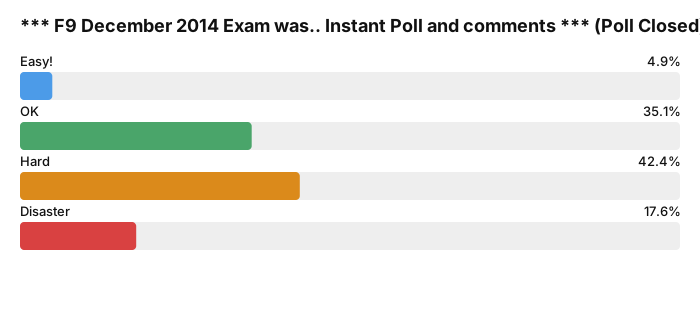
MCQs were very tricky - other questions were reasonable
The section B was okay but de mcqs were nightmare
Shouldnt you deduct from positive NPV also repayment of loan in the end of 4th year ? Then you would come to positive NPV under 1,000k ....
I think I got around 14 out of 20 of the MCQs as per Opentuition's suggested answers. That means I need just 22 out of the remaining 60 :D :D :)
It's like the exam team said to each other "let us gather the most difficult objectives the world has ever seen" something about yield curve sloping upward or downward I was like wth.?!?! Not sure of 40 marks pure disaster!
Hi guys,
I guess you are all aware of it but the ACCA EXAM AND STUDY FEEDBACK survey is now open. You can share your thoughts on the past F9 paper (especially on MCQ).
Cheers,
'Dear student
ACCA welcomes your feedback on the exams that you took at the December 2014 session. The feedback you give will be considered by the Global Exam Review Board. The Board meets to review the questions, answers and marking schemes after the last exam paper has been sat at each exam session. This ensures that the papers are a fair and reasonable test and is one of the final stages in the quality assurance process before they are marked and the results are finalised. We are also interested to know more about your experience with your learning provider if you have used one for this exam session.
We would be most grateful if you could take the time to complete the attached survey here. Your identity will be kept confidential at all times.
Please reply no later than 15 December 2014, 09:30 AM (GMT). The survey will take around 15 minutes of your time. '
the overall paper was ok but mcqs were were rough i never even finished my last answer on foreign exchange issues.
looking at the answers for section a - i would have got 6 right for sure, but potentially rising to 10.
looking at the other question, if i only got 6 right in the MCQ then i have failed the exam with a score of about 40-42% :( if i managed to get 10 correct then i might just have passed.
so fail it is. :(
The paper was fair. I love the new format because its easier to finish the papervon time. However, multiple choice, especially tge theory part was tricky
Topic lockedNew replies are closed.