Skip to contentSkip to search
Kaplan Publishing: Black Friday countdown

AA*** F8 December 2014 Exam was.. Instant Poll and comments ***

Oopentuition_teamAdmin11y ago

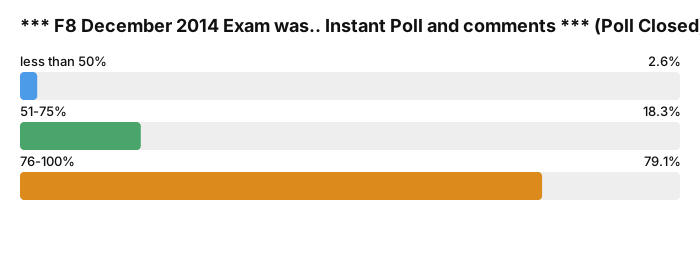
Please vote in our Instant Polls about the F8 December 2014 Exam.
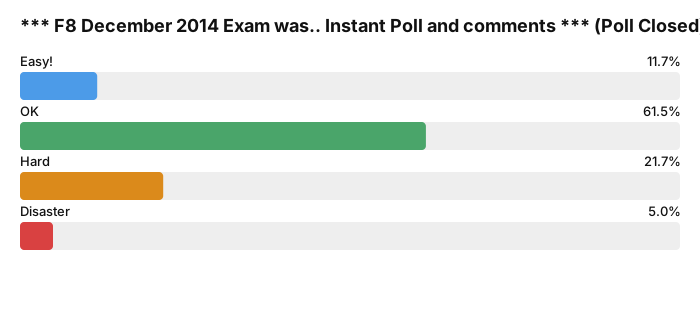
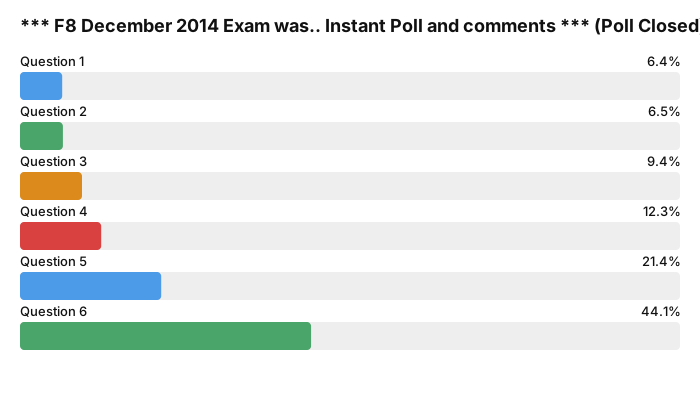
*** F8 December 2014 Exam was.. Instant Poll and comments *** poll results *** F8 December 2014 Exam was.. Instant Poll and comments *** poll results *** F8 December 2014 Exam was.. Instant Poll and comments *** poll results Please note, the ACCA have asked us to allow posting comments only after 5pm UK time.

SSam12345678911y ago#181
Yes Xlnc As these are Obligatory than the other 2 were voluntary
SSam12345678911y ago#182
Trust me money laundering is 100% obligatory. Terrorist offence is also obligatory.
Oopentuition_teamAdmin11y ago#183
We have published answers to Section A https://opentuition.com/acca/
RRoy11y ago#184
"If in the auditor's judgement the company will not be able to continue as a going concern and the financial statements have been prepared on a going concern basis the auditor shall express an adverse opinion" this is from bpp rev kit. this clearly says that use of the going concern assumption is inappropriate
Ttom11y ago#185
1B,2D,3C,4C,5C,6B,7A,8D,9B,10D, 11B,12B. https://www.accaglobal.com/content/dam/acca/global/PDF-students/acca/f8/exampapers/int/F8_2014_Dec_q.pdf review answers that i guess is well with your opinion which is wrong
Xxlnc12311y ago#186
@moofr00tz said: In my notes from my tuition provider: Voluntary disclosure - an auditor may decide to disclose information if he feels it is in the public interest e.g. if the management are involved in fraud (I linked the money laundering sentence to this). They may also disclose information to defend themselves in a claim of negligence or if suing for unpaid fees.
Sean. Refer to exam paper December 2011 q4c This whole paper was based from previous past paper questions. Obligatory Auditors are obliged to make disclosure where, for example, there is a statutory right or duty to disclose, such as if the auditor suspects the client is involved in money laundering, terrorism or drug trafficking in which case they must immediately notify the relevant authorities. In addition, auditors must make disclosure if compelled by the process of law, for example under a court order or summons, under which they are obliged to disclose information 5 (a) Voluntary In certain circumstances auditors are free, as opposed to obliged, to disclose information without obtaining the client’s permission first. These circumstances can be categorised into the four areas below: Public interest – An auditor may disclose information which would otherwise be confidential if disclosure can be justified in the ‘public interest’. This would be perhaps if those charged with governance are involved in fraudulent activities; Protect a member’s interest – Members/auditors may disclose information to defend themselves against a negligence action, disciplinary proceedings or if suing for unpaid fees; Authorised by statute/laws – There are cases of express statutory provision where disclosure of information to a proper authority overrides the duty of confidentiality; Non-governmental bodies – Auditors may be approached by non-governmental bodies seeking information concerning suspected acts of misconduct not amounting to a crime or civil wrong. Disclosure should only be made to those bodies with statutory powers to compel disclosure.
RRoy11y ago#187
(2) Companies are not required to establish and maintain an internal audit function i think u missed the not word here. this statement is correct since companies are only required to review need for internal audit. dont understand why your answer is A
SSam12345678911y ago#188
Woho I don't agree with 2 of the answers which have been published defiantly not 12 that's not right Q3 as well. Why is that C?
Xxlnc12311y ago#189
@abbas7796 said: (2) Companies are not required to establish and maintain an internal audit function i think u missed the not word here. this statement is correct since companies are only required to review need for internal audit. dont understand why your answer is A
Under corp gov, aren't they supposed to form an internal audit
RRoy11y ago#190
Which of the following statements, relating to the auditor’s reporting responsibilities for going concern, if any, is/are correct? (1) Where management is unwilling to make their assessment of the company’s ability to continue as a going concern, the auditor should include an emphasis of matter paragraph in the audit report (2) Where the use of the going concern assumption is inappropriate, the auditor should include a qualified opinion in the audit report This should be D ( Neither 1 nor 2) since the emphasis of matter para can only come if management assumption of going concern is correct but significant uncertainty exist. here in the question it clearly said that management assumption is INAPPROPRIATE.
RRoy11y ago#191
No only review the need on yearly basis.
SSean11y ago#192
I disagree with Q2 on the basis of my tuition notes! Q5 I'll concede as I was torn between the two. I had arguments for both of them.... for the going concern one I know they have to evaluate management's use of the going concern but they don't have to express an opinion in every report, only highlight where they feel it has been used inappropriately. For ISA, surely as this is a global paper in certain national contexts it wouldn't apply? Therefore in certain countries where ISA has no legal status the auditor would not be responsible for following them as it represents best practice like the UK corporate governance code. Q10 I disagree with as well because internal auditors should report to independent NEDs / audit committee and not the finance director who could have a vested interest in the internal audit
SSean11y ago#193
@xlnc123 said: Sean. Refer to exam paper December 2011 q4c This whole paper was based from previous past paper questions. Obligatory Auditors are obliged to make disclosure where, for example, there is a statutory right or duty to disclose, such as if the auditor suspects the client is involved in money laundering, terrorism or drug trafficking in which case they must immediately notify the relevant authorities. In addition, auditors must make disclosure if compelled by the process of law, for example under a court order or summons, under which they are obliged to disclose information 5 (a) Voluntary In certain circumstances auditors are free, as opposed to obliged, to disclose information without obtaining the client’s permission first. These circumstances can be categorised into the four areas below: Public interest – An auditor may disclose information which would otherwise be confidential if disclosure can be justified in the ‘public interest’. This would be perhaps if those charged with governance are involved in fraudulent activities; Protect a member’s interest – Members/auditors may disclose information to defend themselves against a negligence action, disciplinary proceedings or if suing for unpaid fees; Authorised by statute/laws – There are cases of express statutory provision where disclosure of information to a proper authority overrides the duty of confidentiality; Non-governmental bodies – Auditors may be approached by non-governmental bodies seeking information concerning suspected acts of misconduct not amounting to a crime or civil wrong. Disclosure should only be made to those bodies with statutory powers to compel disclosure.
Ah ok, thanks :)
SSam12345678911y ago#194
Some of these answers don't even make sense. Why would internal auditors report to FD? That's outrageous
HHong11y ago#195
Your answer is B? Why the q12 answer is B?
SSenya11y ago#196
Hi, Guys My answers below: 1 b (2) 2 d (2) 3 b (2) 4 c (2) 5 c (1) 6 b (2) 7 a (1) 8 d (2) 9 a (1) 10 b (2) 11 b (1) 12 b (2) - incorrect What do you think? Thanks
BBilly11y ago#197
Guys relax... u discussing here wont change a thing !! Lol... lets just leave F8 at that... we all know how it was :( and lets just hope & pray we dont have to see something as boring as "AUDIT PROCEDURE" again :D Back to life ...........
RRoy11y ago#198
Yes they seem to be correct and 12 was D not B
NNashad11y ago#199
i put down as d as well... Can anyone confirm the answer for the following.. Describe procedures which should be undertaken during the audit of wages as a result of the manager’s assessment of the increased risk of fraud.
RRoy11y ago#200
from the question paper: In October 2014 the financial controller of Eagle was dismissed. He had been employed by the company for over 20 years, and he has threatened to sue the company for unfair dismissal. can this be valid for an audit risk of provision not recognized or contingent liability disclosed?
TTez11y ago#201
I put down for 12 d its an adverse opinion (qualified adverse)but fs assumption is inappropriate and as such fs are incorrect. Also not sure why 10 is d? I agree for internal audit function I never read anywhere to report to the finance director therefore disagree.
Xxlnc12311y ago#202
There appears to be a deficiency in the answers provided by open tuition. Describe a recommendation (2 marks)
Xxlnc12311y ago#203
@abbas7796 said: from the question paper: In October 2014 the financial controller of Eagle was dismissed. He had been employed by the company for over 20 years, and he has threatened to sue the company for unfair dismissal. can this be valid for an audit risk of provision not recognized or contingent liability disclosed?
Yes that's def an audit risk. I put that one down
HHong11y ago#204
Experienced increase in competition, can I said management might be feel under pressure to manipulate the result?
Xxlnc12311y ago#205
@wayhern said: Experienced increase in competition, can I said management might be feel under pressure to manipulate the result?
Increased competition reduction of Sales price - fewer cash flows and debtors increase due to favourable prices And key customer on 6 months credit I refered this as a the appropriateness of the use of going concern. Perform going concern audit procedures, enquire bank, lawyers etc inspect the cash flows for reasonable assumptions Inspect board minutes. If the company is not a going concern and produce the accounts on a going concern basis, it's materially misstated Although there is no mention of financial difficulty, the auditor must always consider the assumptions of going concern under IaS1
HHong11y ago#206
But there is any financial difficulty?
Former userFormer user11y ago#207
MCQ was fair, thumbs up if you got all correct
Xxlnc12311y ago#208
@kolkleen said: MCQ was fair, thumbs up if you got all correct
The audit risk MCQ was a joke! Haha
Former userFormer user11y ago#209
@xlnc123 said: The audit risk MCQ was a joke! Haha
I think BPP had a similar question which I flunked. So i was careful with this one lol.
SSam12345678911y ago#210
question 10 has been amendment it is B but Q3 i have a big problem with coz the suggest answer doesnt make sense. The thing option D is a pre condition of the audit so how can you even get evidence about that. Q12 i dont agree with either. the coorect answer should be D as both statements are wrong reagding going concern. i mean if the FS are wrongly prepared and the going concern assumption is wrong, why would you give Qualified opinion, surely you give adverse opinion as the FS are NOT true and fair.
Topic lockedNew replies are closed.