Skip to contentSkip to search
Kaplan Publishing: Black Friday countdown

PM*** F5 December 2014 Exam was.. Instant Poll and comments ***

Oopentuition_teamAdmin11y ago

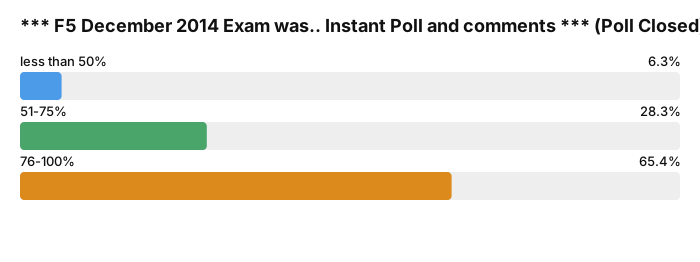
Please vote in our Instant Polls about the F5 December 2014 Exam.
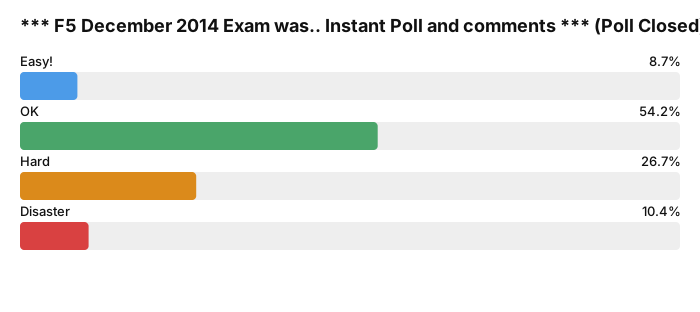
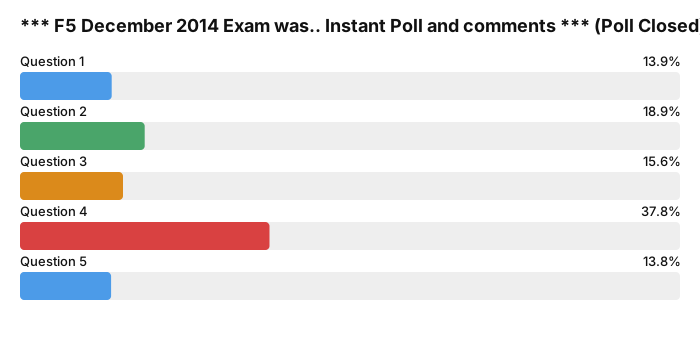
*** F5 December 2014 Exam was.. Instant Poll and comments *** poll results *** F5 December 2014 Exam was.. Instant Poll and comments *** poll results *** F5 December 2014 Exam was.. Instant Poll and comments *** poll results Please note, the ACCA have asked us to allow posting comments only after 5pm UK time.

Fferoz11y ago#391
why lol?:P
MSmarium salman11y ago#392
typed and edited :p it's an whole essay you wrote.
GGvtftf11y ago#393
Feroz, generally i had the same. However, both you and i made mistakes on environmental mcq, as the first statement was correct. Regarding relevant costing, my number was 9455, however, then, imadded specific apportionment of ten percent. But this does not change much. Regarding variances, i got 5k something adverse mix and 9900 yield favorable. Considering comments, i told that it was fault of sales manager as his advertising was not goid for sale of higher quality soaps
GGvtftf11y ago#394
Both of us also made mistakes on tpars, but should be awarded points for correct approach
Iinn11y ago#395
U can't remember all this and score less than Pass!
GGvtftf11y ago#396
I got total kg used of 181512, then judt multiply by the relative proportion of each product in budgeted mix
Fferoz11y ago#397
std mix for me is calculated for each individual ingredient by taking each individual ingredient which goes into making one unit divided by total ingridents which go into making one unit multiplied by the total quanity of all each and sepreate ingrident used. then u deduct the figures from actual usage to give u mix variance in quanity then u multiply this by the std cost of each indiviudal ingrident.
CChris11y ago#398
Feroz That is a very long winded explanation of mix variance. Simply, 181,512 (actual mix of actual production) divide by 1.35 (standard mix) and then multiply each product by (from memory) 0.25, 0.6 & 0.5 respectively. The first two ingredients were adverse and the third favourable. However, third was cheapest and therefore overall adverse variance etc due to more expensive mix (think most people agree with this). Yield was very easy to get following on from that. Commentary will vary from person to person. An adverse mix would usually generate a favourable yield (a better "quality" product). However, this seemed to go the other way for customers and as soap is a product based on texture and smell the revised mix (although a better "quality") did not improve the experience for the customer. Not sure how sales manager can be solely responsible for that? You can't sell a soap that customers don't want (and complain so aggressively about) no matter how much advertising you do. However, I think on balance I ended up blaming him anyway!!
MSmarium salman11y ago#399
I am on board here with Chris.
GGeshi11y ago#400
Shadow price by definition the additional contribution generated from one additional unit of limiting factor so I guess it's 56
CChris11y ago#401
Then you ignored the extra cost of $2 per unit - making the revised $16.
MMatsatsoSupporter11y ago#402
@chris1975z said: After he gets to see the paper on the ACCA website I would imagine!!
Yes Chris, so I'll put it different way, when will it be published?:) if you don't know, I can make assumptions myself
CChris11y ago#403
I would suggest you do so then as my crystal ball has broken down......
CChris11y ago#404
;)
GGvtftf11y ago#405
The answer was increase of 16
Xxgovindaangad11y ago#406
F7 is tomorrow. Whoa
GGeshi11y ago#407
Shadow price is 2.80 which means increase in one more unit would result in increase of contribution £2.80 so if 20 more unit available then 20 multiply by 2.80 which is increase contribution of 56
GGvtftf11y ago#408
Geshi, i think you missed Cris's comment. Your calculation is simple and wrong
GGeshi11y ago#409
Extra cost not needed I guess question was about increase in contribution. Shadow price was given which is increase in contribution of 1 more available unit. So if 20 more unit made available increase will be 56. Any way let's wait for official answers. :)
GGvtftf11y ago#410
Lets wait, but similar question was in bpp mock exam
HHatif11y ago#411
Shadow price was 2.8 which means we can earn contribution of 2.8 per kg but after paying the price of $2 per kg which leaves us with $0.8. $0.8x20=$16
Former userFormer user11y ago#412
How did you guys get round figures for your mix variance? If I remember correctly, I had some decimals like .33 and .67 for the standard mix. The yield was fine though, twas a whole number.
SSam12345678911y ago#413
Absolutely agree with Hatif I think people misunderstood shadow price for contribution and simply divided it
SSam12345678911y ago#414
Yes some decimals if I can remember first 2 were adverse and the last was favourable.
SSam12345678911y ago#415
Yield was multiplied by £6 and some pence if I can remember
SSam12345678911y ago#416
I mean to say dollars haha.
GGvtftf11y ago#417
16; first two were adverse, the last one fav
GGvtftf11y ago#418
I do not remember anything regarding decimals. If i had, then i definitely rounded up
SSam12345678911y ago#419
Yeah agreed! I can't revise for F8. 8 so eager to know my F5 results especially MCQS coz if I can get about 8 to 9 right than I can pass! At the moment not looking great
Former userFormer user11y ago#420
Do u mean the weighted average price? Cos that would have been 4.74 or something since you would have divided the weighted price by the total number of units (6.4/1.35) or so.
Topic lockedNew replies are closed.