
Skip to contentSkip to search
Kaplan Publishing: Black Friday countdown

LWPaper F4 Dec 2010 exam was

Oopentuition15y ago
Please share below with community your comments about F4 exam!

Take our F4 exam survey >>


Vote in our instant poll!
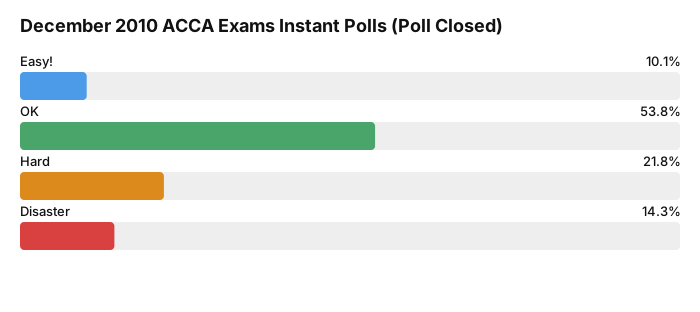
Paper F4 Dec 2010 exam was poll results
Ssoniasameersohail15y ago#31
i think if neighbour principle is related to damages then it has to have the explanation for duty of care where we need to quote the case of a woman who drank a bottle of gin that contained decomposed snail at the bottom..i dnt exactly remember the name of the case but its probably donoghue vs stevenson
Former userFormer user15y ago#32
@sizzlin89 said:
will someone tell me what was question 8 related to?? i wrote about intentions and a bit of unilateral offer..wen i came out of the hall a friend told me they were askng about suffiency of consideration??? wat was it related to...


I wrote about Consideration due to the promise in the question and in the scenario.

it was a promise for an Act (Carlill) - the element of value to which both parties must present.
in this case Amy was promised £1000 for her services - consideration was sufficient.

I thought Long hard about intention, however i dont think it was the case for question 8.
Former userFormer user15y ago#33
@ali_zia4u said:
I think in Question 8, Domestic agrrement will not apply in case of brother and sister.

Both were liable for their 1000 pounds individually.


I think the law for question 8 was consideration. Intention looks at social issue or commercial issues.

However there was a mention of promise both in the question and scenario.

An Act for a Promise or A promise for a promise to perform an Act.

I thought long and hard about Intention - However, there was no written agreement, no professional capacity, subject to contract, No in "Binding Honour Only". I may be wrong but i think the gave the clue when the used the word promise.
Former userFormer user15y ago#34
@saaag said:
what was principle of neighbor?


I think this wants a bit of history from donoghue v stevenson and then talk about the broadness of it - bringing a more streamlined law caparo v dickman - establishing the need for proximity in the principle
Former userFormer user15y ago#35
It wasnt too dificult to be honest but i didnt do well as I spend my time on other topics according to tutors they weremore likely to come out , such as company secretary, corporate governance, veil of incorporation, debentures , all the staff about money laundering insider dearling wronful and fraudulent trading, they said a question in sttatutory books wont be likely to come out and never look in details about the dissolution of partnerships , so those questions although I have answerr them with the little knowkedge that I have from previous experiences on jobs that I have heard, and also question 8 was a bit tricky cause not sure if it was consideration, social domestical agreement or what were they looking for , bit dissapointed :'( , will see on the results but I reckong I will have around 30 -40 marks :(
Rrazor18015y ago#36
Q2 I wrote about breach of conditions, warranties, quoting the opera singer case, where damages or repudiation of the contract can occur, anyone else?
SShunmas15y ago#37
Pre-emption rights are the rights of shareholders to be offered any new issue of shares before the shares are offered to non-shareholders.

Also you had to write about about public companies and shareholders waiving their pre-emption rights...etc.
Mmask15y ago#38
paper was good !!! It was OK but very lengthly ....... did not remember pre-emption :( and loosed 4 marks for this one, and scenario based Q10 about general partnership was incomplete....

overall paper was good & attempted well
SShunmas15y ago#39
@ali_zia4u said:
In Question 2.

I only write that damages are available as common law remedy in case of breach of contact.

Moreover Equitable remedies are available for

1. Specific performance

2. Injunction


Then i explain injunction with a example.


I dont know that it was correct or not?

Common Law Remedies: Damages, Quantum Meruit, Action for Price
Equitable Remedies: Specific Performance, Injunction, Rescission, Rectification
Jjoevassallo15y ago#40
I think I might get 51 if I am lucky. I allowed 0 marks for Question 8 (I put consideration, executory and promissory estoppel, but do not think it is correct.
The other questions were ok but I did not write as much as I would have liked. Fingers crossed.
Kkateyliz15y ago#41
I was unsure where q8 was going - so I mentioned offer/acceptance, legal intention due to family connection, consideration and promissory estoppel as thought they were all relevant in some way! My answer ultimately was both to pay Amy :)
No idea if this is right or not - so hard to judge.

Also how on earth can you get 10 marks out of q10?!
Former userFormer user15y ago#42
I absolutley hate law at this point it was my 3rd attempt so sick of it as got 49 and 48 points in previous attempts. I think this one was the worst one.
as always started thinking to much about 3 last questions and got confused finally and spent 2 much time on them. 3 hours is deffinatley not enough time to writte the answers that are expected from us.
I think examiner is taking his paper 2 serious we are accountants not solicitors...
Former userFormer user15y ago#43
ye kateyliz

q10 got me totaly confused as all previouse questions in relation to partnership were to do with partnership liability and I wrote so much shite that the 13k (20 from disposal less debt 7) to be distributed equaly between partners and that 3 for personal loan doesnt have to be paid. Im so stupid so embarest of writtin so much rubbish.....
I think they should first pay debt of 7 and 3 for personal loan and than split remaining 10 in proportion of capital introduced but not sure of that either
Ssoniasameersohail15y ago#44
well kuzma to be very honest..i did the same..i distributed the remaining 10000 as the return of capital with geo being returned the highest..i even made such a mess outta that answerr..im definitely not done with question 10
Former userFormer user15y ago#45
@shunmas said:
Q8...i think it involved financial arrangements from a commercial sense....so there was a contract....Ben & Che have to pay
Ssuresh32015y ago#46
Examiner is clever Tort, I did not cover, my lectuer handouts had nothin about dividends, Overall I think I may barly crawl over the finish line..I studied for more harder topics.
Former userFormer user15y ago#47
Here is what I did:

Question 1

I didn't mention anything on case law, as I thought the question was just about legislation. I talked about primary legislation being from Parliament, and about the typical process of creating statute law (green paper, white paper etc) and that delegated legislation comes through Parliament's power to delegate. I mentioned MPs/civil servants creating the technical detail to achieve the major aims of the Act delegated. I also mentioned local authorities and bye-laws and professional regulations (ACCA).

For the second part I mentioned that the courts can strike down delegated legislation if it is proved that Parliament acted ultra vires regarding its power to delegate, or if it is incompatible with the ECHR enacted through the HRA 1998. I then finished stating that with regards to primary legislation the courts could not do this and must declare it incompatible (Bellinger v Bellinger) or interpret it in a way that was compatible (Ghaidan v Godin Mendoza).

Question 2

I spoke about repudiatory breaches and anticipatory breaches (Hochster v De La Tour) and about discharging the contract or continuing until actual breach. I think then I went slightly off on breach of conditions and mentioned Poussard v Spiers). Then I think I went on about quantum meruit if there had already been some work done and mentioned the case of the Duke of Wellington's funeral, as I couldn't remember the name.

I also spoke about Ruxley Electronics v Forsyth for when the cost of cure is excessive, and somehow shoe-horned in the tests for remoteness of damage from Hadley v Baxendale and an illustration of these in the Victoria laundry case. There may have been more but I can't remember.

Question 3

I think this one was about the neighbour wasn't it? I talked of Donoghue v Stevenson, but didn't think that was enough. So I took a shot about the duty of care and proximity laid down in Caparo.

I can't remember the what else was asked, but I wrote something down.

Question 4

I said what pre-emption rights were, then for a long shot threw in that if this wasn't followed it is not a variation of class rights!?! Don't know what that was about. Then I said what a rights issue was and a bonus issue, but I couldn't think of much to put so I don't think I did well here.

Question 5

Statutory books I think? I harped on about register of members, register of charges, register of director's service contracts. The second part I said that the records must be sufficient to give a true and fair view...previous 6 years... accurate stock records blah blah...

Again didn't write much so I'm not optimistic for that one.

Question 6

I listed the seven statutory duties of directors with a bit of filler on each one.

Question 7

Spoke about the requirements to qualify under the ERA 1996 and the exceptions to the rule (pregnancy etc). Then went on to talk about automatically unfair reasons, fair reasons and the employer showing they were reasonable etc.

The second bit I explained reinstatement, re-engagement and compensation.

Question 8

I read this one as a question about intention to create legal relations. I pointed our the cases for close relations (Balfour v Balfour) and the presumptions of the court, along with the rebuttal (Merritt v Merritt) for Ben, and the case of Simpkins v Pays for Che. But I also pointed out that in each case the work was for their business, so assumed the court would treat it as a business situation. In either case, then, the courts would presume intention.

To be honest promissory estoppel didn't even enter my mind. I saw it as an offer of £1000, an acceptance, sufficient consideration, and intetnion.

Question 9

As the distributable profits are accumulated realised profits less accumulated realised losses, I concluded that the dividend was illegal as it was from capital (then said a bit about capital maintenance)

Then I said that Dee and Eff would be liable to make good the dividend payment back to the company, or if it went into administration before then they would be liable to the creditors.

Question 10

I stated that the creditors would be paid first, then the partner who had made a loan leaving £10,000 to be distributed in the ratio 5:3:2. I mentioned something about there may be interest due to the partner if it was in the agreement, but as there was nothing mentioned I assumed not. I couldn't think of much more to put!

Overall I didn't really enjoy the paper, I found it hard to get into. I hope I have done enough to pass as I haven't really enjoyed this module. Until I get my results in February though, I'm going to keep reading over the notes incase I have to re-sit.
Former userFormer user15y ago#48
@amandagray said:
I think this question had to do with voluntary liquidation so thats what i spoke about, as partnership was still solvent. Dunno maybe im wrong??


This crossed my mind initially, but when I was about to write 'voluntary liquidation' I thought of 'members voluntary liquidation', and thought that it may only apply to companies and not partnerships. I was quite hesitant about that - I wish I had mentioned something along those lines though.
Ssoniasameersohail15y ago#49
question nine was a complete lame attempt from me..i said that both dee and eff cannot pay dividends as accumulated realised profits are less than accumultaed realised losses..the 5000 of the revaluation is supposed to go to the reserves and cannot be distributedd...
Ddolphinslover15y ago#50
The paper was not so good - the questions examined werent quite unexpected - not favourable.

Well, for Qn 8. i think, its consideration..
for Qn 10. i dint know how the partners distribute the assets.
for Qn 4. what are pre- whatever shares.

I skipped the registers and annual returns part while revising, and thts the qn i see as 5 - so cudnt do it :( !

i so hope i passs :( !!
im not happyy about the ppr :(
Ssoniasameersohail15y ago#51
can anyone help in relation to question 10 of the paper..i dunno wat the answer shudve been
Former userFormer user15y ago#52
@curiousmeerkat

I pretty much answered each question as you did, even down the cases. I did not think the exam was too bad. I expect to pass but not with a stellar mark. Where I did not know the exact cases, i built up an example (i.e. i could not remember an anticipatory breach case). I think the exam was fair but not easy.
Former userFormer user15y ago#53
@curiousmeerkat dont think the answer in question 2 was right it was much more simple than that ; they were asking excatly about remedies and there was a lot to say :
Common law :
Damages :
Basis : liquidated damages
unliquidated damages - assessment of unliquidated damages
Equitable remedies
Secific Performance
Injuction

Q3. It was about professional Negliegence as Financial/ economic loss arise when a person as rely on and advice of a professional , the But for test ...
Uuid019115y ago#54
took singapore variant...
at least i can guarantee a definite pass for this paper compared to the shock in F6 :(
Aali_zia4u15y ago#55
I think no one mention in Q8 that "If there is an implied promise to pay for services then it is suffient consideration for a valid contract"

This is mention in last paragraph of "Past Considearation in Kaplan Publication".

Although providing services with nothing received in advance is a past consideration but it is suffient consideration as it is a implied promise to pay.
Former userFormer user15y ago#56
You reminded me, I did mention injunctions and specific performance, but completely forgot liquidated damages.

With Q8 what led me onto intention was when the question pointed out the reasons given by Ben and Che for non-payment: that they were friends and family trying to help her out.
Former userFormer user15y ago#57
On Q8 - I decided that the subject was " Past Consideration" and that the monies could not be enforced by Amy, and applied the case of "Re Mcardle" and " Caseys patents". Q10, I split the $10k up in ratio 5:3:2 and added to Capital and ended up with grand total of £50k on dissolution. As these were assets being used in the company, and added them to the Capital. Other questions I was ok with. Dividends Q9 I said that it was illegal, as a PLC needs the court to decide on reducing capital, as in a revaluation.
KKwameSupporter15y ago#58
I covered all the syllables well. I answered all the 10 questions but my only problem is I didn't write much, I didn't answer them wells . I'm just hoping for 50 marks.
Hhhhmmm15y ago#59
Thought questions 2 to 8 were just ok, not great. 9 and 10 were a mess. I was very disappointed about question one. I thought I had covered everything for that one but then they through up primary and secondary legislation. When I went to read up on it last night in BPP, I couldn't find it! Not in revision kit questions either. Not happy
Aali_zia4u15y ago#60
@curiousmeerkat said:
You reminded me, I did mention injunctions and specific performance, but completely forgot liquidated damages.

With Q8 what led me onto intention was when the question pointed out the reasons given by Ben and Che for non-payment: that they were friends and family trying to help her out.


Domestic agreements only exist between spouses (as mention in Kaplan.)


Kaplan Book covers all the questions of this attempt except preEmption rights......
