APM*** P5 March 2016 Exam was.. Instant Poll and comments ***
Oopentuition_teamAdmin10y ago
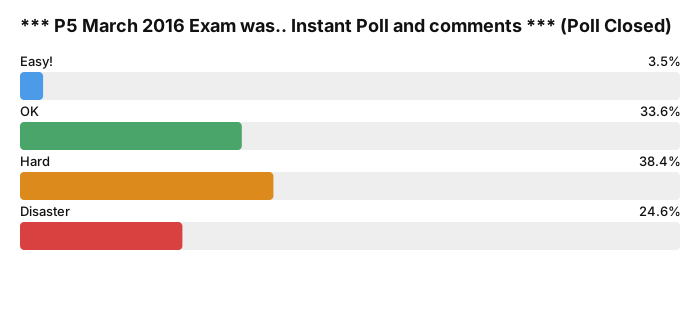
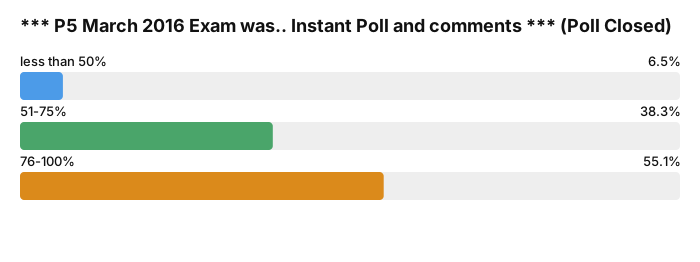
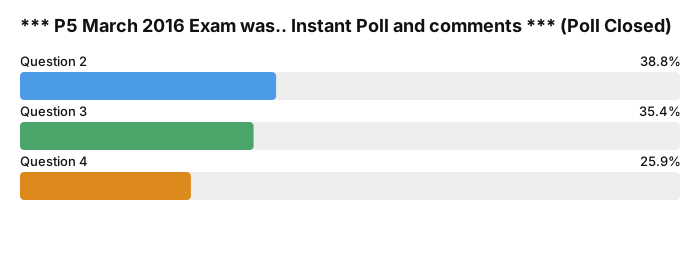
Please vote in our Instant Polls about the P5 March 2016 Exam.
Post your comments about P5 exam below
OOlga10y ago#121
Dear Olga
Thank you for your patience whilst we have been looking into your complaint in more detail.
Since you contacted us on the 16th March, I have had the opportunity to speak directly with our Exam Content team.
They have provided me with more information about the P5 examination.
The P5 examination, like all ACCA examinations, undergoes a rigorous quality assurance and scrutiny process to ensure that requirements are clear but are of the appropriate educational standard for the Professional Level and that the examination is manageable in the time given. ACCA examinations are developed by a team of qualified people, not just one individual and there is never any intention to mislead candidates.
The examining team often find that candidates find the questions time pressured when requirements aren’t closely read and as a result a lot of unnecessary information and analysis is provided. This gives a false impression to candidates that the question was asking for too much. Whilst ACCA cannot comment on Question 1 from March 2016 as the marking process is underway, we can illustrate this point with an example from the December 2014 Question 1(ii) and the comment made about performance on this requirement in the examiner report.
(ii) Briefly justify appropriate management approaches to each of the stakeholders and, based on this analysis, evaluate the appropriateness of the performance measures suggested in Appendix 1.
Examiner comment: Many candidates chose to rework the analysis of interest and power stating whether or not they agreed with it, which wasted time when the focus of the answer needed to be on suitable management approaches. The discussions of the five given performance measures tended to be general rather than specific to the issues in Boltzman and the stakeholder analysis and as a result, candidates tended to write many words before getting to the point of their answer.
The stakeholder analysis has already been done in the scenario and yet this was overlooked in many instances, so the result is that candidates write a long response which scores very little because they have then not answered the requirement. This then also leads to time pressure for the rest of the question.
Your email references that the advice for an approach to P5 is to treat the questions like real life situations, but the tasks are made deliberately tricky. I am sorry to hear that this caused you anguish and stress in your exam. Before the exam is signed off and printed ready for the exam sessions, we always make sure that the requirements are clear and are usually backed up in the narrative in the scenario. This can be illustrated with another example from the December 2014 examiner’s report.
As mentioned , a number of candidates chose to ignore the advice in the scenario ‘The CEO has asked that you do not, at this stage, suggest long lists of additional indicators’ and its repetition in the question requirement to ‘evaluate the appropriateness of the performance measures suggested in Appendix 1‘. Again, these extra indicators (often without any justification) wasted valuable time. It may be helpful for candidates to read all of the question requirements rather than just part by part, since it would then be obvious that the part (iii) deals with suggestions for new indicators.
This is good exam technique as all requirements should be read and planned out and there is no rule that says you must answer them in the order set although your report should have an appropriate structure and headings. I would also suggest having a look at past exam papers and reading the scenario against the requirements for example in Question 1. The information presented in the scenario often flows in the order of the requirements so again good exam technique would be to note against those paragraphs which requirement that information relates to.
It is also worth noting that a lot of core management accounting topics arose in the March 2016 examination, some of which had been examined in earlier studies, so the examining team are in no way attempting to trick or mislead candidates. This would be extremely counter-productive on the part of ACCA, as we want students to pass and become Members and carry on our tradition and reputation for producing outstanding professionals within the very competitive global market.
Whilst I can see that you have attempted P5 a few times now without passing, your marks have got progressively better with each attempt. You also have a very strong examination history, having passed previous papers with good marks.
If we can help in any way with additional support for P5, please do let us know. If you have had an administrative review in the past which indicates which questions you have passed, I would strongly advise working towards the failed questions. Whilst this may be stating the obvious, it may make focussing revision on your knowledge gaps.
We do have a great deal of exam resources online for students to help them with their studies. You may well be aware of these, but if not, you can find them on our website here;
https://www.accaglobal.com/uk/en/student/exam-support-resources/professional-exams-study-resources/p5/syllabus-study-guide.html
I do hope that the above helps to provide you with a broader context for the paper itself and that my advice and guidance is useful.
I wish you the best of luck with your studies ongoing and do hope that this time on results day you are pleasantly surprised with a well-earned passing grade.
Kind Regards
James
EEi10y ago#122
I complained for P5 as I am on the same boat with those who find this paper as cash cow and making our life difficult. Please join to complain as below.
[email protected]
CGCrazed Guy10y ago#123
May they have mercy on us on the results day! only a week left...

 Post your comments about P5 exam below
