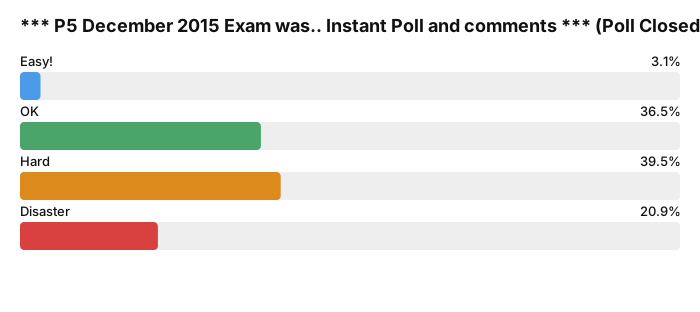
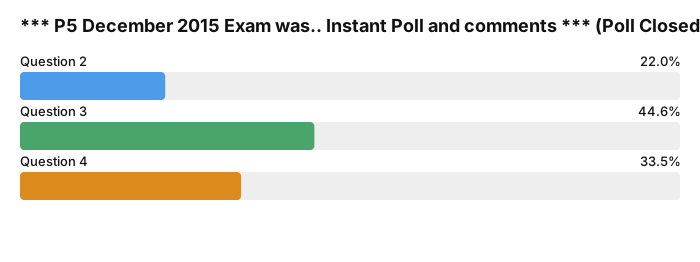
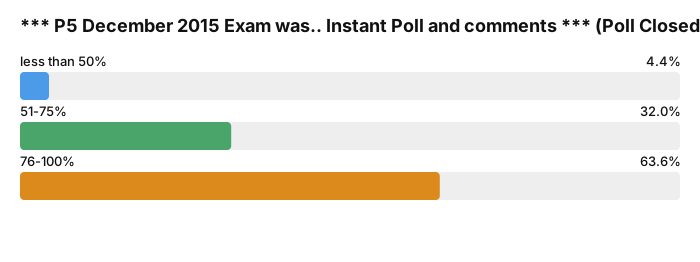
APM*** P5 December 2015 Exam was.. Instant Poll and comments ***
Thanks Latoyah for replying re operating leases to Alexandra.
Q3. the 540 extra passangers (135 per train) overcrowded is from working out the capacity and comparing to passangers travelling.
At peak in region A there was 4 trains with 7 carriages each has 70 seats thus capacity is (4 ×7 ×70)=1,960 but there was 2500 passangers for region A at peak times hence the 540 extra 2500-1960 which have to stand in the 4 trains thus 135 extra per train. .
I felt like it was an easy paper.. or that i was really well prepared. Except.. i was time pressured :/ i could do about 80% of it. But i "think" i did quite well in that...
Please God.. make me pass this time...
I did question 2 and 3. Question 2 and 3 were both very similar to June 2013 exam and sir Gromit's lectures on those questions so awesome :) (Transfer pricing and Balance scorecard). However i think i did really well in question 1 too (EVA, JIT, Kaizen, implementation of a new IS). If only there was more time...
For q4(b), it goes something like this: access how the role of treese management accountant will change as a result of new IT system and strategic initiatives and benefits it will bring to the company. Quite confused on whether the benefits here should be in the context of the new IT system or due to changes in management accountant.
This paper was really crazy... Is there moderation for this paper?
My take on the exam. Like many others have said
Q1 was fair. Nothing too difficult although had to rack my brains a bit on suggesting a new KPI. The project initiatives were interesting as I could relate the quality projects to a CSF but the KPI had little or no relevance to the innovation CSF
Q3 balance score card. Good question, not too difficult
Q4 thought was easy because it was five forcesuntil I actually read the requirement and scenario. Mind went blank. Wrote a lot of Rubbish because I didn't understand the requirement.
Overall, I think I completely botched q4 and it's almost a write off.
Looks like a resit or I'm taking p6
This was my second attempt to pass P5. In June 2015 I scored 49 marks.
In June I was almost crying during the exam because I could not understand the questions asked although I was well prepared and had very good results from mock exams.
This time the exam was not so difficult compared to June 2015 siting. I finished all three questions in time and used two booklets.
Question 1 was pretty short compared to previous sittings.
Regarding EVA.
R&D should be capitalised (Profit and CE adjusted)
Operating leases should be capitalised AND depreciation charged (adjustments to profit and CE)
Economics depreciation = accounting depreciation
In WACC calculation post tax cost of debt should be used.
D/E = 100% means that D=E means that D/(D+E) = 50% and E/(D+E) = 50%
Opening balance of CE should be used.
Question 3 seemed to be the easiest one.
The trains were overcrowded in peak times, in other times the occupancy was not so bad.
Question 4 was very strange.
(a) I did not understand why there were given all five forces although we were required to analyse only those with high threat.
(b) I focused on IT system impact but ignored the three strategies mentioned in the question and in the scenario as I did not understand well what these strategies are about.
After two attempts of passing this paper I have the following understanding about the examiner's approach:
This paper does not test your knowledge of theory. The examiner stated that the difficulty level is compared to postgraduate degree. At this level you are not expected just the repeat the learned words and phrases. You need to be able to analyse, compare, make conclusions, give recommendations. The same will be required at your real job. Nobody cares that you can name all five Porter's forces. You will need to propose how to change the performance of the company to deal with these forces and stay competitive.
Operating profit is the profit from operations, before deduction of interest and tax.
Check the technical article about EVA. It describes two methods of calculating NOPAT - you can start with operating profit OR start with profit after tax. There will be some slight differences in adjustments related to interest expenses.
Some questions I don't really know what exactly asking for. I felt terrible when I finished my exam, pray for mark 50, I don't want see this paper again.
P5 exam wasn't good for me too! I did Q2 and Q3 and I found Q1 quite lengthy and time consuming with too many requirements. EVA is around $235 for me.
This was my 2nd attempt, last June 15 exam was comparatively easier and I did well too, but still flunked. Now really hope if I can pass this one.
Very difficult paper, if any one remembers the questions and Mark allocations? If I remember:
Q 1
EVA Calculation and comment - 15 marks
Weakness and suggestions of KPI - 6 marks
Assessing the CSF & KPIs for new initiatives which are JIT, Kaizen & zero defects - 15 marks
The New IS and the relevance to the 3 initiatives - 10 marks
Structure - 4 marks
Q 2
Didn't attempt so don't remember
Q3
Explain measures of suitable BSC - 10 marks
Evaluate and calculate crowd (should be only calculation) - 7 marks
Behavioural aspects of PM (don't really recall) - 8 marks
Q4
Explain high threats, assess suitable performance measurements and detail (must be expecting for min 5 PMs) - 15 marks
Management accountants change of role - 10 marks
Not enough time, too lengthy and examiner perhaps wants to keep pass rates < 30%
Amen to a 50
Hi guys, re EVA calculation:
1. I don't think R&D should have been adjusted to capital employed as it was mentioned in the question that all of that was incurred during the current period.
2. Post-tax interest charge is added back only if you start from profit after tax but the junior started from operating profit so post-tax interest charge did not need to be adjusted for
My only worry is that I highlighted that marketing capitalised should not be added back because if it was capitalised in the first place then there is nothing to add back (i.e. no expense was made in the period so nothing to add back). But I just looked at June 2014 model answer and the use the same terminology i.e. "marketing capitalised" to add back marketing that was clearly expensed there. However I can only hope that examiner will appreciate that it was not clear whether the marketing spend was expensed in the period or capitalised in the period.
This was my third attempt at this horrible paper. It wasn't too bad this time. Took one look at the transfer pricing question and decided to avoid it. On the face of it, it seemed quite easy but under exam conditions, with time pressure? NO WAY!
Question 1 was strange. If the company's mission was to increase shareholder wealth and value, why on earth would they move to leaner production methods? A lot of Q1 was just applied theory, like explaining what the different methods were and talking about computer systems. Alex Watt does have one hell of an imagination I can give him that.
Hopefully this'll be my last time. I hope everyone on here gets a pass too :-)
The exam was rather fair and okayish when compared to what i had expected, Time management was the key and crucial thing, Here's what i did
Q1- a- EVA. Took opening balance of CE, Adjusted tax in calculation of WACC, Operating lease 115/5- Deducted this as economic depreciation from profit, and added 115-Depreciation in CE, Added RD expense to profit, added marketing expenditure assuming life of the brand was 4 years and ammortised it, EVA was higher then that in question it was 200+.
Q1-b- Different product mix, new products don't have to be successful
Q1-c- JIT- greater supplier interaction, a culture inducted into company- would decrease wastage, decrease innovation and decrease labour hour as well. Kaizen- Innovation and autonomy to employees, Would increase labour hours, Greater innovation. Zero-defect, Conformance, non-conformance, Increase labour hours as more care is put in quality, Less wastage and Less innovaton.
Q1-d- Had only 20 minutes for this and Q4-d- so blabbered random stuff.
Q3-a- Takes look at wider perspectives so address concerns of all parties involved, helps avoid focus on a particular measure, control, assist in evaluating decisions by different Point of views.
Q3-b- Overcrowded only in Peak time region A, others had spare capacity, government comments were generalized and wrong about whole right to the extent of region A peak times, should be addressed as we depend on government for contract renewal.
Q3-c- cant really remember what was it.
Q4-a- Explained how high threats can be managed, Wrote about barriers of entry for New entrants, Diversification or strategic alliance for substitute, Long term contracts or supplier acquisitions, difficulties to measure and quantify threats, PMs- Dependency on suppliers, sales lost to substitutes, number of potential entrants.
Blabbered random stuff about Part b due to lack of time though wrote that outsourcing would require greater supplier interaction, and management accountant would be asked to analyse data provided by systems.
Hoping for the pass, Attempted 80 marks in full spirit and the other 20 marks were just random blabbered stuff. Overall a fair time-pressured exam.
Q 1 EVA was ok. don't know about the rest
attempted Q3 and Q4 . Saw Balanced Score card and porters. jumped into it. But,,,,,so much confusion. Overall Time pressure and unclear requirements. Exam Practice is the only way to beat this exam. Because knowledge base has nothing to do in the exam....
Seagot!!
truly you reminded me of Inception the movie, I couldn't resist bursting out loud. Surely examiner is a luckiest person likely he's the top boss at acca. Had anyone been reviewing his famous "diet" most of his drafts would have land in reviewer's cabin labeled "not healthy".
The exam was a little bit fair compared to June 2015 but i was time pressured and failed to finish question number 2 after question number 3.I waffled around to question number 4 that looked easy to me after seeing porters five forces but when i started reading the scenario I couldn't PICK a point of what really the examiner want and went back to question 2.I Regretted having not done question 4 at least i could have scored decent marks in b but am still hopeful it will work out.
Guys seriously tell me what do you think the examiner really thinks about shocking handwriting? I find that for Q1 my handwriting ok and then it just goes downhill from there on as the time pressure increases. In the past however i have passed exams with truly shocking handwriting though not all the time.
Just how bad is everyone's handwriting? Do you think the examiner really punishes us for the handwriting, i mean ultimately as long as he/she can read it (even if it takes them time) then we're ok?
@Agness
So which Questions did you do apart from compulsory Q1?
@Michael
I agree that writing gets worse due to increasing time pressure (not particularly the fatigue). OT tutors has stated many times that markers do make effort to read our scribblings.
We would really have to look at a number of different scripts from all around the world to make a good comparison of our writing quality amongst the others.
As far as I'm concerned markers have a limited amount of time per paper so they won't spend enourmous amount of time deciphering words.
I felt bad about question 4 because up to now I dont know what the questions was asking with the exception of performance measurement to provide... I was highly confused with the requirement.
Hi
same as you did..but i manage to escape q4 and enter q2 with 30 min remaining..
fingers x.
I read somewhere that markers only have about 8 minutes to mark each answer booklet.
With the general time pressures of the exam and time lost on trying to understand the requirements, I can imagine that handwriting for most people will become pretty shocking during the exam.
I do believe markers would try to understand the points being made but there's only so much they can do under their own time constraints.
Probably contributes to the low pass rate.
I did question 1 and thought question 3 and 4 seems like the better options. I stayed cleared of the transfer pricing thinking five forces was an easier option, 10 minutes into it I realised that was a mistake. I kept reading the questions and requirements everytime I wrote a sentence. I still do not know what was required of me, that question left me so confused! I am hoping for a pass, this is my last paper to qualify and I failed it last sitting. No sure how I will do considering the BS I wrote for question 4.
It was too time pressured....the exam wants to keep the pass rate at 30%
Time pressure is fine and fair as this is one of the pillars of ACCA exams. However when requirements become a wording puzzle then it becomes a nightmare.
If there are like 4 'and' words + relation to 3 different subject matters in one question (say c) why not splitting the requirement into two parts c) + d) part?
You still examine what you want but it is easier to approach by the stressed student in exam hall.
Who remember what part C in Q3 was about?
it was riddles ,riddles and riddles , did q1,3 and 4 , seeing q3 about trains reminded me of a similar scenerio of trains and lines in p3 exam kits ,well as others said q4 felt easy till it came face to face and the time on clock left was 30 minutes just tried to keep writeing on the high threats of substitutes how to manage them and measur ethem really have no clue what i was writing anything that came to mind i wrote ,though this scenerio also reminded me of a similar question in p3 about a event manager it was something abt style of management in p3 ,and thank god had read kaizen a night before was stuck in my head but i would say i did 85 percent of the paper lets hope ,this new examiner is like GANDALF "YOU SHALL NOT PASS"
Hybrid paper Sep/ Dec link:
https://www.accaglobal.com/content/dam/ACCA_Global/Students/prof/p5/d15_hybrid_p5_q.pdf
Now this hybrid paper would be nice to have :)
Time management is always a big enemy, i just pray for 50 on spot, nothing else.
Topic lockedNew replies are closed.