
Post your comments about F9 June 2013 exam.
How did you do? How did this paper compare to previous exams?
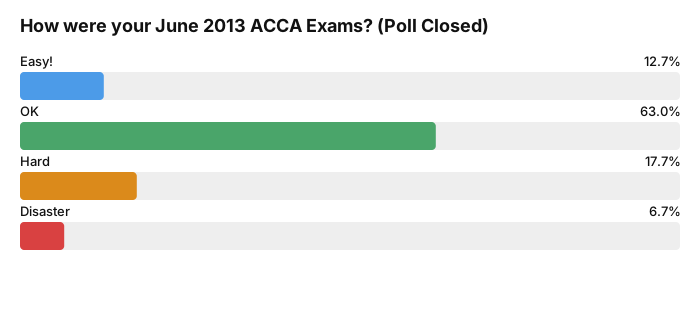
Vote in our Instant Poll

<cite>@hassanatcams said:</cite> Well actually i n calculating the EPS i made a big mistake and its that i deducted the dividend payment from the PAT and then divided the figure by 10m shares. well can any 1 say how many marks wud this mistake cost?I have the impression that this examiner does not give ANY points if you have mistaken something. My last sitting I had 48 points and I was expecting above 55 based on the marking scheme published, so I don't think he awards any mark for partially done thing.
 Former user13y ago#124Former user13y ago#125
<cite>@hassanatcams said:</cite> the ques 4 part regarding the working capital policy i calculated the current operating cycle and then the revised operating cycle by recalculating a/c recv, payable and inv days. Then i calculated the revised a/c recv, a/c pay and inv vales on the basis of the revised recv, pay and inv days. My revised a/c recv days and inv days had shortened and the new a/c recv value had decreased. i calculated the amount of decrease in a/c recv and applied the 5% interest on it to calculate the finance cost saving. was this procedure correct?correct but there was other finance cost savings
<cite><a href="https://opentuition.com/members/Lambyang/" rel="nofollow">@Lambyang said:</cite>
1st question wacc 11.6%...am i right?
i think i got d same ans<cite>@bilal123123 said:</cite> i made all the correct calculations but made a mistake by choosing MMh rather than FMH as preferable..how many marks will i lose?same mark as some1 who forgot to give an opinion ( me) on the preferable method xD probably 1 point for FMH 2 points for MMH since u need to explain the steops and 1 mark for opnion i guess
<cite>@semreh said:</cite> My Answers. Q1a - NPV postive approximately $4.5million. make sure you inflated selling price, variable cost and fixed costs from the first year onwards. tax and capital allowance one year in arrears with balancing addition in y5. scrap value in y4, working capital of 575 regained in y4. initial wc in y0 with additions in y1, y2 & y3. Q1b - Nominal and real. Nominal takes into account inflation and interest i.e. fisher effect, not actual cash flows. Real is the actual cash flows but does not take into account the time value of money. (this may be incorrect) Q1c - primary objective is maximizing shareholder wealth either through revenue or capital gains. secondary objective of a listed company is value for money. This would be the primary objective of a NFP. Q2a - WACC was 11.24%. Preference shares are included. 4% / 0.40$ = Kps 10%, market value 3000 * 0.40 = 1200 Bank loan 4% - 30% tax = Kd 2.8% = Bank loan = 1000 for OSC I do not remember. Q2b - CAPM can be used to find specific project Ke because the B can be manipulated and i.e. companies B's in other fields can be ungeared and regeared to your capital structure to find your company specific Ke in that field. Q2c - Ke is more expensive then Kd because of pecking theory. Equity shareholders are the last to get paid. Kd is usually also secured with either floating or fixed charges and perhaps a covenant of some type. Q3a - WCC - 67 days after changes from 130 (or 140 days). Extra financing cost I believe was $32000 (difference in overdraft * 5%, i believe i forgot to account for taxation savings here) Q3b - Receivables policy - competition in industry, investment/risk wanted - longer rec. period more chances of bad debts, startups & small companies must give longer periods to lure customers, business environment - i.e. supermarket has little or no receivables, construction company has receivables which might be years old. aging analysis should be done etc and also the benefit of cash received must outweigh the cost of securing the payment. Q3c - forex risk - The 3 risks for a multinational are translation, transaction and economic risk. Q3d - forward market hedge was +2000$ more profitable Q4a - find share price in 2-3 years, discount back to current price. I suggested this was unsuitable because even though it would give future growth, it is signalling to shareholders their are underlying problems with the company. Furthermore, even though M&M stated that shareholders do not care between revenue and capital growth, revenue orientated shareholders will be driven away. Q4b - EPS will rise but will dilute ownership pool Q4c - Debt issue will give the best EPS and will not dilute ownership. Must take into account gearing of the company in order to ensure the new debt will not raise the cost of the Ke and therefore negate the savings of the lower Kd. Convertible debt should be considered since it is a form of delayed equity and will not affect currently the EPS. Q4D - Venture capital / Traded Bonds / Equity Finance VC - high risk / high reward, ke required of > 30%. not for listed companies. good for aggressive moves i.e. takeovers. Equity finance - pecking theory states will require the highest return of all financing. Bonds - usually secured with a floating or fixed charge or a covenant of some type, lowest cost of all three finance options here (i think maybe this is incorrect).congratulations u passed :D however for the question of why ke is greater than kd, u said becuz if pecking order thoery ? :O isnt it just a preference for sources of finance?
<cite>@icedawn said:</cite> congratulations u passed :D however for the question of why ke is greater than kd, u said becuz if pecking order thoery ? :O isnt it just a preference for sources of finance?my money mrket hedge was more profitable...:;p
<cite>@thebear said:</cite> according to my study text , BPP already give a reminder that the preference shares should not be included in the WACC calculations to quote chapter 15 , page 302 of the study text by BPP " when calculating the weighted average cost of capital , the cost of preference shares is a separate component and should not combined with the cost of debt and cost of equity "I may be mistaken but sure Pref.shares are included in wacc calcs
<cite>@tornado said:</cite> Did anyone NOT inflate due to that was asked only the NOMINAL and the real?I didn't. !!!!!! I thought papr said nominal rate specifically in the info and the question
<cite>@skay123 said:</cite> Hi guys, In the WACC calc....working out the cost of the redeemable loan note ......in the irr calc for df@5%and 10% for both Npv I got was negative...did anyone get this or maybe I went wrong with the calculator....????.?I got that but the 5% was so close to zero I decided it rounded to 5% in the end!!!!!
<cite>@united26 said:</cite> I got +4million for the NPV 8% I think for the WACC but left out bank debt from the Cost of Debt and MV of Debt Picked Forward Market 298k over MMH 296K Can anyone remember the marks for Ac's recievable Management factors? I mixed it up with Working Cap financing- really annoying me cos I had the right answer learned off a few times over beforehand but think just panicked when seen it and got mixed up.I left the bank loan out because I thought capital related to long term and overdraft is short term. on past papers he has allowed with overdraft but I didn't have time to add anything I thought was not necessary. I did enough unnecessary mistakes so I didn't add anything on purpose :)
<cite>@leogr said:</cite> wacc was 11.2% i think recblemanagment marks was 6 or 8I had 11.2% but other people had different so I thought I had it wrong. so glad someone else must have had the same thought processes as me on this one even if it is wrong :)
<cite>@hassanatcams said:</cite> the ques 4 part regarding the working capital policy i calculated the current operating cycle and then the revised operating cycle by recalculating a/c recv, payable and inv days. Then i calculated the revised a/c recv, a/c pay and inv vales on the basis of the revised recv, pay and inv days. My revised a/c recv days and inv days had shortened and the new a/c recv value had decreased. i calculated the amount of decrease in a/c recv and applied the 5% interest on it to calculate the finance cost saving. was this procedure correct?Don't know if it is correct but that is what I did too :)
<cite>@leogr said:</cite> applied 5 and 10% and got 5.5%got two negatives as well and an IRR of 4.67 or i guess 4.7%
<cite>@giorgia said:</cite> I've calculated the revised receivables, inventory and payables, using the revised cash operating cycle. The question said the working capital remained the same, therefore the o/d must have been the balancing figure. That's how I've done it at least.yea its correct
<cite>@ifrah16 said:</cite> Yep.. that was fixed for the 4 year period wasn't it? Or was it given as 9000 in the first year only? The thing is, if we weren't to use 9000 units then what else were we to use? :Sto me it increased by 9000 per year
<cite>@debbiebrown said:</cite> To everyone at OT from the lecturers and techies to the cleaners THANK YOU SOOOOOOOO MUCH. You guys are the A TEAM. I love you all. I would never have got past my first exam without you and I have just sat my 6th. You are the only source of tuition I have and you covered everything in that paper. I am not sure how I did but I managed to give an answer to all questions and there is no doubt that I could only have got the info from you because there is simply no one else :) :) :) BIG HUG TI YOU ALL FROM ME :) :) :)