
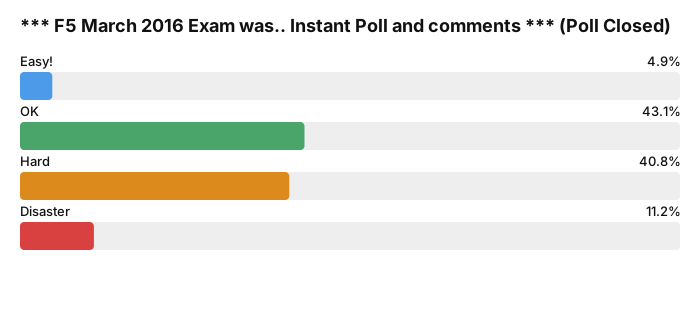
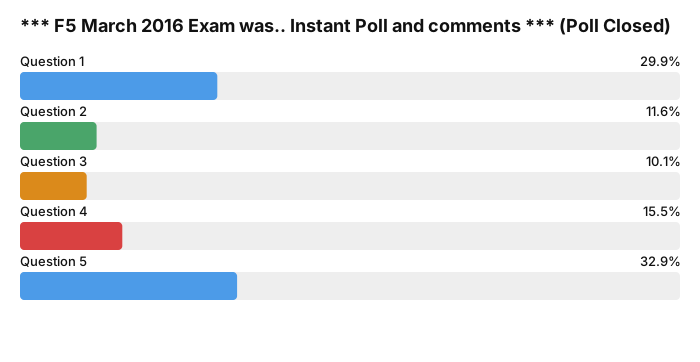
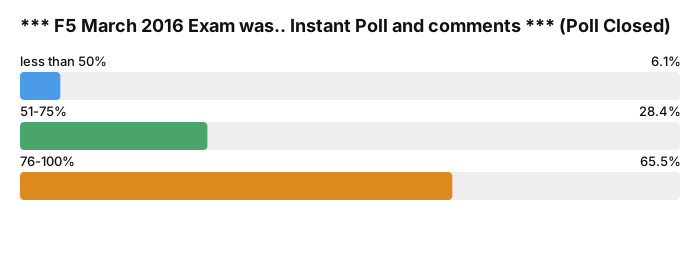
Please vote in our Instant Polls about the F5 March 2016 Exam.
 Post your comments about F5 exam below
 Post your comments about F5 exam below
@jolitag said: I thought overtime was mentioned just to justify why we had an adverse labor rate variance..Can you rem what got overall variances were? And also your planning and operational variances? I was thinking the amount was probably due to overtime
 Former user10y ago#156
@wingman0401 said: Taken from the ACCA site; "image and relationship costs: costs that, by their nature, are intangible, for example, the costs of preparing environmental reports." That to me reads as though relationship would be right but mine was a guess, anyway.
Former user10y ago#157@saifoo786 said: MCQ's were hard as they were based mainly on the theoretical side of the syllabus. However, I found the number ones okay. Section B Question 1-Llike everybody is saying it was to just calculate the profit by deducting the costs and it did state the equation could not be applied, so that gave me some confidence to continue this method, I got 4 batches to be the most profitable. Question 2 - Lifecycle costing. I don't quite recall what I did for the Patent cost for 10 years. I think I divided the figure by 10 and multiplied it by 2 also adding the renewal costs for each year. Lawyer's fees was due to the product patent, so I did not deduct that either from the General Fixed costs. Advertising and Marketing was calculated by multiplying each figure with the probabilities and adding them together for both years. Question 3 - My ROI was around 25%. I deducted dep'n from the expenses and used Net profit for my controllable profit because depreciation is not controllable by the manager. Part b was just explaining the reasons to why ROI is not a good divisional performance measure and reasons like it encourages sub optimal behaviour and managers are keen to keep ROI's high whereas an investment in a project can be profitable for the business in the long term etc. Question 4 - Balanced Scorecard. I was glad I practised a question like this on the Kaplan Exam kit and it went really well, the aim was to just read the scenario carefully and pick out any improvements the business could possibly make to improve their performance. Question 5 - The labour rate variance was Adverse and Favourable for efficiency. After I pretty much messed up really, I don't think I scored very well on the last question. In part C, I added a few points like planning is not controllable and operational is and therefore the manager should be assessed fairly by only looking at the operational variance.
@aliwright said: How did you study and what materials did you use?I used the Kaplan studying materials and watched the OT lectures. I also used the BPP exam kit
@shoj said: Can someone please explain their reasons for dividing $42 per hour standard labour by 3 hours for the labour question (Q5)? The formula for labour rate planning variance is (standard wage rate - revised wage rate) x actual labour hours used; so why divide $42 by 3 hours? 3 hours were used in total to make one pair of shoe. My answer for labour rate planning variance was ($42 - $42.84) x 37000 total hours used = $31080AYou have to divide $42 by 3 hours to obtain the hourly rate of pay. If it costs $42 for 3 hours work, then it will take $14 for 1 hour, and this $14 figure is the hourly rate which will need to be used. From what I understand of variances, you will have to use the hourly pay rate in the formulas for labour variances, so it is the rate per hour, not per unit.The hourly pay rate is the "wage rate" which is to be used in the formula you have mentioned.
@shoj said: Can someone please explain their reasons for dividing $42 per hour standard labour by 3 hours for the labour question (Q5)? The formula for labour rate planning variance is (standard wage rate - revised wage rate) x actual labour hours used; so why divide $42 by 3 hours? 3 hours were used in total to make one pair of shoe. My answer for labour rate planning variance was ($42 - $42.84) x 37000 total hours used = $31080A@Shoj. I did exactly the same thing you did throughout my variance workings and everything was Perfect! but somehow dividing by 3 actually seems right however our answers just might score half marks for knowing the technique at least. it sucks realizing it now but lets keep our fingers crossed.
Former user10y ago#171@shoj said: Trust, it was on a per hour basis. Questions would always give you a standard rate per hour. This is what is bewildering, the fact that some people have divided it by 3 hours. I can only assume some people did this because one of the past papers was done in this manner (DEC 2012 Q2); but this was done on a per batch basis. However, I can clearly remember that each pair of shoe took labour of $42 per hour. This was not the labour cost for 3 hours, otherwise yes you would have to divide it by 3 hours to get the standard rate per hour.The question did not give you the per rate hour... It have you the standard cost of Labour. It took 3 hrs and the standard cost was 42. Standard cost = hours * rate In variances the formula is Efficiency = actual units * standard hours per unit...in this case it was 3 Rate = actual hours * standard rate It is not Times the actual cost per unit. You use the standard cost to find the overall variance...however that variance can be evaluated into separate components Labour efficiency + Labour rate
@sapphire16 said: You have to divide $42 by 3 hours to obtain the hourly rate of pay. If it costs $42 for 3 hours work, then it will take $14 for 1 hour, and this $14 figure is the hourly rate which will need to be used. From what I understand of variances, you will have to use the hourly pay rate in the formulas for labour variances, so it is the rate per hour, not per unit.The hourly pay rate is the "wage rate" which is to be used in the formula you have mentioned.
@sapphire16 said: You have to divide $42 by 3 hours to obtain the hourly rate of pay. If it costs $42 for 3 hours work, then it will take $14 for 1 hour, and this $14 figure is the hourly rate which will need to be used. From what I understand of variances, you will have to use the hourly pay rate in the formulas for labour variances, so it is the rate per hour, not per unit.The hourly pay rate is the "wage rate" which is to be used in the formula you have mentioned.Like what Saph said, the standard labour rate should be used not the standard cost of labour.
Former user10y ago#175Former user10y ago#177Former user10y ago#178Former user10y ago#180