PM*** F5 March 2016 Exam was.. Instant Poll and comments ***
What was all the sections tested in the written parts of the questions, Life Cycle Costing, Balanced Scorecard, and which others?
Q1 -4 batches -14400 profit
Q2- ROI in 2017 36% but not sure if didnt mess up with the depreciation
Q3- i Included all the cost except for 20k od the lawyer and 800k lost contribution, i thought it was more about the total life time cost of the PRODUCT rather than decision making.
Took into account 2 years x200k the patent cost- maybe incorrect not sure-never even thought about it... The total profit was 1650000 i think so very low considering 34milion revenue- IF taking into account lost contribution it would be even less - 850000. Not really sure od this question...
Q4- balance scorecard
Q5- total labour rate variance was adverse- budgeted rate was 14, revised 14.38, actual 14.28. Total efficiency variance was favourable. (Budgeted time was 3hours, 3.25 revised, actual 2.94). The planning rate variance was adverse-, operational was favourable, the planning efficiency was adverse and operational was very favourable! Unfortunately didnt have enough time to describe them. Not sure why the overtime rate was given- didnt use it so not sure if answered correctly.
What was the price od perfect informacjom in mcq?
Yes please finally someone who has something similar
It went like this for me
Planning
The original was 14.00 * 37,000
The revised was 14.28 * 37,000
Operational
Revised was 14.28 * 37000
Actual Labour (cant remember)
For the rate I got a small adverse rate of 3 something
For the efficiency = (Budgeted - Actual) = Overall Adverse
The operational variance was however favourable - I think I got 20 something
I put the Manager did well since this means the average time per unit was less than the revised rate of 3.25.
I also put despite the large labour rate variance the operational variance was small and this could have been attributed to overtime but we need further information to evaluate the overtime variance since it could be a possibility that the adverse variance at the labour rate was due to extra time workers had spend to meet demand and also because of the extra logo print. That could have been the cause of the overtime if the workers were already to capacity and then a portion if not all of the adverse variance was due to planning
@yashikmaharaj@gmail.com said: What was all the sections tested in the written parts of the questions, Life Cycle Costing, Balanced Scorecard, and which others?- Pricing (non-algebraic method) - Labour variances (planning and operational) - Return on Investment
I got 150
I got E only too
Outsourcing ended up cheaper than making internally
The formula for Average Capital Employed is
NBV at the Beginning - Which was the closing Capital Employed
Then NBV at the ending
(New Investment - Depreciation) +(Closing Capital Employed - 1,250,000) = Total
Total/2
That would be the average
MCQ:
one was what is constraint if limiting factor is used:
wood,
labour,
inspection (i guess it was something else)
output
ans. was output
MCQ:
One was which is constraint as per limitation factor:
wood
labour
inspection ( I guess it was something else)
Output (correct Ans.)
Slight Off-Topic, (but exam related), I wondered if anyone could answer my query.
Today was my first sitting of an ACCA exam, and I understand that on the front sheet of the answer booklet, you have to tick which questions you attempted in Section B (There were 5).
I attempted all 5 questions, but I forgot to tick them on the front sheet to say I attempted them.
My answer booklet has rough workings on the first few pages for MCQs (which I later crossed out), and I then started each Section B Question on a new page, and shaded in the relevant bubble at the top of the page.
It might be a silly question, but will there be any problems recording my marks/marking in general for Section B if I didn't confirm my question attempts on the front sheet, with my answers not seen until a few pages in?
For the labour rate planning variance I compared the number of hours paid at $14 per hour with the revised rate of $14.28 and recorded an adverse variance of $0.28 x the number of hours worked (can't remember the number of hours)
Labour rate operational variance was favourable because the actual rate paid was lower than the revised rate but overall the variance was adverse.
The labour efficiency was adverse for planning but favourable for operational, the total labour efficiency was favourable which was remarkable given the additional time it was supposed to take for the new design.
On the learning curve question I originally put 2.37 but changed it because they were asking how long it will take to make each product going forward (not the average time per unit for the 100) , ie after the 100th onwards. I figured at this point the time taken would have drastically reduced per unit but I couldn't get the formula working to calculate it so guessed at 1.57 or something like that
Guess mine ended up wrong since my overall Labour efficiency budgeted vs actual was unfavourable due to the fact that budgeted and actual time was unfavourable
Planning - adverse
Operational - favourable
For Labour rate = overall unfavourable since the rate at the original stage was less than the actual rate at the end
Planning - adverse
Operational - small adverse
Starting to get really worried after reading this.
I thought I nailed the variance question but now a lot of you are saying you didn't include overtime.
Isn't the over time 0.25 hours x 1.25 x $14.28?
My answers were still:
Labour Rate Planning - A
Labour Rate Operational - F
Labour Efficiency Planning - A
Labour Efficiency Operational - F
I also added up the labour rate planning and ops which gave me the total labour rate variance for part (a) and the same for labour efficiency.
I completely screwed up the ROI question - I got 18.9%. Got the depreciation correct ($800k from my memory a year) and adjusted everything for inflation so I am hoping I get a couple of marks. For part (b) I talked about Dysfunctional behaviour, manipulation of profit and the superiority of RI over ROI.
I didn't include any of the technology patents or whatever it was in life cycle costing because it said it was related to the new pair of shoes so I was assuming all costs to do with the pair of shoes they were asking about that had a 2 year life cycle.
Question 1 was awful but still wrote 4 batches so hoping to get 1 or 2 marks there.
MCQ - made a few silly mistakes.
Praying that we have nice markers.
I spent so much time revising ABC, TPAR, Linear Programming, CVP graphs, Learning Curve and none of it came up in section B.
@christa316 said: I got 150I got 150 too. Did the EV of each line and chose the one with the most profit. Then the EV of the highest profit amount on each line. Took the difference and it was 150. Haven't a clue if it is correct or not.
It won't be an issue, they will mark all your answers in the paper.
what was the answer for the MCQ on budgeting that was changed 9 months later with 3 months of the year remaining, was it forward control?
I choose FF control since they used forecasts
May be 1.52
what's the answer for the perfect information question
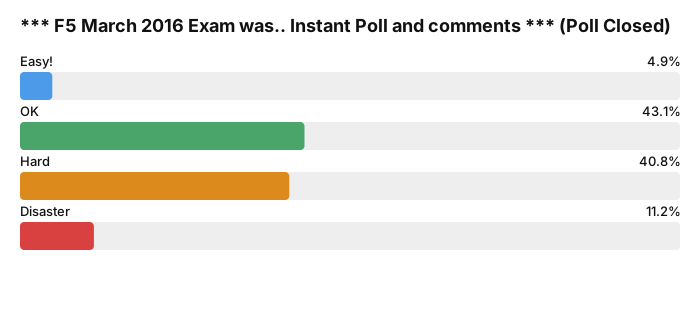
Agreed! I went with 4 batches as well. Life cycle costing was really easy. But which marketing cost you have used? ROI was ok. Variance was a disaster. \i have suggested 3 balanced score card for WSB one for customer service, management division got one and one for maintenance department.
In 5c-assess performance of production manager- my answer was the performance was bad cause he did not update the accountant on the changes in standard cost and something else....
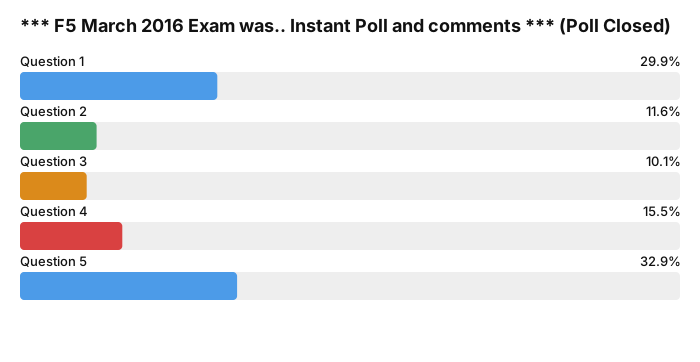
I would say question 3 , 4, 5 where pretty easy.
question 3 was life cycle costing
4 balance score card explanation and application to the question (1 goal, 1 measure, and reason)
5 straight forward operational and planning variance with tricky numbers. (Labour per pair of shoes 42$. one pair took 3 hours ). Then access manager's performance.
Overall question 1 took more of my time. I had no clue what was going on there for a while. Question 2 what the inflation and depreciation needed a bit of focus.
Damn! you have all the multiple choice answers crammed ! plus numbers from written section. With such memory you should hit a perfect score in the exam!
What did you get for your calculations
What did you get for the overall Labour Rate & Efficiency Variances and when they are broken down into Planning and Operational variances what did you get?
Mine was more like
Q5 part 1 - 2 marks
Overall Labour and Efficiency were both unfavourable/adverse
Labour Efficiency
Planning - Adverse
Operational- Favourable
Labour Rate
Both Planning and Operational were adverse
@flapper84 said: Anyone able to confirm the answer to the learning curve MCQ?2.72 if I'm not wrong
Few mcqs I remember:
Logical operation for confidential information:
1)Data encryption
2)Antivirus.
3)Segregation of duties
4)Internal usage policies
Second was on value engineering. I guess all the statements were correct. So option D I guess.
Third I remember was in which cost drivers were asked that are not volume related. I guess one was production runs. Cant remember the other. Because material and labour wasn't the correct option.
Then there was a question on sales mix and quantity variance. If im not wrong, it was 400 adverse.
Fifth was on relevant question. My answer was twenty sevent thousand and something. Or it was 29 thousand. Can't remember exactly
First mcq, answer was C because. MIS system are the only one that provide extensive information. I was confused with executive, but then I remember that executive sytems do provide information but that is not extensive. That question was copy paste from a becker mock I guess.
What are your thoughts people.
Can any body tell me that ACCA will publish the March2016 Section B questions or they only publish after the June2016 exam like that previous practise part of September 2015 And December 2015 section B questions.
@yashikmaharaj@gmail.com said: It won't be an issue, they will mark all your answers in the paper.It won’t be an issue, they will mark all your answers in the paper.
Topic lockedNew replies are closed.