Skip to contentSkip to search
Kaplan Publishing: Black Friday countdown

PM*** F5 December 2015 Exam was.. Instant Poll and comments ***

Oopentuition_teamAdmin10y ago

Please vote in our Instant Polls about the F5 December 2015 Exam.
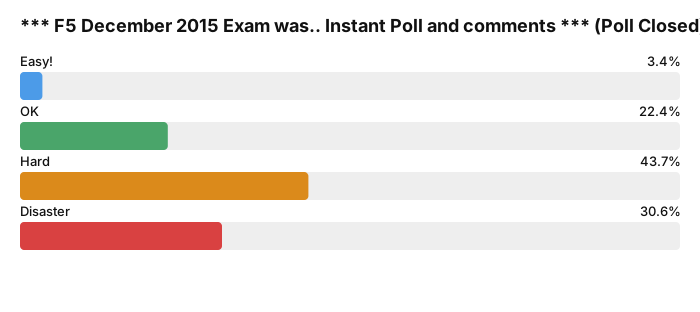
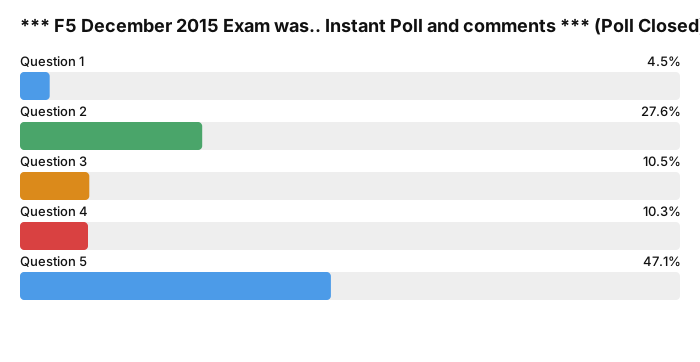
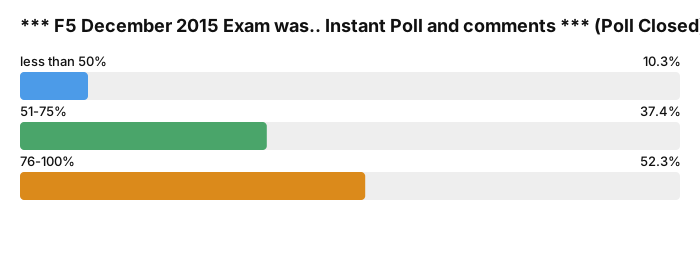
*** F5 December 2015 Exam was.. Instant Poll and comments *** poll results *** F5 December 2015 Exam was.. Instant Poll and comments *** poll results *** F5 December 2015 Exam was.. Instant Poll and comments *** poll results Post your comments about F5 exam below

BBenson10y ago#31
b a a a b a b d b a a c d b c b c a b d MCQ's.
LLaura10y ago#32
@benson1 said: hey did anyone get mat. mix as $16.54 and yield as $82?? this was the only question that i was confident about!!! Also, the RoI question did we have to reduce 6.8 mill(value of the investment) from the capital employed??</blockquote I think my mix was 16.51 adverse and my yield was 19 something favourable totals was 3.3f which I matched back to the material usage variance not sure it's correct though.
BBenson10y ago#33
@saed said: Hello guys regarding question 5 the maximum demand requires less than the level of Kgs of Material A and Material B that are available. therefore, the company should manufacture the maximum demand to maximize its contribution. Thanks Saed
so produce everything in-house is what you're saying?
CChris10y ago#34
Producing everything in house required 12600 kg of material a and there was only 12400 kg available. If we produced all 800 units of X in house we would have to make less L or M We could produce 600 units of X in house without breaching any constraints, the question was whether it was better to produce the last 200 of X in house or buy it in.
AAproop10y ago#35
Question 5 - Total cost for manufacturing X in house is $23 And 600 should be produced in house and 200 should be purchased And what is the variances for question 1? If any one remember?
GGia10y ago#36
Q1 - Mix & yield variance: I converted the grams in kg, worked out Mix variance A, yield variance F. Discussion part was me rambling about the yield variance: it occurs when the output is lower than the materials used for the actual quantity produced, due to: human error factor in making the loafs, poor quality of materials, human error in weighting the materials, more breads rejected by the inspector. Q2 - weird approach to decision making with bottleneck resource, worked out the net profit by using the throughput vs the costs of investment. Option 1 was the only one covering the costs of investments. My interpretation of the table was that it was showing how the bottleneck is elevated at different options of investments. Q3 - Incremental & participative budgets. Clearly incremental budgets, false impression of participative budgets. Suggested other types of budgets the JT & CT division could use. Commented on the veto decision of the AT senior manager, Mr. Molar (seriously? - cracked me up a lill bit :P). The managers are unmotivated, goal congruence is not achieved, missing on potential new clients due to old technology...stated some of the disadvantaged of incremental budgeting. Hope they make sense. Q4 - worked out the ROI using both the profit before the head office costs and after, commented on the uncontrollable aspect of their apportionment and that division N's manager could have gotten his commission if ROI is calculated before the HO cost allocation.Did not understand why they are asking me to discuss about my choice of the figures in calculating ROI...don't remember the rest of the Q. Q5 - got $23 as the cost of X, part b) did not understand how they want me to calculate the limiting factor. I took into consideration the making of all the products: L M LX and MX, their demand, the materials used, got Material A as limited...deleted my answer :)) , then i got stuck, i tried working the contribution per limited factor, ranked them, again i used ALL the products, got weird result, even more stuck, moved to c) can't properly recall what they were asking but wrote general things (like the quality of X might not be the same, loosing clients due to not meeting the demand...etc) I hope for the best and expect the worst... fingers crossed i will pass... Also the MCQ, some of them were soooo long, took me two minutes to read and properly understand some of them. Compared to what Q they used to give in previous exams (I have done all the BPP revision kit Q, all the Q in the book, studied all material, studied via opentuition, done all the past papers from 2009) this exam's questions were vague, weirdly formulated, long MCQ, but all in all, if you payed more attention (but one just simply can't focus during an ACCA exam due to the time pressure) it was a passable exam... Best of luck to us all.
HHafsat10y ago#37
Honestly, i'm tired of this F5 exam team! seriously what was that q2 about?? i have never seen such a question in the textbooks and it just took me off guard.This is my 3rd time writing F5 and i'm at my wits end with this paper! i don't have any problem with the remaining papers apart from this particular one. And its so sad that they keep on setting this rocket science questions to make students deliberately fail! Also, the Q5 looked like a linear programming question so i didn't really know what was going on, as i have only ever seen single limiting factor with make or buy questions and this one had multiple limiting factors (Material A and B), I racked my brain on how to allocate the resources and produce the optimal plan but i just couldn't as i was running out of time. Also, MCQ's were annoyingly long and difficult! the theoretical ones especially. Overall, this sitting was worse than both june and september sittings and i hope ACCA would review pass rates and do something about it>
Ss@min@10y ago#38
this paper was outrageous. i worked out so many past papers i cud nt see even a paper so tough. Question 5 the limiting factor till last time i kept thinking how to work this out but cudnt figure out
Ffarid10y ago#39
It was extremely hard i still don't know what the examiner wants from student I study this papar too hard this was my third attempt for F5 and still not hop to pass,I fell to quite studying ACCA if Instead I was study MBA I was completed by two years but in ACCA I could not pass F5 during this time period it is life consuming what we should do with this qualifications if we spend all our life on it, ACCA should change the exam question style for me even every area of syllabus is clear but this sort of question is not even come in past exam papepr and exam kit,I practice alot past exam paper also exam kit. I felling to bad I don't know what should I do please please please advise me I become mad
Former userFormer user10y ago#40
Q1..in the mix variance, I didnt convert grams to kg..in the yield variance, I converted grams to kg..eg 450/1000x950...All adverse for mix variance, all favourable for yield variance.......Q2...A..I saw it in a technical article but forgot the methodology...The lesson to the company thoigh is that as the management elevates a bottleneck, another one appears...
Former userFormer user10y ago#41
Q3....Very subjective..Incremental budgeting and imposed budgeting as against participatory budgeting...Q4....division F manager exceeded Roi due to his shortemism while division N couldnt meet up with the required ROI of 10%..Hence, no bonus for him but he should be rewarded based on his contribution to the long term profitability through the acquisition of the machine that will enhance productivity.
MMARIA10y ago#42
Hi, I also got 23. Hope it's right :)
BBabawale10y ago#43
@chrismary said: Q1..in the mix variance, I didnt convert grams to kg..in the yield variance, I converted grams to kg..eg 450/1000x950...All adverse for mix variance, all favourable for yield variance.......Q2...A..I saw it in a technical article but forgot the methodology...The lesson to the company thoigh is that as the management elevates a bottleneck, another one appears...
I was wondering if converting grams to kg is necessary as the actual and standard usage were similar.. Example Actual 626 kg and Standard 600 gramms.. Converting gramms to Kg will mean a very unrealistic huge variance. I simply worked it the way it was in the question. No conversion to gramms
MMohammad10y ago#44
Question 5 I got that 600 KG are left X so Make 600 units and buy 200 units
Wwakil10y ago#45
wt was q2 nd q5??? this 2 ques destroyed my f5 xm.when i saw q2 i was so confused nd my brain stopped,after watching q5 requirment i was so happy coz i thought make or buy easy for me.....bt when i tried 2 do it feels like i was raped by q5 nd also q2......my fst paper was f5 yesterday in part 2 nd it starts with fail.......just need a miracle........
MMohammad10y ago#46
@benson1 said: so produce everything in-house is what you're saying?
I got for X to Make 600 Units and buy 200 units
MMohammad10y ago#47
Hello All, I Think the Exam was kind of new style, Long MCQs and over Average difficulty level. Question B was exactly as in the Examiner Technical Article . Limiting Factors in Q5 , I got that only Material A is a limiting Factor so Make 600 Units of X and buy 200. I was just upset with MCQs that were hard and long compared to previous Exams. Do you agree?
CCee10y ago#48
By chance did anyone have to calculate the average capital employed. Correct Me if I am wrong but it Said in the question they were assessed on division performance. Therefore the traceable profit aka the full net profit was used . I did not use traceable profit at all. I wouldhave if they Said they were getting the bonus based the managers profit. Also I did not include payables when I was calculating the capital employed. I just used the first two numbers in each column
MMohammad10y ago#49
I fully agree with Regard to MCQs. I have done alot of practice before the exam but I thought these MCQs were the longest. Maybe the examiner wanted the reduce the Pass rate for Dec 2015!!!!
JJason10y ago#50
I think I have failed, looking at all the mistakes I made, I didn't convert the cost to grams on that mix/ yield question, rookie mistake but I was focusing hard on remembering how to do the variances. Annoying really, hopefully I will get some marks for at least doing the workings of the variance. I actually think they should just give the cost per gram and it's a bit of a trick to catch you out like that with the pressure of the exam and the time limit. It's not a test of the syllabus just a test if you are paying complete attention. The dentist question I found odd, 7 marks to explain why it wasn't a participative budget, seemed to be a lot of marks for discussing this, I did not come up with seven separate points. I worked out the ROI as being I think 28% for one manager and 11% for the other, took controllable profit divide by capital employed For the question about bottlenecks I simply multiplied the extra units by the long term value they gave per unit and took off the investment. Not sure if I viewed that too simply? My answer was to go with option 1. I saw the bit about throughput at the top but ignored it.. The final question was beyond me, I did not give this enough study time and it seemed a particularly difficult variant of that style of question, so I blew a lot of marks there. MCQ I found reasonably ok.
CCee10y ago#51
How did you guys calculate question 2 I just used the throughout times the units produced in option one. ? I only got the 2% times the salary for the first division. What figures did you use to get the divisional profit
Bbullocin10y ago#52
What was Q#2 testing?? throughput maybe, no clue..
PPavlena10y ago#53
Hi guys, q1 adverse mix variance, favourable yield for about 19.90 $. The secon part was tricky, asking for suggestions why an adverse variance will appear. q2 investment options - my result was that investing in P and T process maximises NPV q5 - part a: 23 cost of making, part b: material A was limiting factor 12600 when 12400 available. I ranked the four products per contribution of limiting factor. I got something like 33 units of X can not be manufactured.. It was for the fourth product which was with the smallest contribution. Anyone who got the same results?
Aahmedkhan10y ago#54
really unexpected i practiced last three year exams and no doubt this is one of hardest i find.q 2 any idea only 2 marks for abc costing......really hilarious disappointment at the end
PPavlena10y ago#55
So if I did not convert the kilograms into grams ..my answer was not correct ?
JJason10y ago#56
I was just wondering of those saying the cost of manufacturing X was $23, did you include a variable overhead rate multiplied by the machine hours in your calculation?
PPavlena10y ago#57
@jasewildheart said: I was just wondering of those saying the cost of manufacturing X was $23, did you include a variable overhead rate multiplied by the machine hours in your calculation?
yes 3h x 0.80 $
Aahmedkhan10y ago#58
change the grams into kg more easy,yh might be you lose some marks ere
SStylianos10y ago#59
I think you mixed something with the hours. $21 is correct.
PPavlena10y ago#60
@ahmedkhan said: change the grams into kg more easy,yh might be you lose some marks ere
I calculated yield variances using two methods :) Should I be awarded bonus marks :)
Topic lockedNew replies are closed.