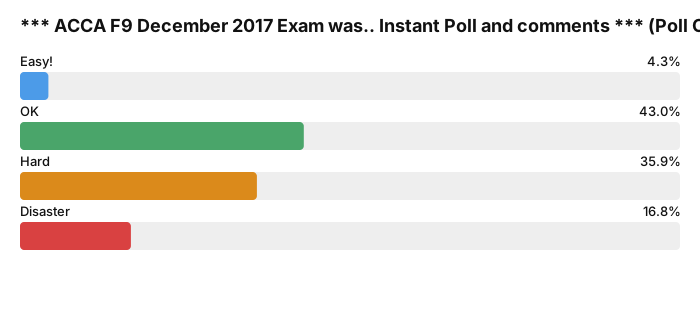
FM*** ACCA F9 December 2017 Exam was.. Instant Poll and comments ***
Not USD 3k, is around USD500+ you need to calculate the interest, not the whole loan itself
@maxxskeleton said: Not USD 3k, is around USD500+ you need to calculate the interest, not the whole loan itselfWhich question are you talking about?
It seemed Easy at thé moment but when reading your answers it looks obvious that i failed
Yes I chose closing account receivable the average balance will give a false operating cycle I think we always use the closing balance
MCQs for this paper were difficult in comparison to the LFQs in my opinion!
Was it correct to deduct 25% corporation tax off interest In wacc loan calc?
Which one is not element of working capital?
I chose ‘cash’ . What do you think?
Cash is a current asset though
I choose sales since its not an asset or liability
All the other options were assets or liabilities
@hits123 So for the nominal cash flows, i assumed you had to adjust for the inflation (contribution and fixed costs) and discount at 10%? I remember getting a NPV of 2.294m?
Then for the real cash flows, i assumed we didn’t adjust for inflation and use the discount factor of 6%? I think i got a NPV of 970k?
Also for the WACC did anyone get 12%?
Got approx the same for all 3 :O
I agree with your answers
@hits123 said: And also, even more frustrating when you do practice questions they quote the share price as ex-div which is what you need for the questions. Whereas in this paper they decided to quote in cum div? I assume you just minus the dividend to be paid from the share price to get the ex-div? Anyone else do thisyes i did it too
@gulush9128 said: Which one is not element of working capital? I chose ‘cash’ . What do you think?My choice was also cash - I was hesitating between sales and cash but i looked at the formula of cash flow cycle and the sales is an element of counting receivables days. So for me is cash. What do you think guys ?
For question 31 i got a WACC of 12% however i changed my answer to 23% as i decided to change my ordinary shares to 50 million x Share price!! The shares were already given in the question and the nominal value was given to put you off! Did anyone else do this?
Are you talking about the market value of equity? If so isn’t it no of shares x PO?
Yes the 50million ordinary shares given in the question
I went for sales as the element not related to working capital but the more I think about it now the more I think it’s cash. This is a typical ACCA mcq where you think the answer is obvious but it turns out not to be! So many of this type of question in this exam to trip you up.
@opentuition_team said: <h3>Please vote in our Instant Polls about the ACCA F9 December 2017 Exam</h3>Hi everyone. How did you calculate the Market value of the 6% loan note, with a nominal value of 100, cost of capital 9%? Hope I remember the figures right.Post your comments about the ACCA F9 exam below (comments will open after 5pm UK)

I second Andreea's question how did u guys calculate the MV for the 2 MCQ on loan notes
Or at least what option did u pick
I got around 12.27 % for my WACC.
For the nominal NPV I only adjusted Contribution and fixed costs using the specific inflation rates and then discounted it using the nominal discount rate.
For the real NPV I think I may have made a huge mistake coming to think of it now. I took the after tax cash flow from the Nominal NPV and deflated it by the general inflation of 4.7 percent and then discounted it using the real discount rate. Hoping atleast get partial credit for this.
Also in terms of the working capital cycle, I chose cash as not being an element of it because it is not used in any of the calculations. The options mentioned such as trade credit and sales are all used to calculate debtor days etc etc
I don’t remember correctly as to what I picked but if the loan note is redeemable you calculate market value by (Interest x Annuity) + (Redemtion x Discount Factor)
Did you incorporate the tax % anywhere in this computation?
If I remember well, the redemption value was pretax.
If that’s the case then you would have to take the post tax interest. Interest (1-T)
For the WACC calc the cost of debt was redeemable so essentially what I did was
Time 0 - Po
Time 1 - 8 I(1-T) discount at annuity
Time 8 - RV discount at present value
And then discount at two discount factors (lower and higher) and then work out the IRR = Kd (cost of debt)
@elenarus said: Agree with the "customers will buy cheaper abroad" and 2.4 years for the payback. What was the answer about the risk for purchases abroad (economic / transaction / translation)? I chose "economic+transaction".hopefully that's right, wrote the same answer.
I am sorry thats not the case. we use average receivables and not year end.
It was a company should accept a project based on roce only if it exceeds the target rate. The target rate may be the cost of cap ,but not necessarily. depends on what the management thinks is the best rate for comparative analysis.
we are calculating the value of the loan notes and not the cost to the company, thus we wont after-tax it. Its the amount at which the potential buyers value a load note and not the effective cost incurred by the co.
mcq's will be the key determinant i guess. Cause almost all of us screwed up the section c
it obviously was.
sadly, its sales. cash is why there is an operating cycle. The operating cycle is all about the time it takes for us to get cash generated out of our transactions.
Topic lockedNew replies are closed.