
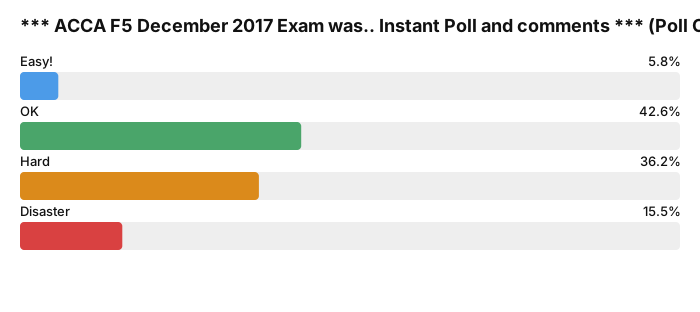
Please vote in our Instant Polls about the ACCA F5 December 2017 Exam
 Post your comments about the ACCA F5 exam below
(comments will open after 5pm UK)
 Post your comments about the ACCA F5 exam below
(comments will open after 5pm UK)
@jgoodall said: I got $110,000 for the Relevant Cost Question, as the machine could have been used to produce a separate product making $110,000, therefore being the opportunity cost. Last question i calculated Gross Profit Margin, Net Profit Margin, Interest Cover and talked about the 50% admin expenses, the compensation costs and the foreign currency fall of 25% etc. Anyone get what the Lifecycle Costing one was? I remember guessing that one.I got $370 for lifecycle cost
@viscera said: What was the answer for the quarterly rolling budget question... I choose 880,000 as 3 months in a quarter and increase was 10,000 per month .. I don't remember it all by I'm not sure I did it right... How foolish of me to loose 2 marks for a just a simple question as that if I'm wrong with 880,000 :(but it was stated that per quarter 10k increase not per month isnt it?!
@odean20 said: The learning rate is 75% D 38.6875/90^(1/3)This was for the 16th unit so it should have been to the power of 4 (^4) not ^3
@anastassiya777 said: The worse thing that we will not know the right answers for mcqs after so much discussions and opinions of it!:(I'm using Google to find out about the confusing ones I haven't come across. I've so far found the answers to a few. Sometimes ACCA also publishes some of the actual past questions in a specimen paper but of course every question won't be in one paper.
@musmang44 said: Quater question had something ti do with words like based on nedt quater so i choose 3 quaters amd added 880 ROI I CHOOSe both dnt knw knw i got very good roi valueDon't worry, there's usually a topic everyone's not good at. Mine is all the decision tree probability stuff. I was SO happy that it didn't turn up if anything.
@accountinglearner said: For the planning variance MCQ I got my answer as 1,000 F which I think was choice A. This one threw me at first, as normally we are given the raw data, (e.g. number of units, prices, actual quantities etc.), and we use these to compute the variances. However for this one they gave us the variance totals but not the raw data. I spent the first 15 minutes of the exam writing down all the variance formulae, throughput formulae etc. on the blank page of the question paper as I was worried about it all 'falling out of my head' so-to-speak. From these formulae I plugged in the numbers that we were given in the question and used simultaneous equations to eliminate the unknown 'raw data' parts of the formulae. So that I could get the last remaining variance.Yup, The Planning + Operational variances = Total Variance. I really hope this paper is a pass for me but you never know.
@aglong said: I'd be interested to know how other people approached the last question - as there was no BS sheet info, couldnt perform ROCE (etc.) calculations... apart from gross and net profit margin %'s, what other calculations did other people use? Thanks
@april04 said: Hi, I am terrified cause only 11 answers matches your and there is no chance i have passed it. Really annoyed with myself:(Hi, Based on the answers everyone's given/shared 10 of mine could be wrong too! I also remember you being scared about auditing results and you passed! I do think its more terrifying when you can only take the 1 exam every 3 months.. :( I've only got this and F7 left.
@musmang44 said: 15th question sales rolling budget ideas ? A b c d ? Something i think it added up to 3 quaters not 4 ??? 14 throughput one ? Ideas??increase by 40 so 890 best way is to draw a table with 5 quarters fisrtst 4 being first 12 months and 2-5 being next 12
@accountinglearner said: For the Sales Mix and Sales Quantity variances, I got that both of D6's sub-variances were adverse, and one of D7's was adverse with the other being favourable. Overall both were adverse. One of them was something like 1,911,545 A. The numbers I got were not nice and round in any way shape or form, if that helps others. I used £301 and £449 for the Standard Margin as the question was about an Absorption Costing organisation rather than a Marginal Costing organisation. In the last 20 mark question I forgot to calculate the Interest Cover like other people did, so that was a mistake. I thought from the top of my head that only GP Margin and NP Margin could be calculated from the P+L alone, but the Interest Cover could also be calculated. I did some adhoc, bespoke calculations like working through what I would expect the Admin Expenses to be if the computerised billing system really had saved 50% of expenses. Namely from the 20X6 figure of 14,000 I did: 14,000 x (9/12) + 14,000 x (3/12) x 50% = 12,250 12,250 was in the ballpark of the actual 12,600 20X7 figure, and so the machine was indeed helping to save roughly 50% of costs. So yeah, I'm not sure if random calculations like these are acceptable, even if they aren't official ratios if you see what I mean!I got exactly this answer, thanks for reminding me. I also did the add hoc calculations too with the same figures haha
@heychi said: I do think its more terrifying when you can only take the 1 exam every 3 months.. :(You can take two exams every three months if you like, but it is hard work. I sat my last two F papers this time round, hopefully trying to avoid being forced to take the CBE versions next year as I don't like the idea of having to do calculations using a computer when you spend your study time doing it on paper.
@heychi said: I included this and still got 50%.Yes i did the same as commision was indeed a variable cost. 44% was my answer
@accountinglearner said: For the final part of question 31, for 9 marks I calculated the sales price and sales volume variances for D6 and D7, and also looked at the 10% increase in market size for D7 and so calculated a revised budget for that one and computed planning and operational variances for it and then just made some comments about what I calculated. Hopefully that was a reasonable thing to do and that the marking guides are open ended enough to allow credit for doing that, as I must admit I was a bit lost as to what to do exactly.What was q32 ? Wasn't it asses the financial performance ? Like comparative results ?
@dipta3308 said: can anyone tell what the ans of 1st question... bcz in the question its said that manager are not complete his account... that's why I used traditional absortion costing... and my ans is d... is it right???? or is it with ABC set up cost is calculated with number of set up.. so what about the others costs....????It's activity based costing so the answer is A. If it was Absorption costing it would say in the question and you would not have the cost drivers and cost pools available to work with anyway.