Skip to contentSkip to search
Kaplan Publishing: Black Friday countdown

AAA*** P7 June 2015 Exam was.. Instant Poll and comments ***

Oopentuition_teamAdmin11y ago

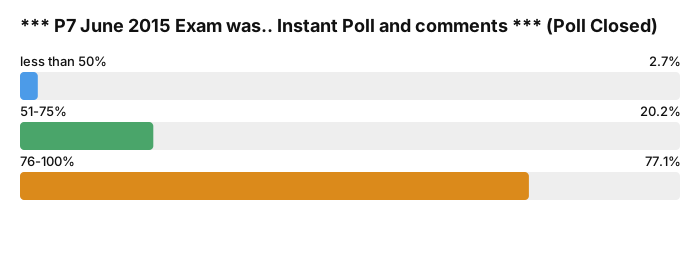
Please vote in our Instant Polls about the P7 June 2015 Exam.
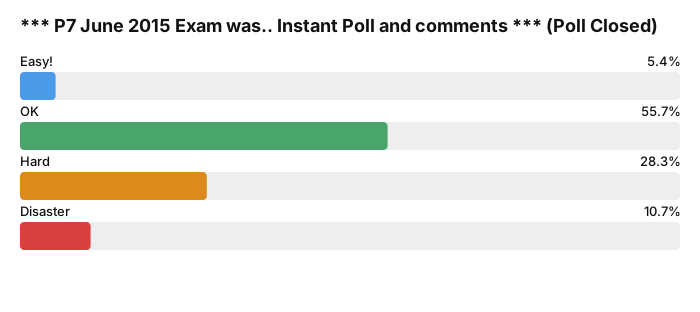
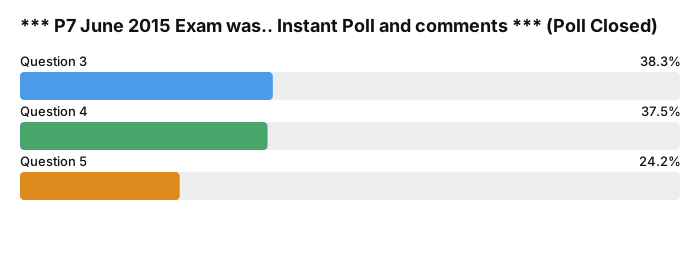
*** P7 June 2015 Exam was.. Instant Poll and comments *** poll results *** P7 June 2015 Exam was.. Instant Poll and comments *** poll results *** P7 June 2015 Exam was.. Instant Poll and comments *** poll results
Former userFormer user11y ago#31
Overall, I think the questions weren't too difficult, however the time was extremely pressured. Feel like I could have written for another 30 mins at least! Also, thinking about it now not too sure whether I have been specific enough in my answers. @tallaghthoop - I also touched briefly on possibility of money laundering in the Laws & Regs question, literally only 3/4 lines, just to be alert as to the possibility. If it's incorrect I'm sure we didn't waste too much time writing it! Very wordy paper, lots of standards tested. I hope to pass but think it may be very tight!
SSam11y ago#32
Very time pressured, answered the whole paper but meant sacrificing writing one or two final points on some of the earlier questions. MY HAND HURTS. Question 1 EPS IAS 33 Knowledge was rusty. Did think it was unusual they were adjusting profit after tax for amortisation and depreciation? is this not manipulating / inflating the earnings figure? I mentioned about bringing in prior year restatement for comparability, given it was not listed previously and this would not have been done - not sure if this was necessary? Sale and leaseback with repurchase was a little confusing with the "at market" buy back option. But if it were an operating lease they would be massively overstating the profit (through the profit on disposal)? Combining this with depreciation considerations for 3 months being stopped and the finance cost on the £35m loan (in substance) would be very material to the p&l? In substance it just felt to me that they were manipulating their year end profit by selling and leasing, so just played it safe and used IAS 18 / IAS 17 for revenue recognition and leases respectively to conclude it was an operating lease / not to derecognise the assets (£35m Proceeds - £8m profit on D for £27m NBV), adjust the profit on disposal and simply recognise a liability / loan with interest of LIBOR +2%. UK Variant was a pain as I assumed a 10:11:10 split with 4 professional on the marks (Does not show split in partner email) only to hear it was a 6:17:8 split... Bleak! Mentioned about cut off being a risk on revenue but forgot to slip in the deferred income issue even after noting it down in my plan! Was quite a few other risks I identified, namely overstatements of assets and income, understatements of expenses... Referred to ISA 510 items specifically only for first requirement. Hope that was what it was hinting at! Question 2: Can't remember what I wrote for first bit - all I knew my hand was starting to cramp up and fail! Acquisition in this question was fewer marks than the first part. Expected something to do with consolidations would come up and had IFRS 3, IAS 28, ISA 600 ready and waiting! Toxic chemical part was a bit hit and miss - will have to wait and see! Referred to ISA 250 and duties relating to non compliance and reporting, along with potential frauds / Money laundering given the shady nature of the warehouse manager - applying professional skepticism. Couple of ethics points on intimidation and confidentiality I noted too. Question 3: Professional skepticism was quite nice given the ACCA article. Focused mainly on that being linked with QC and lowering detection risk by obtaining sufficient appropriate evidence thus lowering audit risk. Used each example in turn to apply to hopefully crank up the marks after explaining it. Question 4: Some nice ethics, quality control ISQC 1 / ISA 220 stuff to slip in with professional issues too. Followed on nicely from the ACCA technical articles. Question 5: Took one look at the comment on construction contracts under IAS 11 and read no further. I assumed this was being replaced by IFRS 15 so what's the point, there is no way I am even looking at it for my P2 exam let alone P7!?
AAli11y ago#33
Funny we weren't tested on this many IASs in the P2 Reporting exam in December 14 but now in an audit exam, it was IAS after IAS after IAS :P
Sseagoat11y ago#34
Thanks for posting such good comments - they make me feel failed even more :)
SSam11y ago#35
@rebecca2 said: Overall, I think the questions weren't too difficult, however the time was extremely pressured. Feel like I could have written for another 30 mins at least! Also, thinking about it now not too sure whether I have been specific enough in my answers. @tallaghthoop - I also touched briefly on possibility of money laundering in the Laws & Regs question, literally only 3/4 lines, just to be alert as to the possibility. If it's incorrect I'm sure we didn't waste too much time writing it! Very wordy paper, lots of standards tested. I hope to pass but think it may be very tight!
Snap. I mentioned about the Money laundering, criminal activity, professional skepticism (Seemed to be a recurring theme in this exam, particularly after the ACCA article) given the nature of the products in the warehouses, the shady warehouse manager and the lack of evidence available for sales under £10k. Mentioned about not tipping off, MLRO, SOCA etc on this as well as ISA 250 non compliance etc
Former userFormer user11y ago#36
After reading the comments on here, I always wonder why I forgot such easy points in the exam and missed out on several easy marks that could prove vital haha! :-)
GGabriel11y ago#37
@seagoat said: Thanks for posting such good comments - they make me feel failed even more :)
Totally agree. What? Money laundering? I wonder whether I will reach 40%?
Former userFormer user11y ago#38
I found this paper to be decent and it went better than expected, I made it my mission to learn both Technical Articles on the ACCA site and was glad I did so, anyone who didn't would have struggled as almost 30/40% of the paper was based on this. Q1 a) with regards to planning an audit, specific matters which relate to an initial engagement should be considered, these include vetting the client, ensuring that management has integrity, contacting the previous auditors and checking the audit file for any issues that arose last year, the firm also needs to spend more time learning about the business and industry to assess the business risks and ultimately how much resourcing and time will be required as a result. b) with regards to risks, I made use of several IAS/IFRS's (I knew all IAS's by heart - atleast 25% of the paper was IAS/IFRS related), the suprising one was IFRS 8 - segmented reporting since the firm generated 25% of it' revenue from the internet, IAS 32 related to financial instruments for the presentation of the short-term investment, IAS 33 related to EPS, the method they used was flawed, you don't add back dep and amortisation. IAS 16 relates with depreciation in addition to this IAS 8 deals with any changes in accounting estimates, so a potential adjustment to comparatives could have been required, IAS 38 - Intangibles, amortisation should be done over the UEL of the asset unless it has indefinite life in which case impairment review should be done atleast annually. IAS 24 - related party transaction, since the director and his family had 30% shareholding in the company there is a chance these could have taken place and were not reported. c.) Procedures for the short term investment included enquiring why market value not used, obtaining written representation for this, checking bank statement / cash book to reconcile the $8m paid for the shares and checking the market value at that date using online information / newspapers, Procedures for EPS, redoing the calculation, written representation for method used, why is depreciation and amortisation added back, ensuring correct values used for dep and amortisation. 2. a) This was initially a sale of asset through IAS 16, but then it involved a leaseback in accordance to IAS 17. b.)Sub treated as an associate, IFRS 3 - Business combinations to demonstrate why it is not a sub and why there is not control, and then IAS 28 - investment in associates to demonstrate significant influence and use of equity method. c.) Possibility of the hazardous chemicals being a breach of the country's law, auditor has responsibility to inform relevant bodies, should maintain confidentiality and only report what is needed to, may resign from audit if company is breaking the law, should seek legal advice if going down this route. Intimidation threat by warehouse manager, should whistleblow to the audit committee / those charged with governance. Also generally poor controls as customers in whenever they want and no documentation, increases audit risk, may need to perform more procedures. 3. a) Pro scepticism (she spelt it wrong :P "skepticism") is the attitude that includes having a questioning mind, being aware that circumstances may exist which indicate fraud or error is present and critically evaluating evidence. It is used in the planning stage to ensure that management has integrity, when performing the audit it needs to be used especially if there is a lot of judgemental / subjective matters and when reviewing evidence, looking out for any contradictory info. b) Check with internal audit head that it is plausible, matters could have changed since last year to indicate that method is not plausible, previous audit team may not have paid enough attention and taken assumptions at face value. c) Procedures for impairment, recalculate to ensure you get same amount, ensure goodwill figure calculated correctly, ensure same assumptions used as last year, obtain written representation towards the impairment assumptions used. d.) Steps in forensic audit, interview two staff, interview internal audit and review their findings, try to quantify the potential loss, check bank statements / cash books for evidence, use complex analytical procedures to uncover, document everything and check dates as to when payment was made and contract signed. 4.) a) Intimidation threat, not extending fee even though more work, cutting corners = lower audit quality as lower sampling size and higher materiality this increases audit risk, firm needs to ensure it reviews the work and has quality control in place as recommended by ISQC 1 / ISA 220. b) Offshoring can reduce cost but chance of lacking audit quality, overseas staff do not have access to the same as client based team therefore less information on which to do the work. Reputation of firm may also become damaged and staff may not be competent, should check to see that staff are competent and potentially send an audit senior to review their work, if not possible - consider shutting down this operation (overseas operation) c) Russell has an interest in the company at the date of FS, so he has self-interest, even though the firm has taken a safeguard to keep him out of the audit team, he is advising Lestor and therefore the threat is still present, this could deter objectivity. offering non-audit services could pose a self review threat, offering targets for non audit work given, could damage the reputation of the firm as clients could perceive this as just a form of money making. -- That's what I remember
Mminaa11y ago#39
I pretty much wrote what you wrote in the whole exam. :p I had gone through the articles as well. Didn't mention segment reporting though.. Mentioned the increase in development costs this year in Q1 audit risk and that it should be checked weather all amount capitalised meet the criteria according to iAs 38. mentioned poor corporate governance as no internal audit, audit committee and only 1 NED. Lack of internal controls as its a newly listed company. The reason why previous auditors resigned. It could be due to the fact that company has grown and the previous auditors didn't have enough resources but should be confirmed. EPS wasn't right and was material. Forward contracts, the risk is high as its a complex area and should have been written down to their fair value.
Former userFormer user11y ago#40
Q1i messed up the first bit. I somehow froze and decided to leave a blank space after email introduction. Then i continued mentionung 8 audit risk including ifrs 9 financial instrument, ifrs 7 fi disclosure, ias 33 eps, new audit client detection risk with short isa315 discussion, poor internal control, ias 18 revenue recognition matching of risk and rewards etc., compliance risk since the company is a newly listed entity etc. Then i came back to the first bit also discussing inherent risk of incorrectly recording sales, fx risk etc. Complexity of financial instruments, fi has to be disclosed. Audit procedures such us obtaining board minutes, recalculating eps keeping an eye on items that may affect eps calculation ie profit attributable to shareholders such as the depr and amortisation adjustment and perhaps possible manipulation on number of shares therefore shareholder list must also be obtained. Procedures on investment portfolio again board minutes has to be verified for any mention of this investment, check the bank statement, discussion with management re investment strategy, review financial statement for disclosure Q2
Former userFormer user11y ago#41
@Minaa said: I pretty much wrote what you wrote in the whole exam. :p I had gone through the articles as well. Didn't mention segment reporting though.. Mentioned the increase in development costs this year in Q1 audit risk and that it should be checked weather all amount capitalised meet the criteria according to iAs 38. mentioned poor corporate governance as no internal audit, audit committee and only 1 NED. Lack of internal controls as its a newly listed company. The reason why previous auditors resigned. It could be due to the fact that company has grown and the previous auditors didn't have enough resources but should be confirmed. EPS wasn't right and was material. Forward contracts, the risk is high as its a complex area and should have been written down to their fair value.
Very nice ;), yup - I also mentioned the massive increase in development cost and there is a risk that research cost could have been expensed as well, also profit was much higher than last year so I did mention that as well, obviously it being a new audit that is also a reason for risk, I mentioned that 1 NED and no internal audit means control risk is high which is a component of audit risk, more procedures may be required. Also existing auditors left after issuing the audit report, they completed the proactive part of subsequent events but not the reactive, this could have caused an adjusting event which wasn't picked up. Lol, I really tried everything. And yeah, EPS is material by nature as important to the users Good point on the forward contracts, I missed that one :P, lucky bugger got away!
Former userFormer user11y ago#42
I share the feelings,Snowia!
Former userFormer user11y ago#43
Q2 i considered it as a finance lease. Ias 17 mentioning risk and rewards checking evidence such as lease agreement B. Question on why a 52percent shareholding on a company is classified as an associate instead of a subsidiary. Test of control, voting rights etc has to be scrutinised. Subsidiary has to consolidated in the group financial statement. Check items that have something to do with ifrs3 business combination such as goodwill, NCI, fv of na acquired and perform additional audit procedures on this. C. I touched up a little on money laundering - mlro, training, not tipping off, duty to disclose info, possible misunderstanding with management, obtain legal advice as we may already have tipped off the client. For 4 marks i mentioned few info re bribery act 2010 and 6 principles to avoid the bribery incident from happening. Management commitment, proportionate procedure, due diligence, risk assessment procedure and so on. Poor internal control having possible illegal activities in a property own by the group.
Former userFormer user11y ago#44
I also mentioned possiblw overtrading since the revenue has increased significantly by 43 percent but not in proportion with the the cost of sale having staggering 62 percent increase on gross profit.
Mmichael11y ago#45
For the exam I sat Q1/2/3/4. Q1 - found standards hard but made 12/13 subsections on risks in regards to the audit. I watched a video at the weekend stating the examiner wanted application to the case study , application to the company. I mentioned that the company is a gaming company. Lots of shift to the digital side, so no physical copies. Could make the audit more riskier. May not be able to recognise properly. Talkked about company being recently IPO. How expensive this is. Risk that company will have much more costs and paperwork may not be able to afford audit Some general points in relation to the audit Risk of timing staff experience do we audit a competitor in the market Also mentioned the licencing. Stated there was a five year period on the case study. No mention of when it was up as it was a significant income. I discussed this Talked about the investments. Stated that it is understandable within the market they are in (New technology) but must be seen properly. Risk is the accounts are not properly stated and the audit may not be done fully correctly. Mentioned about 5/6 other sub headings but I used standards throughout the paper and just panicked a bit on Q1 (first time doing p7.) Still, done 3/4.pages on 1A+B. Thought 2/3/4 was ok if I'm being honest just want the 50%!
Rrawfay11y ago#46
Q2 part B was not about money laundering i.e. ISA 240 auditor's responsibility regarding fraud and error. It was about ISA 250 laws and regulations. i.e. what an auditor is required to do if came across any non compliance.
Ttallaghthoop11y ago#47
The scenario was vague plus there was 9 marks going for it which suggested it was more complex than just auditors responsibilities to fraud and error. I mentioned ISA 240 and how its changed but the scenario was so poor in the real world, i just asked myself whats going on here?? or what could be going wrong - so I went with the income as being a cover for money laundering i.e. stolen property and people coming and going..so very open to us to consider.
SSam11y ago#48
@rawfay said: Q2 part B was not about money laundering i.e. ISA 240 auditor's responsibility regarding fraud and error. It was about ISA 250 laws and regulations. i.e. what an auditor is required to do if came across any non compliance.
I agree, reckon ISA 250 was the main focus but I think it hinted at potential criminal activity and the proceeds being the revenue (not being substantiated under £10k). Might have been implied / undertone? I just added it on as an additional discussion point.
Former userFormer user11y ago#49
This was by far one of the easiest P7 exam question papers ever. Too bad this at a time when I was heavily underprepared, could have easily aced it if this came out in the previous session I attemped it in. That said, P7 always looks way easier than it actually is. The exam marking is pretty darn tough. I think I rushed the entire last question, question 5, which was a fairly easy question on audit reporting. Time management fail as always.
Mminaa11y ago#50
Haha, I thought the question with dangerous chemical storage had a lot of marks, couldn't come up with points worth 9 marks :( But anyway, I can't be too sure for theoretical paper until I see the results. :p
Ttallaghthoop11y ago#51
Looks like your going to get 100%
Former userFormer user11y ago#52
The more i read commebts here the more i think i did not manage to write enough on q1!!
SSumati11y ago#53
Hey guys! Exam was okay but few of the parts were difficult for me. I did question 4 n question 5. And I found them quite easy. It's only like sometime during the exam, I couldn't focus on time management. Hopefully I'll pass.
Ssanket72311y ago#54
Q1 C) what primary audit procedures for audit of financial instruments and EPS (used in the case) Q2) ethics / independence and ISA 250 Q3) Professional scepticism and fraud Q4) Ethics, independence, audit fee and quality Q5) Audit opinion and construction contracts (IAS 11) Overall exam was ok, nothing tricky or unexpected, only challenge was to manage time and limit the writing..
Former userFormer user11y ago#55
Tricky paper to say the least, but fair in the most part. Did 1,2,3,4 and found that question 3 was my best attempt. The professional skepticism part was something i felt that i was strong at "elaborating" about, but only 6 marks though. Managed to use very pertinent clues in the passage such as "oil extraction biz - to elaborate on recent downtrend in oil & gas industry, likely to be impaired further", "decline in profits of circa 33%, compared to impairment of less than 1%, suggests over optimistic assumptions" and a few other points.. Question 1 was was tough for me as the 17 marks Audit Risk requirement shocked me at first. Managed to only write out 9 points for this and i doubt i'd score more than half for this section. Hope to get the professional marks for my decent format! For question 2, sale and lease back with substance over form points kept playing in my head, however, i couldnt find the right words to elaborate my points, ended up skipping the explanation and went straight to audit evidence. I hope the examiner could give marks for this! I had around 30 mins left when i attempted question 4, couldnt complete the 5 marks in the middle on time but overall attempt was decent for the other two parts. Hope to pass!
NNasrullah11y ago#56
the paper itself is not hard but lenghty and time consuming.I have to rush thorugh question 3&4 in the last hour of exam.I hope it worked well.lets see.
Vvimis11y ago#57
it was a good paper and the examiner is unpredictable.This makes ACCA to be an interest Career.paper was good i managed to attempt every question.so it else remains for the marker to judge. hope for a 50% and be a member
Nnz11y ago#58
ELLA, Congrats, 101% :-)
Aalice1011y ago#59
Oh dear I misread Q1 a I thought it was around internal audit l!! Damn 6marks lost! Hope I picked it up in the rest of the paper I'll try not to panic too much!!
Kklown11y ago#60
I voted "okay", to be honest I couldn't have asked for better questions, consider how tough it could have been, that was definitely an "okay" exam. I ballsed up the first have of Q1 and wrote more about tendering that audit planning, but thankfully that was only 6 marks, and I thought the rest went well. Knew Q5 was the one to avoid straight away when I saw construction contracts and integrated reporting. Q3 was best question for me, the professional scepticism was straight forward and had revised forensic and goodwill quite a bit. Hopefully a pass, would be gutted if I've failed because the questions will no doubt be much tougher next time.
Topic lockedNew replies are closed.