AFM*** P4 December 2015 Exam was.. Instant Poll and comments ***
@sam04071989 said: It was a dollar receip Question 3 Think I misread the question. The hedge was related to a 20.56m Euro receipt in 3 months time. You decide to buy or sell wrt the contract currency. Contract currency was in Euros therefore you would want to translate the receipt into dollars (buy dollars) hence sell the Euro contract currency. Surely this would be go short on the futures contract (sell futures)? Similarly this would be a put for the options, no? Got forward as best rate to use and then explained if the rate had increased above 1.3500 to c1.3600 or 1.3700 (they gave the indirect rates and direct rates, so I just converted them so they were all comparable and consistent: (Direct rate = 1/indirect rate)) then this would have made the option worthwhile as the premium paid would have been outweighed by the exercised option. Think I may have got confused in the heat of the exam as a result of the contracts being put compared with many example calls in the question banks.I did the same for Q3 contract size was denominated in euros therefore it was sell futures now and buy later at the date of the spot transaction in 3 months time had to calculate the futures price using the basis i guess. did any one else did the same thing? For options it was put options since we had to sell the euro contracts. What did you guys make of the part b of this question?
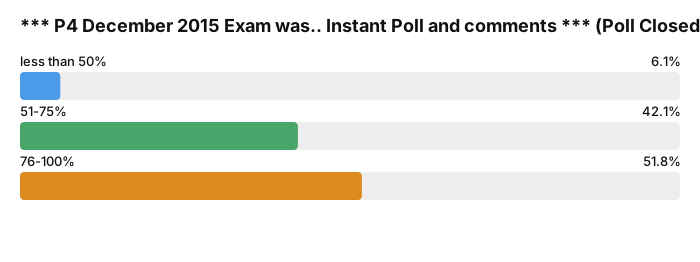
Sam, you averaged 74%?? I averaged around 51% each time, hope this will be the same! Or even better!
Few things I've got, Q1 WACC 9%, Q2 Wacc 14% after using fisher model, Q3 sell futures. Hoping to collect easy marks from theory questions!!
I got WACC 14% for Q2 also
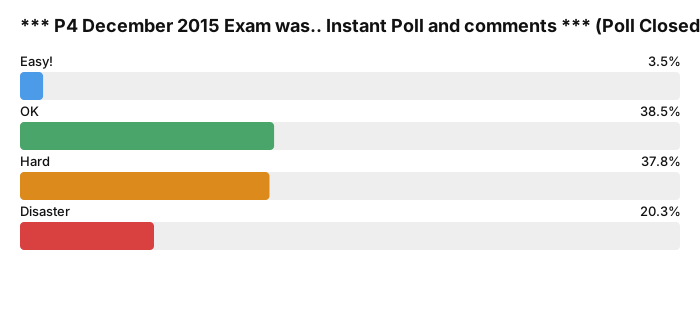
Was easy paper but a bit lenghty
@harriet88 said: Sam: you averaged 74% in your other P papers? I don't think you will have trouble passing :) is this your final? What other option you choose?Yeah - final exam! Potentially the final exam of my life (Hopefully - unless I decide to do CFAs...)! Really don't fancy re-sitting in March given it's my busy season so would probably end up waiting until June which would mean another 6 months on non-qualified salary... £££ I did P7 as the other option - employer gave me no choice and had to do the UK Variants for P2 and P7 which were a hassle learning the international stuff as well as the New UK GAAP / UK based info too. What did you chose for your option or have you got it left to sit?
Other option was P5 which I sat on Wednesday! Fingers crossed never have to sit one again!! Did you sit P7 this sitting or last?
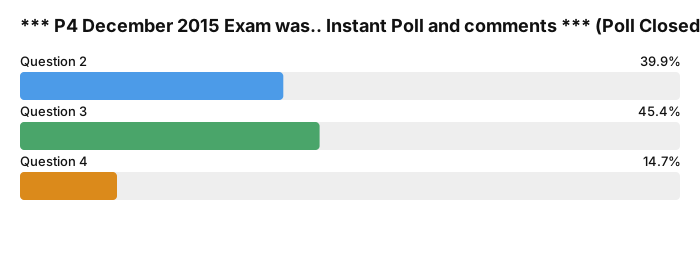
hey guys, its like no one attempted question 4.
question 4 was the easiest on paper if you read the recent article by the examiner on securitization and tranching and also islamic finance. The question really was a give away. except for the a part which involved a bit of calculation and that also was a bit strightforward.
the capital rationing was easy but didnt revise it so just wrote anythin i could but luckily it was worth just 5 marks. the investment appraisal and the discussion was quite straightforward too.
number one the beast, obviously i dont think anyone has ever got 50/50 in the number one p4 question so you are bound to make mistakes because of the time pressure and all. so it was more of like perform up to where u get stuck and then leave it. the easy marks where in the discussions and had nothing to do with the mathematics of p4. it was more of like reading the scenario and answering the questions. the method and assumptions used can also gain some marks.
so all in all i think it was an ok paper if u had read the articles but if not it would have been a tough nut to crack
I did Q4 based on reading the articles also Jigsaw! Stayed away from the forex as the other two looked far easier!!
Why I am not getting all your talks about forex? I got 27.95 something for forward which was the highest so was appropriate. Secondly q4 was fairly easy. Ditto GoSlo Motors from previous attempt. Q1 part a i is stupid. Examiner has given us the information which was cannot be used. So much assumptions are made. Lets see
dis paper was fair...q4 was easy cant believe people didnt go for it.it was examined in 2009 or 2010 same concept just change in percentages of the tranches. hoping for a pass
Q4:part a based on the last article was the easiest one.calculation was easy(so 11 marks in bag)
Part b(6 marks)
Risks:(i think in dec 09)
1-correlation risk:it is assumed that defaults in the assets side of tranching is uncorrelated.
2-timinig and liqidity risk:fulfilling the obligation of various tranches depends on the timely cash reciept which is difficult in "waterfall" cashfliw modeling.
3-default and collaterasiation risk:success of securitisation depends on the quality of loan.it is crucial to have a proper credit assessment process and cotrol over loan negotiations.
(I myself donot know what are these....i ONLY keep them in mind from past paper and write it on the exam paper...as the possibility of tranche question in exam was 100%...because of new article)
Benefits for moonstar:
1-it can get in money required QICKER
2-it cannot issue shares(said that the major shareholder is not agree) and also it has a poor credit rating(it cannot borrow) so this is the best way
3-it removes risk to trancheholders
C-i:Sukuk...i dont know(lose 4 marks)
C-ii:Mudaraba:(4marks)
Bank provide capital and moonstar bring expertise.bank is not allowed to participate in decision making.profit is shared between two parties according to pre agreed rate but all losses should be beared by capital provider ie bank.
Bank may concern about it because whilst it provide money,it cannot take part in decision making.all losses should be beared by bank.
Since it is not the money of moonstar and all losses are beared by bank so moonstar may take more risky decision which is more possible because bank is not allowed to participate in decision making.
HI all.
Hope all will pass this time InshaAllah. Will anybody pls confirm the %age for collateral allocated for securitization in Q4. I am bit confused whether it was 90% or 75%.
Thanking in advance
Hi Obiora06. I think very few people attempted Q4. luckily u r the one. do u remember what %age was allocated for securitization as collateral?
thanks
Q1 is not hard but quite long. I solve Q2 & Q3 first, and then not enough time to solve Q1. 28 marks not attempted. Time management problem again :(
% of collateralise was 90
75% was the percentage of shares hold by a family as a major shareholder as was irrelevant to the collateralisation
I think q3 we were buying therefore it was call option
@juve it was 90% of 200m
Yes...
.90*200=180
Does anybody have any ideas regarding mark distribution in Q1-b(I,II,II), Q2-a and Q3-a? My main concerns are the proportion of text/calculation marks and required volume of text per 1 mark for explanations.
mate please condider this
the downside of tranching is, the company can only issue a percentage of the total receipts to serve as incentive to subscribe the loan, in the exam it was 80% i think
too much costs involved in setting up the programme
it can send bad signals about a company cuz if u hear that a company is doing tranching, this means the company desperately needs cash and is willing to loose some of the receivables 20% just to get the 80% cash and this can cause share price fluctuations
sukuk is islmaic bonds,
the only difference with coporate bonds is that sukuk there is no interest paid annually. the compensation is in the form of sharing of gains made by the issuer of the bond in the investment he made the gain. if he made no gain in the investment then the bond holders get nothing.
this means as a company issuing sukuk bonds u must have had a good history of being a good business company so that all bonds can be subscribed for.
80% question 4 was by far the easiest on paper if on had read article on securitization and islamic fianace.
@Obiora and Juve: Thanks brothers. You made my day. I used 90% as collateral pool as well. InshaAllah we all will get through. great start of the day. Just woke up after a good long night sleep.
q3 was provided euro options. how can a company buy euro put now if it does not own any euros?
in the previous questions its usually buy call options of home currency. US company receive euro in future needs buy us$ Call to hedge against euro depreciates.
im really confused can anyone help to clarify?
@yanchen15 you buy put option to hedge Euro receipt because the contract currency was also in Euros. So when you receive Euros on 28th Feb you will sell those euros to money changer/bank to buy $s. As contract Currency is also in euros so you will buy 164 Put Options. so the decision on whether to go for PUT OR BUY IS BASED ON WHAT YOU ARE DOING WITH CONTRACT CURRENCY. iN SUMMERY IF SEELING CONTRACT CURRENCY THEN PUT; AND IF BUYING CONTACT CURRENCY THEN CALL.
@faisal1990 said: I did the same for Q3 contract size was denominated in euros therefore it was sell futures now and buy later at the date of the spot transaction in 3 months time had to calculate the futures price using the basis i guess. did any one else did the same thing? For options it was put options since we had to sell the euro contracts. how many contracts did you get for options and futures
@harriet88 said: Other option was P5 which I sat on Wednesday! Fingers crossed never have to sit one again!! Did you sit P7 this sitting or last?Nah, I just sat P4 this time round. Did P2 and P7 together, then P1 and P3 together in December 2014. Fingers crossed! 18 January are results right? P7 seemed a significant amount of writing for the amount of marks, but is to be expected given it's a wordy paper! How was P5?
@sam04071989 said: Nah, I just sat P4 this time round. Did P2 and P7 together, then P1 and P3 together in December 2014. Fingers crossed! 18 January are results right? P7 seemed a significant amount of writing for the amount of marks, but is to be expected given it's a wordy paper! How was P5?P5 was ok but find it difficult to understand what they are asking so might be a re-sit
Anybody remembers what was q1(d)
@esoluyemo said: You will divide all of them. You buy futures and not selling futures. You will sell futures if you are borrowing or making payments. Here, you are expecting to receive payment in Euro and the bank is buying dollar. This means the bank is buying futures.I did the same, but got confused with futures calculation and ended up getting really long figure!
In terms is of Q3 - did it ask to just set up the hedges in relation to FRA,Futures and Options not to show the result of the hedges?
Might be wrong here but I just set up the hedges using the three questions for Futures and Options,
1, Buy or Sell
2. how many conts
3. which date
Am I on the right lines or have I missed something?
Also thought the discussion section was worded funny - found it difficult to ascertain what they were after.
So i describes the benefits of using derivatives to reduced Forex risk and then I described the difference between treasury and finance department and the benefits or having the sep department. My writing by this point was horrific though due to tiredness - hope this can be overlooked.
Additionally i would advise anyone to tackle section B first as section one is very time consuming and can bog you down from collecting easier marks on shorter questions when you are fresh.
Topic lockedNew replies are closed.