
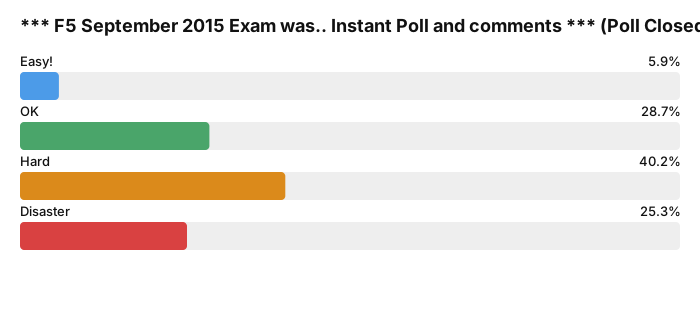
Post your comments and vote in the Instant Polls about the F5 September 2015 Exam.

@umerr786 said: I had $110 as relevant cost, but it just seems wrong and didn't cross my mind during exam that labour was in employment anyway so they would be paid regardless, so the only relevant cost should be the lost contribution which is $40Agreed, although it's more annoying that we will never find out the answer.. For question 4, I did the optimal mix, would I be penalized for this? I worked out the contribution per unit for each product, then ranked them, then I worked out the cumulative revenue/ contribution. I still drew the constant mix line as it is from the fixed cost up to the cumulative revenue, so I assume I still get marks? Need to get an idea so I know what to study for in December.. :(
 Former user11y ago#96
@beataziobro said: Examiner was asking for breakeven chart this is where the total revenue line cross the total cost line, for multiple products you must cumulate units, costs and revenue and then draw lines, this is normal chart not cvp. the next subquestion was what would happen if the products were sold starting from the most profitable first, when you draw cvp you start from the most profitable one so they wouldn`t ask for this if you had to draw cvp chart.so are you saying drawing a PV graph would not score marks? Did all the cumulative revenue etc.
@beataziobro said: 110$ in relevant cost is the right answer and end of story. They were saying that workforce is working in full capacity so relevant cost in this case must include variable labour hour cost plus any associated variable overheads (weren`t mentioned so 0) and any contribution forgone. If workforce was not working in full capacity than the labour cost wouldn`t be relevant if they are paid anyway. All other information about strike were just distracting from getting the right answer.Labour was working on full capacity because they were on the other project which generated a contribution of $4 per hour. When we take them off the other project that means labour would have free time which can be used on this project. Labour will be paid regardless whether they work on 1 project or another, so i dont see this as an incremental cost. I would love it if the answer is $110 because that's what i got but looking at the theory I think the relevant cost is the foregone contribution $40
@abuzer said: This my third attempted I think fail also what I should do just leave F5 and I should try other papers like F7 or F8 or I should try F5 fourth time I'm really frustrated. last Lune I passed F6 by 73 scores in June 2015 but I was fail in F5 by 40 in December 2014 .You'll have to pass them all at some point. Just keep trying and eventually you will get through!
@beataziobro said: 110$ in relevant cost is the right answer and end of story. They were saying that workforce is working in full capacity so relevant cost in this case must include variable labour hour cost plus any associated variable overheads (weren`t mentioned so 0) and any contribution forgone. If workforce was not working in full capacity than the labour cost wouldn`t be relevant if they are paid anyway. All other information about strike were just distracting from getting the right answer.Wrong! The variable cost of labour is irrelevant as it will have to be paid anyway, regardless of the work they do! Moving them on to a different project merely results in a loss of contribution from the work they were originally supposed to do.
@theimaginarynumber said: Wrong! The variable cost of labour is irrelevant as it will have to be paid anyway, regardless of the work they do! Moving them on to a different project merely results in a loss of contribution from the work they were originally supposed to do.Didn't the question say the workers were on strike. So what contribution is being earned while workers are outside picketing? ZERO. A project must be completed and current staff are unavailable (strike). Therefore the additional cost will just be the labour required for the project (from agency staff). There is no contribution forgone from the other project, as striking staff cannot return a contribution.
@siknagudruole said: Kaplan revision kit-Labour is in short of supply so it is an opportunity cos +contribution forgone. I have posted exampe from open tuition notes in my previous post showing both cost should be included, so it is 110. Two of them cant be wrong.BBP study Book has the similar example and the labour cost is relevant cost plus contribution forgone. I know it doesn`t seem to be logical but this is how it is. Who got 110$ got it right.
@abuzer said: I know I should pass them all but my question is can I do F5 later and Just try different paper Like F7 or F8 or F9 because I tried F5 three times but I didn't go through. I'm really I need someone to advise me. I will be appreciated it.I did my F7 just after i passed my F3. I'm sure you can do any of F1-F9.
@abuzer said: I know I should pass them all but my question is can I do F5 later and Just try different paper Like F7 or F8 or F9 because I tried F5 three times but I didn't go through. I'm really I need someone to advise me. I will be appreciated it.I think the lost contribution didn`t matter. If you supplied 600 but were sold only 500 this means that contribution was 500*5.20 - 600*1.80.
@nishmaster said: Hey all, Demand not given in the Flowers question, but all you had to do, well I think this is right,is to multiply 500 supply by 5.20 per bunch and then 500 by 1.80 and add up...same for 550, 600 and 650. Then for the ones where demand was more than supply you had to find lost contribution of the bunches that could have been sold. The multi product breakeven should have been 5 lines - one from fixed cost to breakevenm then one each for C, T and R, each line getting less steep, then a line for constant mix going from fixed costs to the end of the last line. The MCQ's were slightly unfair - really surprised that there was even a graph for one of the questions! Overall an OK but unfair paper with a few very complicated questions such as the flowers question!!!I think the lost contribution didn`t matter. If you supplied 600 but were sold only 500 this means that contribution was 500*5.20 – 600*1.80.
@beataziobro said: from the link it indicates that should be 110$. Labour at full capacity-can`t hire extra staff-relevant cost is contribution lost plus variable labour cost.I bet we going to get someone who will post "No/Wrong" it should be $40 :)
@tarunkumar said: @JIMBOB, Ref. to question for Variances, the Budgeted Selling Price was given right at the begining of the question and the actual selling price somewhere near the middle of the question, There are various ways of calculation, I used the Actual Units Sold and Multiplied it by Actual Selling Price and Actual Units sold multiplied by Budgeted Selling Price, if memory serves me right the variance was adverse as the Budgeted SP was higher than actual SP hope this helps.I think budgeted selling price was $16995 and actual $16000 with budgeted sales of 140 and actuals sales of 154
@siknagudruole said: I think budgeted selling price was $16995 and actual $16000 with budgeted sales of 140 and actuals sales of 154For sales price variance did you use std. contribution or std. selling price?