

Skip to contentSkip to search
Kaplan Publishing: Black Friday countdown

PM*** F5 December 2011 Exam was … Post your comments and vote in Instant Poll ***

Oopentuition14y ago
Post your comments about December 2011 F5 exam.
What came up? How did you do? How did this paper compare to previous exams?

Vote in our Instant Poll
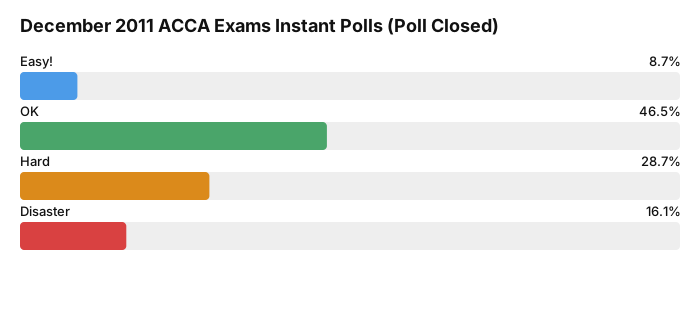
*** F5 December 2011 Exam was … Post your comments and vote in Instant Poll *** poll results
Nneilsolaris14y ago#91
I think you're right Laura, a learning curve should occur just once, which is why I hesitated. In the end I thought I'd better answer it literally, just in case there was a change of staff at the beginning of year 3, or the unit was adapted. Hopefully I won't lose too many marks though!

I realize now I may have made another mistake! Did it imply that the steady rate starts on the 101st unit, not the 100th unit? I assumed the latter, but I think you're right.
Ll_ACCA14y ago#92
@chimen said:
I think the right method should be
calculating ‘cumulative average for 100 units x 100? and ‘cumulative average for 99 units x 99?. Subtract one from another and get the time for steady state which I then applied for the remainder of units, i.e. 299,900 units.

Well, I think it said "learning curve applied for the first 100 units" which, in my opinion, means that steady state starts from 101st unit therefore we had to find time taken on 101st unit to know the time for steady state per unit. Well I don't know, maybe I misread the question:/ We'll see when answers are published.
Cchimen14y ago#93
The question said that learning curve effect apply for the first 100 units, which means manufacture time for 101st unit must equal to 100th unit (no more leaning curve effect for 101st). Hence, the steady rate starts on the 100th unit.
Former userFormer user14y ago#94
oh no I think I may have applied the learning curve to year 2 and 3.
I used the same method as Chimen that the cumulative average should be calcualted for '100 units x 100' subtract '99 units x 99' for the 100th unit.
Ll_ACCA14y ago#95
@chimen said:
The question said that learning curve effect apply for the first 100 units, which means manufacture time for 101st unit must equal to 100th unit (no more leaning curve effect for 101st). Hence, the steady rate starts on the 100th unit.

Yes, that makes sense.
Hope I won't loose lots of marks on that as it was purely misunderstanding of English :(
Former userFormer user14y ago#96
Here the exam of dec 2011
https://www2.accaglobal.com/pubs/students/acca/exams/f5/past_papers/f5_2011_dec_q.pdf
Former userFormer user14y ago#97
Will there be any body who will work out the model answer since the Qns paper has been uploaded :)
Nneilsolaris14y ago#98
Now I've re-read question 4 without the pressure of the exam I can see I misread it, it's not at all ambiguous. Hopefully I won't have lost too many marks.
Aasifrox14y ago#99
@hadpole said:
Will there be any body who will work out the model answer since the Qns paper has been uploaded :)


yeah :D
Former userFormer user14y ago#100
@asifrox said:
yeah :D

who will be uploading it? and by when? :)
Yyifanyang14y ago#101
Didn't think this exam was that hard, just the questions that I'm strongest at like ABC, Target Costing, Throughput, Limiting Factor, Quantitative Analysis didn't come up

1) Relevant costing

This was quite straightforward, just had to identify which costs would be incurred as a direct consequence of undertaking the project and which costs can be classed as sunk costs and ignored. I added the opportunity cost of not being able to sell the old swipe system as a result of undertaking the contract, not sure if right or not.

In part b, i made a not of the fact that the $500 penalty for late completion of project X can be avoided by completing project X first and then starting the Push Co project as they had no work lined up for a weeks time


2) Transfer pricing

a was relatively simple, prepare profit and loss statements for both divisions and then combine to give a company profit and loss. think I made a mistake of including divisional profit and losses in the company profit statement, probs couple marks lost

for part b, i took the optimised transfer price to be $65. this is because A has autonomy to buy the same part externally for $65 so if B charges anything more than $65, then A would simply choose to buy externally.

part c, I think I worked out that at a transfer price of $65, A would see an £800,000 increase in net profit while B would see either a smaller increase or even a loss. I said that even reducing the transfer price to $65 would benefit the company overall, B would be unwilling to accept because it would give them poorer profit figures. Didn't provide a reasonable recommendation though so probs couple marks lost.


3) This was tricky, never seen a question on budgeting quite like this so just improvised and wrote down as much as i could.

For part a, think the objectives I wrote down were set targets, control, performance evaluation and forecasting. Gave a little explanation on each

For part b, i took participative style of budgeting as a 'bottom-up' approach so briefly explained what it was and the benefits


4) Lifecycle cost

a was fairly straightforward, calculate total costs and then divide by numbe of units.

b, i made a little mistake on the calculation of the time taken for the 100th unit, small mistake, hope they don't punish me too much.

c, Just wrote jibberish, I said that by using lifecycle costing, you are able to estimate the costs of the product throughout the whole life cycle thus, able to prevent overspending during r + d and under pricing during product launch. Also said something about cost gaps and ways to reduce although thats probs completely irrelevant, only 4 marks tho.

5) Variance analysis, pretty easy, only one which i might have made a mistake on is the set up efficiency variance.

2nd part of this question is easy too


Overall, the exam could have been a lot better if my stronger questions came up, but I'm not that pissed off, I gave every question my best shot and I don't think i've made any significant mistakes (apart from the budgeting question, but that will depend on how strict the marker is), I'm fairly confident I got the 50% but fingers crossed just in case.
Ddannyw198414y ago#102
i was expecting to find questions on the performance of a company (which apparently accordign to my tutor come up every year), i was expecting something on throughput accouting due to reading the examiner's notes and techincal documents and would have expected to see more on ABC and maybe linear programing, but none of which came up (apart from a 2 mark question for ABC).

the exam was a disaster for me personally.

Q1) think it went ok, spent far too much time on though
Q2) i didn't even attempt as i ran out of time
Q3) didn't expect this, but made a complete guess and answered it all
Q4) it looked simple to start with, but then time issues and not understanding the question properly cost me dear
Q5) fairly straightforward, but messed up the mix/yield variance.

all in all, i really don't think i have passed, but we shall see.
Former userFormer user14y ago#103
@dannyw1984 said:
i was expecting to find questions on the performance of a company (which apparently accordign to my tutor come up every year), i was expecting something on throughput accouting due to reading the examiner's notes and techincal documents and would have expected to see more on ABC and maybe linear programing, but none of which came up (apart from a 2 mark question for ABC).

the exam was a disaster for me personally.

Q1) think it went ok, spent far too much time on though
Q2) i didn't even attempt as i ran out of time
Q3) didn't expect this, but made a complete guess and answered it all
Q4) it looked simple to start with, but then time issues and not understanding the question properly cost me dear
Q5) fairly straightforward, but messed up the mix/yield variance.

all in all, i really don't think i have passed, but we shall see.


This is exactly the same way I feel about my exam. Question one is the only question that I could say that I could really be confident in my answer, but it seemed to go down hill from there. Everything you said about the other questions was exactly the same for me.
Bbilldane14y ago#104
the wasnt so tough at all
only for me time was a problem

Q1 was good but i didnt know wat to write so i jus wrote wat i thaught (:P)
Q2 was ok
Q3 was good but never expected it!
Q4 didnt do, cuz i didnt understand it in the first place and no time
Q5 did half of it due to time, allthough I knew all of it (feel very sad for me)

i did the paper for 70%, I just wish atleast I pass
LETS ALL PRAY FOR EVERYONE
Dderek06714y ago#105
In relation to the transfer pricing question it seems to me that under general transfer pricing rules the 20000 spare capacity that B can sell to A can be priced at a minimum of $20 to a maximum of $65.I priced it at $20 as that seems to be the "law" if a division has excess capacity.The company would not get a different result as long as the transfer price is between 65 to 20.Part c of the question iis the tricky bit how to get both of the managers to agree and be happy with the transfer price.The manager of A would be happy as long as the price is not above $65 but a transfer price at variable cost of$20 wiil not be agreeable to the manager of B as this would lead to a fall (i think) of $800000 profit from the original transfer price of $75.A minimun transfer cost for b would need at least an extra contribution from the 20000 units of 800000 ie $40 per unit.Therefore the minimum transfer price agreeable to manager B would be $20 + $40 ie $60.The transfer price needed to make both manager work for the benefit of the company and keep them happy is therefore in the range $60 to $65.A few words about this all being dependant on current conditions and costs/prices staying the same would probably have looked good too.I think this is the right answer and i wish i had written it all in the exam but time was very tight.
Former userFormer user14y ago#106
Q1 – Relevant costing
Q2 – Transfer Pricing
Q3 – Discussion on Budgetary system
Q4 – Lifecycle costing & Learning factor
Q5 – Variance analysis

Honestly, the major topics did not come! My expectation was follow the trend of previous exams and the examiner journals. However, it was not.
Hhamsterham14y ago#107
Well let's all not dwell on the paper, we all gave it a good shot. Some clearly better than others but I think we all should of got 50% or more judging on the conversations.

For me I have F4 Monday, then it is party time!!!
Aasifrox14y ago#108
https://www.accaglobal.com/en/student/exam-feedback0.html


Give your feedback here :)
Ll_ACCA14y ago#109
@asifrox said:
https://www.accaglobal.com/en/student/exam-feedback0.html


Give your feedback here :)


I most definitely will.
Former userFormer user14y ago#110
Feel bad not to see EMA and CVP..question number 1 is ok..messed up with learning curve though I was well conversant..LCC seems too easy..just adding all cost and divide that by total units but will it be right? Transfer pricing seems that each division should sell at their external price and it will maximize overall profit...can I hope for 50 only...
Former userFormer user14y ago#111
In the current syllabus of F5 on Life-cycle costing:
a) Identify the costs involved at different stages of the life-cycle.
b) Derive a life cycle cost in manufacturing and service industries.
c) Identify the benefits of life cycle costing.

But the Dec 2011 exam 4(c): Briefly discuss the implications of life cycle costing on pricing, performance management and decision making.

What the hack is that..?? I just left it blank during exam cos never know about that, but as mentioned in the comment above on the last page (13) of the current syllabus, Table 2 - Deletions to F5: A3b!! (pls check)

On a nutshell, like other F5 victims, I'm pleased to receive freely another 4 marks... ^^,
Ll_ACCA14y ago#112
What's the answer to Q1(b): " ...explain the implications of the minimum price that has been calculated in relation to the final price agreed wig Push Co.". I could not find anywhere in scenario the 'final price agreed'. Did I miss something?
Nneilsolaris14y ago#113
@laurra said:
What's the answer to Q1(b): " ...explain the implications of the minimum price that has been calculated in relation to the final price agreed wig Push Co.". I could not find anywhere in scenario the 'final price agreed'. Did I miss something?


That's a very badly phrased question, and I hadn't noticed until you pointed it out. I just discussed how the relevant cost was one where you'd make neither a profit nor a loss, but an actual price would include a mark-up, and a contingency for material prices rising since the quote, and for the job possibly taking longer than expected.
Ll_ACCA14y ago#114
@neilsolaris said:
That's a very badly phrased question, and I hadn't noticed until you pointed it out. I just discussed how the relevant cost was one where you'd make neither a profit nor a loss, but an actual price would include a mark-up, and a contingency for material prices rising since the quote, and for the job possibly taking longer than expected.


I thought it's just me.

In the end I just wrote that I can't find the 'final price agreed' therefore I can't answer that part of the question.
Ll_ACCA14y ago#115
I don't know, is this just me or this exam was complete shambles? None of the pevious exams were so unclear and disorganized.
Ddannyw198414y ago#116
@laurra said:
What's the answer to Q1(b): " ...explain the implications of the minimum price that has been calculated in relation to the final price agreed wig Push Co.". I could not find anywhere in scenario the 'final price agreed'. Did I miss something?


for me, i just interperated this question as

"discuss why the minimum price which you have calculated may differ from the final price (which will be agreed in the future) and what the implications of this could be?"

i just said that i have calculated the minimumm price that could be charged, and that it is very likely the final price that will be agreed will be different, as there may be more labour needed, more materials might be needed to complete the job, it is likely the job could over run and go over budget still etc.

maybe this was just me though?
Ll_ACCA14y ago#117
@dannyw1984 said:
for me, i just interperated this question as

"discuss why the minimum price which you have calculated may differ from the final price (which will be agreed in the future) and what the implications of this could be?"

i just said that i have calculated the minimumm price that could be charged, and that it is very likely the final price that will be agreed will be different, as there may be more labour needed, more materials might be needed to complete the job, it is likely the job could over run and go over budget still etc.

maybe this was just me though?


At least you did interpret. For me this question simply did not make sense and I haven't attempted it :( It’s so frustrating.
Former userFormer user14y ago#118
Does anybody know when answers are usually published? In two weeks?
Ll_ACCA14y ago#119
@abenatrinidad said:
can anyone say when results will be out?


This is from myACCA page:

"The December 2011 exam results will be made available to view online and sent by email and SMS the week commencing 13-FEB-12.

If you are a student who has chosen to receive a paper copy of exam results, this will be mailed to you in the week commencing 20-FEB-12. You will still have the option to print an official notification of your results via myACCA. Students in Hong Kong, Singapore, Malaysia, Australia, New Zealand, UK, Ireland and Ukraine will only receive their exam results by email or SMS."
Ll_ACCA14y ago#120
It was published but then it was removed. I have a copy if you want. Just give me your e-mail address and I'll send it to you.