

Skip to contentSkip to search
Kaplan Publishing: Black Friday countdown

PM*** F5 December 2011 Exam was … Post your comments and vote in Instant Poll ***

Oopentuition14y ago
Post your comments about December 2011 F5 exam.
What came up? How did you do? How did this paper compare to previous exams?

Vote in our Instant Poll
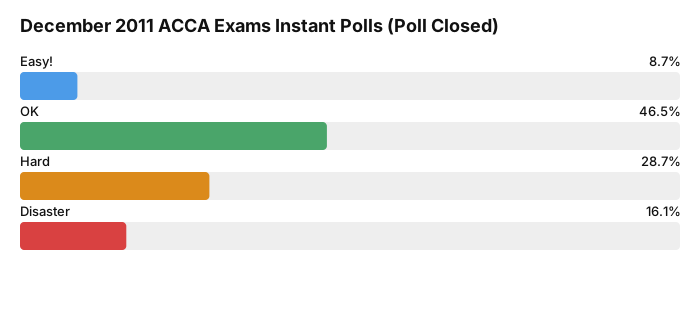
*** F5 December 2011 Exam was … Post your comments and vote in Instant Poll *** poll results
Hhamsterham14y ago#61
For 1, did you add the lost contribution and the penalty together for one of the bullet points? I did, not sure if that was right. I think it was.
Ppblondon14y ago#62
I thought the exam was tough but ok compare with previous exams

Q1 relevant costing, the scenario was endless with loads of details, I left this for last

Q2: transfer price, calculation were relative easy but the written part i struggled a bit

Q3, Budgetary system control, 20marks, WTF? I agree with previous comments BPP didn't put any emphasise on this at all, fortunately somehow I remember PRIME
Planning
Responsibility
Individual
Motivation
Evaluation
I totally missed co-ordination and I'm not really sure how well i explained those points.

Q4, Life cycle and learning curve, first part was fairly easy, tricky calculation for the learning curve and time consuming but overall i feel good about it

Q5 Material price, mix and yield Variances + ABC variances
this was by far my favourite question and that's were i started the exam

I was surprise there was no question about performance but I was very happy that CVP & EMA didn't came up.
Overall i think went ok but you never really know.

Now F9 on friday and that will be for sure another beast of exam, I have concentrate so much on F5 in the last week that I may have neglected F9 to much...... well let's hope for the best.
Ppblondon14y ago#63
@hamsterham said:
For 1, did you add the lost contribution and the penalty together for one of the bullet points? I did, not sure if that was right. I think it was.


there was no lost contribution or penalty because on the next paragraph was quoting " there is no job planned for the coming week and engineers can finish the job"
Like you i first included them in the calculation but then when i was writing the notes i realised that I shouldn't had so i crossed out................ was I right? Anyone remember that part?
Former userFormer user14y ago#64
Quote:
my lecturer said the optimum transfer price is variable cost to produce if the division have spare capacity. In this case $20? if i still remember the figure. But in that case, Division B would not make any profit from the transfer. Since the question only ask for the overall increase in net profit of the company, i just assume that internal transfer price is $20.
Jjaffarkhan114y ago#65
@hamsterham said:
For 1, did you add the lost contribution and the penalty together for one of the bullet points? I did, not sure if that was right. I think it was.


Yeah I did, together with the engineers salaries that made their relevant cost.
Former userFormer user14y ago#66
Are you sure about the engineers salaries, cause they were full time employees so it would be paid to them regardless of the new job...??
Penalty was there for sure because one week delay caused them, but lost contribution - I'm not sure... As someone said before they were free next week and could finish the job, so contribution wasn't really lost, just delayed...
Thus I calculated with delay penalty as only relevant cost for that matter...

And for Q2, in revised model, I've used full capacity for divB, 180K externally @ 80$ (I think that was the price, correct me if I'm wrong) and the rest 20K units they were selling to divA @ 65$, same like market price divA could get.
I think that B selling A for 20$ (mat 5$ + labour 15$ if I remember correctly) would loose B's money that couldn't be recovered through A's contribution in consolidated figures... Hence this approach gives highest total result... Still not sure if that was wrong, please share your thoughts...

Variances - someone asked about correct approach, material usage variance is made out of mix and yield, so if you've calculated these two separately and then added the up to get the total material usage var should give you correct answer, no matter what that approach should be fine I think...

Does anyone know when are they gonna publish exam questions?
Aaqeel12314y ago#67
it was ok, hope for the best
Hhamsterham14y ago#68
@nebojsha0603 said:
Are you sure about the engineers salaries, cause they were full time employees so it would be paid to them regardless of the new job...??
Penalty was there for sure because one week delay caused them, but lost contribution - I'm not sure... As someone said before they were free next week and could finish the job, so contribution wasn't really lost, just delayed...
Thus I calculated with delay penalty as only relevant cost for that matter...

And for Q2, in revised model, I've used full capacity for divB, 180K externally @ 80$ (I think that was the price, correct me if I'm wrong) and the rest 20K units they were selling to divA @ 65$, same like market price divA could get.
I think that B selling A for 20$ (mat 5$ + labour 15$ if I remember correctly) would loose B's money that couldn't be recovered through A's contribution in consolidated figures... Hence this approach gives highest total result... Still not sure if that was wrong, please share your thoughts...

Variances - someone asked about correct approach, material usage variance is made out of mix and yield, so if you've calculated these two separately and then added the up to get the total material usage var should give you correct answer, no matter what that approach should be fine I think...

Does anyone know when are they gonna publish exam questions?


Yeah only penalty for q1 makes sense.
Hopefully only 1 marked lost for adding the contribution.
What was the remaining 6 marks for in q1? Was it explaining relevant costing?

I did the same for q2.
Former userFormer user14y ago#69
Can anyone advise on the Life cycle cost per unit? 6
Hhamsterham14y ago#70
@deborahmcgleenan said:
Can anyone advise on the Life cycle cost per unit? 6


Everyone I spoke to after the exam did it the way I did.

Added up all the costs and divided by 300,000 units.

Then did the learning curve and worked out 100 and more units took 0.33 hours and worked out the labour cost that way.
Rryzvonusef14y ago#71
@nebojsha0603 said:Does anyone know when are they gonna publish exam questions?


They do it after 24 hrs, but for some reason, they haven't! Weird, since they have already uploaded all the other papers, only F5 is remaining
Former userFormer user14y ago#72
@hamsterham said:
Everyone I spoke to after the exam did it the way I did.

Added up all the costs and divided by 300,000 units.

Then did the learning curve and worked out 100 and more units took 0.33 hours and worked out the labour cost that way.

Did it the same way and got the same result! :)
Former userFormer user14y ago#73
Does anybody knows the date, when acca will publish the answers of exams?
Rryzvonusef14y ago#74
@manosal said:Does anybody knows the date, when acca will publish the answers of exams?
I think the answers are published a month or so later
HHandsome14y ago#75
@nebojsha0603 said:
Did it the same way and got the same result! :)


i did the same :)
HHandsome14y ago#76
Q1 – Relevant costing (14 marks for listing out the relevant/irrelevant cost)
I did ok i think and write as much as i can..

Q2 – Transfer Pricing
I suggest to buy from extarnal supplier would be better even Division B make loss but over all there was profit for the company

Q3 – Discussion on Budgetary system (100% written)
it was easy question but very very lenghty and i had write almost same thing in Part a and part b like communication, motivation, plan etc

Q4 – Lifecycle costing & Learning factor
i calculate all costs and divide them to 30,000 in next part the figure was around 0.3334 and did same thing like did in part (a) after adjusting variable cost
hmmm.. dont know what to write in last par :-s but i attmpet that question too :)

Q5 – Variance analysis & ABC (2 marks for ABC only)
this was easy questionn but my theory was week :-s

Overall i did good. I hope to pass :)
Former userFormer user14y ago#77
Does anyone know whether in Q 4 Learning curve of 95% is applied year 3 as well or just in year 2. If only year 2 then why $24 per labour in year 2 and $26 per labour hour in Year 3. I applied for both..
it seems silly but I thought it's been applied for 2 years.
Jjaffarkhan114y ago#78
Where can the papers uploaded be seen on the ACCA website? link??
Former userFormer user14y ago#80
Don't know if I'm remembering right but I think Q4 I got roughly $83 lifecycle cost per unit and this decreased to $75 per unit after adjusting for learning curve. Ring any bells with anyone
Nneilsolaris14y ago#81
@sanjarbek said:
Does anyone know whether in Q 4 Learning curve of 95% is applied year 3 as well or just in year 2. If only year 2 then why $24 per labour in year 2 and $26 per labour hour in Year 3. I applied for both..
it seems silly but I thought it's been applied for 2 years.


I did the same thing as you sanjarbek. I deliberated over this question for a minute or so, wondering why on earth the learning effect would restart for the first 100 units of year three. Although I can't remember the actual words of the question, I clearly remember it stating that there is a learning curve that effects the first 100 units of years 2 and 3.
Ppolldoll14y ago#82
@sanjarbek said:
Does anyone know whether in Q 4 Learning curve of 95% is applied year 3 as well or just in year 2. If only year 2 then why $24 per labour in year 2 and $26 per labour hour in Year 3. I applied for both..
it seems silly but I thought it's been applied for 2 years.

The learning curve only applied for the first 100 units. I assumed the company had given their staff a pay rise at the beginning of year 2 so that's why it was budgeted to cost more. I multiplied my cost per unit for 100th and so on units by 26/24 to get the cost per unit for year 2.
Ll_ACCA14y ago#84
@polldoll said:
Hmm, maybe they had complaints about the paper???


Even so they would upload it anyway, no?

I actually wouldn't wonder if they had complains. Q3 was ridiculous as for such a tiny syllabus area examiner gave us 20 marks question. BPP didn't even cover it in it's Course Notes. Unbelievable. I expressed my opinion about all this to ACCA already and I think all who aren't happy should do the same. If a lot of people complain maybe ACCA will do something about it.
Former userFormer user14y ago#85
Even if they uploaded the paper there is no answer attach to it... So no point...
Nneilsolaris14y ago#87
@laurra said:
Even so they would upload it anyway, no?

I actually wouldn't wonder if they had complains. Q3 was ridiculous as for such a tiny syllabus area examiner gave us 20 marks question. BPP didn't even cover it in it's Course Notes. Unbelievable. I expressed my opinion about all this to ACCA already and I think all who aren't happy should do the same. If a lot of people complain maybe ACCA will do something about it.


I'm wondering whether to contact them about the ambiguity of question four, but I'd need to wait until the question paper is available to be sure that I remembered it correctly. If the question had been phrased "the learning curve applied to the first 100 units of year 2" or "the learning curve applied the first 100 aggregate units or years 2 and 3 (or years 2 and 3 combined)", then there would be no doubt what was intended.
Cchimen14y ago#88
@polldoll said:
The learning curve only applied for the first 100 units. I assumed the company had given their staff a pay rise at the beginning of year 2 so that's why it was budgeted to cost more. I multiplied my cost per unit for 100th and so on units by 26/24 to get the cost per unit for year 2.

I agree with you, the learning curve only applied for the first 100 units of year 2
My answer is 82.3 and 78
Ll_ACCA14y ago#89
@neilsolaris said:
I'm wondering whether to contact them about the ambiguity of question four, but I'd need to wait until the question paper is available to be sure that I remembered it correctly. If the question had been phrased "the learning curve applied to the first 100 units of year 2" or "the learning curve applied the first 100 aggregate units or years 2 and 3 (or years 2 and 3 combined)", then there would be no doubt what was intended.


Well, I would think it was "the learning curve applied to the first 100 units of year 2" because learning curve occurs only once. You wouldn't learn to do something twice. So all in all after 100th unit was produced the steady state was reached and then rest of units, i.e. all 299,900 of them were being produced at steady pace.

I remember calculating 'cumulative average for 100 units x 100' and 'cumulative average for 101 units x 101'. Subtract one from another and get the time for steady state which I then applied for the remainder of units, i.e. 299,900 units.
Cchimen14y ago#90
@laurra said:
Well, I would think it was "the learning curve applied to the first 100 units of year 2" because learning curve occurs only once. You wouldn't learn to do something twice. So all in all after 100th unit was produced the steady state was reached and then rest of units, i.e. all 299,900 of them were being produced at steady pace.

I remember calculating 'cumulative average for 100 units x 100' and 'cumulative average for 101 units x 101'. Subtract one from another and get the time for steady state which I then applied for the remainder of units, i.e. 299,900 units.

I think the right method should be
calculating ‘cumulative average for 100 units x 100? and ‘cumulative average for 99 units x 99?. Subtract one from another and get the time for steady state which I then applied for the remainder of units, i.e. 299,900 units.