

Skip to contentSkip to search
Kaplan Publishing: Black Friday countdown

PM*** F5 December 2011 Exam was … Post your comments and vote in Instant Poll ***

Oopentuition14y ago
Post your comments about December 2011 F5 exam.
What came up? How did you do? How did this paper compare to previous exams?

Vote in our Instant Poll
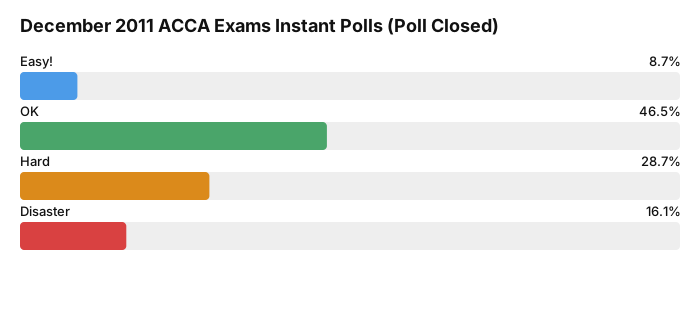
*** F5 December 2011 Exam was … Post your comments and vote in Instant Poll *** poll results
Former userFormer user14y ago#31
Can any1 explain what exactly was suppose to be done in the transfer pricing question, im not sure what i did was right?

Also the ABC variance.

thanks
Ppolldoll14y ago#32
@ryman1 said:
Can any1 explain what exactly was suppose to be done in the transfer pricing question, im not sure what i did was right?

Also the ABC variance.

thanks


I think the Transfer Pricing question you were supposed to:
Work out profit if Div A forced to buy from Div B
Work out how profits might differ if transfer price was altered and Div A was allowed to buy externally
Work out the optimal solution and talk about how it might be difficult for managers to get there.
Unfortunately I wasted loads of time mucking up part a (first assumed B was not selling externally!) so that part b was rushed and part c was a token sentence or 2!

For the ABC variance I worked out the difference between actual set ups and the set ups expected for the number of units and then multiplied by the overhead absorption rate per set up.
Jjaffarkhan114y ago#33
Exam wasn't that tough at all. Perhaps the fact that I realised early on that Q3 (budgeting theory) was something I hadn't prepared for allowed me to do the remaining 4 questions well. Left Q3 for last and did the best I could. Still had 10 minutes left when the paper ended. Hoping for atleast 60%!
Aabenatrinidad14y ago#34
can anyone say when results will be out?
Former userFormer user14y ago#35
@abenatrinidad said:
can anyone say when results will be out?


Week after Valentine;s ;)
Nneon14y ago#36
is the examiner crazy ? what does he think ? we are superman?
Former userFormer user14y ago#37
Did relevant costing well ( I think) was also able to mention installations as being loss leader, variances ok, and life cycle cost with learning curve ok too.....however both transfer pricing and budgetary objectives although attempted will earn me around six marks out of 40 as I spent an hour doing transfer pricing wrongly and did not know what to write for budgetary control.....ended up crossing out all transfer pricing part b!!!!!!!!!
Ddragon7614y ago#38
Does the budgetary control objective are:
Planning
Control
Performance assessment
Financial evaluation
Communication
Stock valuation
anyone let me know it it right?
Sshadowfax14y ago#39
Overall think the paper was ok.. except, transfer pricing part b. But to write for 20 marks for just 2 part question means the examiner can deduct a lot of marks...
Vvjsharksn14y ago#40
Q2. Was so trick... I did 20000 thousand fitting to be bought from... These two words autonomy and high priority was confusing... Hmmmm... Well there are always marks 4 the working right?
Former userFormer user14y ago#41
Can anyone tell me ?what is the answer for yield variance ,is the total yield variance is 2565(A)?The material usage variance is 1150A
Jjm8414y ago#42
For Question 3
Can anyone tells what is the 6 objectives of the budgetary control system?
I wrote:
Planning, control, communicate, coordinate, motivation and performance evaluation. I thought all these is more relevant in F2?

For the second part, I basically write the pros and cons of participatory style of budgeting in related to part (a). But I left 15 minutes for this question, so i am not able to write much on that.
Jjm8414y ago#43
@polldoll said:
I think the Transfer Pricing question you were supposed to:
Work out profit if Div A forced to buy from Div B
Work out how profits might differ if transfer price was altered and Div A was allowed to buy externally
Work out the optimal solution and talk about how it might be difficult for managers to get there.
Unfortunately I wasted loads of time mucking up part a (first assumed B was not selling externally!) so that part b was rushed and part c was a token sentence or 2!

For the ABC variance I worked out the difference between actual set ups and the set ups expected for the number of units and then multiplied by the overhead absorption rate per set up.


For the ABC variance, if you are using BPP textbook, there is one example on how to work out the variance. (I am very lucky as I just did that question 4 hours before the exam, so still fresh in mind)
Uuctovnictvo14y ago#44
Well it was hard, not super hard but I struggle with time and bloody variances...:)
Former userFormer user14y ago#45
Did anyone knows the answer between scenario 1 and scenario 2 in tranfer pricing question. I found the same profit.
Former userFormer user14y ago#46
I just hope I did enough to pass with 50%.

Q1- OK

Q2 - left it to the end, I read one of the examiners article about transfer pricing the night before which made no sense and was hoping it wouldn't come up. This was the hardest to think about what to do.

Q3- I was abit silly here, I first wrote about 6 items from PCCCEMA then thought that was wrong and then I also wrote about the principle budget, sales budget steps etc.. wasted time.
It was hard to find things to say about participatory budgeting for 13marks I think.

Q4- I think I did OK applying the learning curve was tricky, part c about the assumptions or limitations of LCC on profit, performance management and something else had no idea what to write.

Q5 - Should have been easy but foud it tricky converting kg to g and my answers looked wrong. Are the mix and yield variance meant to add up to the usage variance?
I was confused how to do the efficiency and expenditure variance because there were no hours and to use ABC principles at the same time. This should've been easy marks but I found it tricky :(
Pperist198414y ago#47
@manosal said:
Did anyone knows the answer between scenario 1 and scenario 2 in tranfer pricing question. I found the same profit.

I got 400,000 $ higher profits in the first scenario.
Aadam1131014y ago#48
Wow,,,F5 was killer,unexpected topics Q3 ohhhh,,thenQ5 the yield variance,hmmm
Former userFormer user14y ago#49
@perist1984 did you change the demand for division b? falls from 200.000 to 180.000, if you do this did you change the labour and material cost then, adjusted to the new demand?
Former userFormer user14y ago#50
well, generally the paper is okay for those that actually cover the syllabus, but tough for those that question spot because many people thought the examiner will repeat throughput,examine cvp, eviromental accting
Q1. did it very well, i think is ok. 18mks
Q2. scantily done. 5mks
Q3 would hav been the best paper but made a mistake by writing planning and control cycle but well explained.7mks
Q5. did very well but couldn't balance 15mks
Q4. did very well but made mistake. 12mks
with God on my side i shd pass atleast 50mks
Pperist198414y ago#51
@manosal said:
@perist1984 did you change the demand for division b? falls from 200.000 to 180.000, if you do this did you change the labour and material cost then, adjusted to the new demand?

I changed the demand to 180.000, but left the labour and material cost for 200.000 units...
Former userFormer user14y ago#52
@perist1984 said:
I changed the demand to 180.000, but left the labour and material cost for 200.000 units...

ya, the same
but suppose smth should be around opportunity costs - missed it totally
finally I came out with profits for both divisions to be more "attractive"' if used external opportunities and when just stuck on comments...
Former userFormer user14y ago#53
I did the same way except instead of $75, I used the optimum transfer price of $20 instead. So trf price to Division A is $20. I think the same answer will be derive since the Qns is only asking for effect on profit of the whole
Organization as a whole.
Hhamsterham14y ago#54
For the first part of the transfer pricing question, I said A buys all its items from B at $75, B sells 80,000 to A at $75 and the remaining externally.

Was that wrong? Did A only buy 20,000 from B at $75? I thought the question said A had to buy all it's stock from B which implied B sells the amount A needs first.

@olga0912 said:
Actually, I am not sure that my answer is correct, but my assumption was that as maximum production capacity of Division B was 200 000 units and maximum demand from external customers comprised 180 000 units, I recalculated sales revenue of Division B as 180 000 * $80 (price to external) and 20 000 * $ 75 (to Division A), and cost of fittings of Division A as 20 000 *$75 (bought from Division :) and 60 000* $65 (bought from external supplier). Was it correct, how do you think?


I said B sells 180,000 externally at $80 and 20,000 to A at $65 this will maximise profit overall.

What you said was wrong I think as 20,000 units A wouldn't buy from B for $75 as they can get those units for $65 elsewhere. They would buy it from B at $65. This will keep the cash in the company.
Former userFormer user14y ago#55
@guest107 : Are the mix and yield variance meant to add up to the usage variance? - nope, i dont think see below how i did it

For mix variance we should have sum all the quantities aquired and then to do the proportion for each material used in the total quantity used ex sugar: [0.02 kg (sugar used) / 0.45 kg (total material used)] * with sum of the quantity aquired (from actual figures). After you compare this result with the one from the actual budget => variances


Yield - The sum of the quantity aquired should have been divided by the yield of the materials (i.e. 0.45 kg - sugar + syroup + i dont rember the 3rd one) and in this way you would have obtained how many products should have been obtained from the materials aquired. And the variance is the difference between this figure and the actual one multiplied by the standard cost.
Hhamsterham14y ago#56
Nice to see you did it like that dal1buc, I did it the same way.

:)
Former userFormer user14y ago#57
@ hamsterham For the first part of the transfer pricing question, I said A buys all its items from B at $75, B sells 80,000 to A at $75 and the remaining externally - I said the same :D
Ppolldoll14y ago#58
I experimented with transfer prices but seemed to get the same overall profit for all options!
Div A would obtain its fittings @ $65 per unit either way once allowed to source externally so the price needs to get the best contribution for Div B.
Contribution for Div B with fittings @ $80 price was $60 per unit and contribution @ $65 price was $45 per unit so you could either sell 180,000 with $60 contribution (= $10.8m) or 80,000 with $45 contribution and 120,000 with $60 contribution (also $10.8m).
I can't remember the exact numbers but the overall profit came out the same as part a when the contribution for Div B was $10.8m if my calculations were correct.
On my way home I wondered if there was some way of limiting the target price of $65 to 20,000 units and selling the rest externally @ $80 which would increase Div B's contribution to $11.7m...
Hhamsterham14y ago#59
dal1buc said 3 hours, 52 minutes ago:

@ hamsterham For the first part of the transfer pricing question, I said A buys all its items from B at $75, B sells 80,000 to A at $75 and the remaining externally – I said the same :D


:D

For the second part B sold 180,000 externally for $80 and 20,000 to A for $65

Did you do that?
Lleymal14y ago#60
When i saw the questions I was disappointed none of the subjects that i was confident came up.
I spent too much time looking for link between part a and b of question 5 then i realised it was separate question. i have done the variances ok. part b= efficiency i thought for 800 unit one set up budgeted for actual unit it should have been 400 set up.actuall no of set up was less so i said it is Favorable.
Q3 - i was shocked i did not know what to write. i could have wrote lots but i froze.
Q1- i did it but i dont know if labour bit was correct. i was reading and reading i could not understand what was asked. part b- i said items that effect cash flow:)
loads of rubbish i wrote probably.
q2- life cycle i totalled all the cost and devide to no of units and took out from sales.i did the learning curve bit but i have no idea again. this was the topic i did not revise except one or two question.
q4- again i dont know. i had not much time think. first part i took it as it was written. 80K unit at transfer price 120K sales to outside. part c i did not write anything and exam was over. so i dont know whether i will pass or fail.