
Please vote in our Instant Polls about the ACCA Paper AAA September 2018 Exam
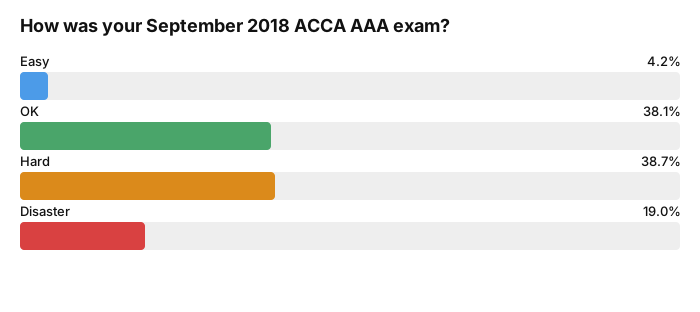
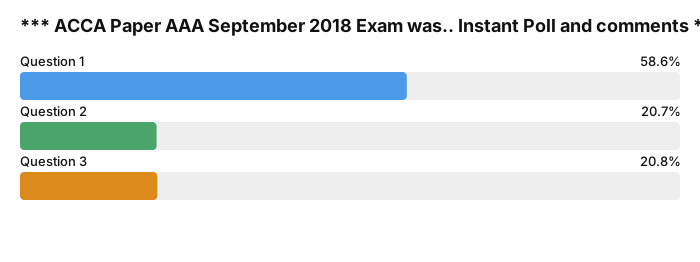 Post your comments about the ACCA AAA exam below
(comments will open after 5pm UK)
Post your comments about the ACCA AAA exam below
(comments will open after 5pm UK)
ACCA Forums
Post your comments about the ACCA AAA exam below
(comments will open after 5pm UK)
@raoul7370 said: I have now seen the actual paper (both INT and UK versions). There is no problem with doing Q1 first, and to those saying it is too long, I was surprised (given comments on here) about how NOT long it is. Now before the usual suspects moan, let me explain: - The intro page, and requirements (Exhibit 1) take only 2-3 minutes to read and digest. Almost all of the marks are for predictable, frequently-asked requirements, and students should have techniques, tried and tested, to use immediately on these. - Only 1 paragraph needs to be read from Exhibit 2 to be able to get going on the integrated reporting request. OK, this means you do not know it is a listed company yet, but there are plenty of other obvious E+PI marks from reading virtually nothing. - Only a couple of paragraphs need to be read from Exhibit 5 to answer the audit strategy bit. No testing of controls (examined before, including on my mock exam, just saying) is an F8 level point. Using client's staff to assist audit of a subjective area, far from a high level point to test. And also makes receivables an audit risk, if they go ahead. There is only 1 exhibit which is large, and that is the FS. So leave it till last. Common sense. Just use it for some ratio calcs, then get out of there. Even saying that, the notes to the FS are usually the best place to find useful audit risk info, not the numbers, and the notes are in nice bite sized chunks. Add to that the huge amount of this exam which is amazingly similar to the specimen paper (which I sense a lot of students did not know existed, let alone had practised), and I think this paper is fairly generous. If anything, I think the accounting in the other questions is the harder technical bit. One more point. Exams are NOT about knowledge, nor should they be. A parrot can memorise things. And now we have the internet, knowledge is far more freely available. To be useful in an office you need an ability to apply that knowledge under time pressure. Oh and 1 more point. Students are a stakeholder, correct. But the aim of exams is surely to be part of the preparation that supplies useful people to the accountancy profession, thus protecting accounting firms and their clients and those who use financial statements. The exam process is to test you. It is not FOR you, if you get my drift. Please be clear - I have complained about things in exams in the past and will continue to do so. But I cannot see anything to complain about for this paper at this sitting. Those complaining about time, length of paper, are hideously under-prepared, whatever they may believe. Tough but fair, which is what it should be each time. Good luck for results day everyone.What do you mean by 'If anything, I think the accounting in the other questions is the harder technical bit.' Were there any catches in the other questions, which were hard enough, as I am getting worried?
@alayanic18 said: I am really sick and tired of the exam technique topic that tutors and examiners are so keen of and keep bringing up. Nobody uses this exam technique in real life, hopefully. In 10+ years working in both internal and external audit, I had my share of time pressured audits. Thank God that I didn't use the exam technique recommended of not reading anything about the client, blankly computing ratios and cherry picking the risks that I'm most comfortable with, or the usual standard risks for the respective type of engagement. Understanding and risk assessment usually took about 25-30% of the time allocated to the engagement. In a highly regulated, rapidly changing environment it is crucial to invest enough time to understand what you are assessing, instead of applying pre-defined knowledge. It could be possible that a risk which affects many similar companies from the industry is not relevant for the audited company, or that the audited company faces uncommon risks for that industry. Regarding money laundering, maybe it should be a big deal for this exam with some requirements of applied knowledge instead of just defining money laundering / stages of money laundering. The number of fines applied by regulators is constantly increasing and there are some recent cases in which the fine value was so huge (several hundred million euros) that the regulator actually had to consider if the company will be able to pay it. Being able to identify ML is more important than being able to define it in my opinion.
@alayanic18 said: I am really sick and tired of the exam technique topic that tutors and examiners are so keen of and keep bringing up. Nobody uses this exam technique in real life, hopefully. In 10+ years working in both internal and external audit, I had my share of time pressured audits. Thank God that I didn't use the exam technique recommended of not reading anything about the client, blankly computing ratios and cherry picking the risks that I'm most comfortable with, or the usual standard risks for the respective type of engagement. Understanding and risk assessment usually took about 25-30% of the time allocated to the engagement. In a highly regulated, rapidly changing environment it is crucial to invest enough time to understand what you are assessing, instead of applying pre-defined knowledge. It could be possible that a risk which affects many similar companies from the industry is not relevant for the audited company, or that the audited company faces uncommon risks for that industry. Regarding money laundering, maybe it should be a big deal for this exam with some requirements of applied knowledge instead of just defining money laundering / stages of money laundering. The number of fines applied by regulators is constantly increasing and there are some recent cases in which the fine value was so huge (several hundred million euros) that the regulator actually had to consider if the company will be able to pay it. Being able to identify ML is more important than being able to define it in my opinion.</block Alaya..thank you for this..an insightful contribution from a "real auditor" Teaching audit is definitely not the same as actually practising audit. I guess it must be the reason why " an award-winning" tutor would recommend not reading the case scenario at all and prefer we just read the requirements and start to write the answer. Very shocking to me when you consider that this is a very practical paper where you have to apply judgement, scepticism and understanding to details you have about the company..which must come from the scenario you have "not read". This is what you have now confirmed is not the ideal approach in the real life of audit practice, which ACCA claims it is training us for. And you are very correct when you say that fast&efficient does not equal pressurized. Time as an input will ALWAYS have an impact on quality of the output, and this applies in all aspects of life, not just audit exams. One day our " it's all about exam-technique " tutors and examiners+students will understand this. I hope.
 Former user8y ago#126Former user8y ago#127
@angelamalta said: Yes I also wrote about about a possible provision for further redundancies. I cannot remember about the software though! Monday seems like weeks ago now! Good luck to us all!In the answer I have written for our college, I decided not to put in the redundancy provision as a risk. I write my answers to real exam time, to keep them realistic in length, and maybe with unlimited time I would have put it in. But the story said redundancies had happened early in the accounting year, suggesting the staff would have been paid in full long before the year end. Hence no provision would be needed. The software relates to spending on intangibles, all of which had been capitalised. This was similar to another risk question from a few sittings ago. You can capitalise such internally generated software, just like development costs, as long as it meets the criteria (product likely to get completed and deliver economic benefits that exceed its cost), so the risk is these criteria are not met.
@boltcutter said: @raoul7370 Keep your expertise to yourself @raoul7370 !! I don`t normal respond to these but the way bulling other studying on this forums since day one is nauseating. STOP annoying fellow students. Let other students express how they felt about this exam freely.Maybe you belong to another group with other "experts"......It will be interesting to see if your results will show the same.raoul7370 is not a student, he is a tutor and former marker for P7. He is trying to teach us how to approach this exam, so let's give him a break. If were him, I would have given up long time ago ?. I actually find this discussion very useful because I never thought to approach an ACCA exam with a high school mindset ?. All we have to do is to memorize the standard risks and audit procedures for each SOFP/P&L line and try to connect them to the problem. Looks like basic mathematics, you learn the formula and you apply it in exam to the question given. Use your comon sense for the ethics part and that's the exam. Probably our problem is that we are thinking too much, when we are only required to learn by heart. I would never do that in reality, but this is just an exam, I guess I will have to go against my gut for this one ?.
@rogman228 said: I absolutely agree planning is crucial in audits. And it is in this exam, too. Like I said previously you need to go in with a game plan. But not just that, you need to go in with plenty of practice of that game plan already under your belt. I sat four mocks before the exam all under exam conditions. 3 from the BBP kit and another from my college. When I was doing that exam, it was virtually like sitting it a fifth time. And I sucked hard my first two mock attempts believe me. Like raoul hinted, once you have plenty of practice under your belt you know exactly how to go about answering the question requirements before reading a thing. Then it's all about highlighting and plucking as many points as possible from the scenario presented and explaining them well. I am not going to be arrogant and pretend I know it all, I don't, and it is not in my nature. I could even still get less than 50 come October if I am unlucky. However, if I am reassured of one thing before then it is that I have done what many students on here failed to do. Writing as many points as I wanted for each part of each and every question. I planned how I could achieve this, practised it at home, then did it on the day. It is not just audit you have to do this in but all the papers. It is just more important than most. But my plan, practice, and follow said practised plan on the exam day has worked for every paper so far. I have scored 84 in P3, 65 in P2, 69 in P1 and 51 in advanced Taxation. And practising your technique to get knowledge onto your answer paper as best as possible was very important to score well for all those exams, too. With all due respect to those complaining about the time, you just didn't prepare enough to be able to manage it.Thank you for your advice, I appreciate it, but please keep your opinion regarding our preparation for this exam for yourself.
@sgaosikelwe said: Be realistic, boot licking does not work for ACCA optional papers The exam was very long, Q1 in particular and the question was also tricky as some statements needed to be read more than once to get the true meaning. there was high possibility that some students may have understood it differently and answered it in a wrong context. i agree with those who said that we have to highlight our concerns with the examiner to set realistic exams which test Knowledge and application under professional conditions. we just talked about time pressure and how it affects the quality of audit. in the same note it affects the quality of exam answers. LETS WALK THE TALKIf we walk the talk and actually receive this extra time, they will compensate this in another way by cutting easy/professional marks, making trickier questions or testing obscure areas of the syllabus. The hints received here show that there is one thing that did not change about this exam in time: the 30% pass rate. It is safer to leave it like that and "work within the framework forced on us". Anyway, by comparison with the polls from the other professional level exams, except for SBL, ours is by far the best :). And I have to admit that the questions were fair, the only issue was the time.
@vind1994 said: Can't there be 2 different risks under intangibles? 1 being the R&D costs not being capitalized accordingly. And the other being amortization with a definite life. I think the Question said the software or something was amortized for a period of 15 years. And as the Co dealt with innovation, 15 years was way too long and so the amort expense being understated? And also regarding the redundancy provision which you have mentioned. Can't we say the provision being under disclosed and as a result of that profits being over stated?I don't think we should talk about risk of under-disclosure because the requirement stated clearly that we should not talk about disclosure.
@sokty said: I don't think we should talk about risk of under-disclosure because the requirement stated clearly that we should not talk about disclosure.Yes, the requirement said "You are not required to consider audit risks relating to disclosure, as these will be planned for later in the audit process."
Former user8y ago#142@angelamalta said: Not a provision for the current redundancy but the risk of possible further redundancies since 5000 had already been made redundant therefore it may be necessary to consider whether there would be further redundancies as a result of the robot and a possible provision needed.aha, I see your point. If further redundancies were announced before the accounting year finished, and the payouts had not happened before the year end, yes fair point. As a general rule I tend to steer clear of the "what if" scenarios (especially when there is so much detail to play with from the scenario already, as others have been keen to highlight...), but I agree and if not in the official solution I would be tempted to give it some marks (after discussion with those overseeing the marking process).
Former user8y ago#143@angelamalta said: Disclosure means notes to the financial statements. Not the same as over or under statement. Or did I miss something.Correct (all of you) - no risks relating to disclosure notes could be mentioned (a shame given the new operating segment that seemed to be appearing). But a provision of course also causes a debit and credit, so would be fair game.
Former user8y ago#144@sokty said: I don't think we should talk about risk of under-disclosure because the requirement stated clearly that we should not talk about disclosure.several risks here in fact: - risk of wrongly capitalising research - the seemingly ludicrous 15 year UEL - capitalising the internally generated software, which might not meet the IAS 38 criteria
Former user8y ago#145@mirzazafarbaig said: All students who attempted Advanced Audit Assurance Paper should fill ACCA student survey regarding exams concerns.The last date is 13 sep to fill this survey.Your little effort may be considered by the examiner.Well that is what it is there for, so yes. Do so. One thing I find a bit odd though. The mock I wrote for our students was not well attempted, with a far bigger % of students running out of time than is usual. Thing is, I wanted everyone to get a chance to attempt as much as possible to embed good technique, so I chose to keep the scenario exhibits a little shorter than I might have done. My point - I am not convinced the number of exhibits or size of the story is the problem. I think this is going to happen at every sitting, and is down to there being a 50 mark question. As a former P1 tutor, the same thing happened every time with the 50 mark question on that paper, even though it was only 1.5 pages of story. A lot of students seem to struggle when there are many different requirements and 1 big story. I remain sure that this is largely a lack of technique, or lack of timed practice of such questions, or a combination of the two. However (and the main reason I continue to post on this thread despite some of the delightful comments I get for doing so), I also think quite a few students simply do not realise that exam stories are deliberately larger than they need to be to supply sufficient points for students to talk about. That 24 mark audit risk question probably needs only 9 well explained risks to get all the risk marks available. I reckon there are at least 20 risks in there. So find a many as you can, pick 9 you are comfortable explaining, and then move on. Thing is, unlike P1 (where any requirement could mean having to read several parts of the story), P7/AAA has always tended to give the story in bite sized chunks. If more students realised this, I think they would, as I do, see it NOT as a 50 mark question, but instead as a 24 marker, a 6 marker, a 10 marker, and a 6 marker (plus 4 marks for a format which requires no reading at all). While a little crossover is possible, it becomes clear quickly that: - 6 marks of audit tests on goodwill need Exhibit 4 only - 6 marks of ethics and prof issues needs just 1 paragraph of Exhibit 2 - 10 marks of audit strategy needs just 3 paragraphs of Exhibit 5 to read The scary bit is of course Exhibit 3, with not just FS numbers but also notes to the FS (although these notes provide another bite by bite exercise, and lots of audit risks). The specimen paper had FS but no notes so of course this is going to take longer to get through. Anyway, I hope those of you reading this take my comments for what they are - an attempt to help you pass the exam. If you believe that the very existence of exam technique is wrong, and that the exam should allow for deeper analysis and more time, and that tutors should teach the subject in its full glory, then sure, happy to do that. I would happily discuss the finer points of auditing all day, as I suspect some of you might have realised...
@raoul7370 said: Well that is what it is there for, so yes. Do so. One thing I find a bit odd though. The mock I wrote for our students was not well attempted, with a far bigger % of students running out of time than is usual. Thing is, I wanted everyone to get a chance to attempt as much as possible to embed good technique, so I chose to keep the scenario exhibits a little shorter than I might have done. My point - I am not convinced the number of exhibits or size of the story is the problem. I think this is going to happen at every sitting, and is down to there being a 50 mark question. As a former P1 tutor, the same thing happened every time with the 50 mark question on that paper, even though it was only 1.5 pages of story. A lot of students seem to struggle when there are many different requirements and 1 big story. I remain sure that this is largely a lack of technique, or lack of timed practice of such questions, or a combination of the two. However (and the main reason I continue to post on this thread despite some of the delightful comments I get for doing so), I also think quite a few students simply do not realise that exam stories are deliberately larger than they need to be to supply sufficient points for students to talk about. That 24 mark audit risk question probably needs only 9 well explained risks to get all the risk marks available. I reckon there are at least 20 risks in there. So find a many as you can, pick 9 you are comfortable explaining, and then move on. Thing is, unlike P1 (where any requirement could mean having to read several parts of the story), P7/AAA has always tended to give the story in bite sized chunks. If more students realised this, I think they would, as I do, see it NOT as a 50 mark question, but instead as a 24 marker, a 6 marker, a 10 marker, and a 6 marker (plus 4 marks for a format which requires no reading at all). While a little crossover is possible, it becomes clear quickly that: - 6 marks of audit tests on goodwill need Exhibit 4 only - 6 marks of ethics and prof issues needs just 1 paragraph of Exhibit 2 - 10 marks of audit strategy needs just 3 paragraphs of Exhibit 5 to read The scary bit is of course Exhibit 3, with not just FS numbers but also notes to the FS (although these notes provide another bite by bite exercise, and lots of audit risks). The specimen paper had FS but no notes so of course this is going to take longer to get through. Anyway, I hope those of you reading this take my comments for what they are - an attempt to help you pass the exam. If you believe that the very existence of exam technique is wrong, and that the exam should allow for deeper analysis and more time, and that tutors should teach the subject in its full glory, then sure, happy to do that. I would happily discuss the finer points of auditing all day, as I suspect some of you might have realised...Thank you, we really value your input, although it may not seem like it :). I still think that the time is not enough for the questions given, though. Also I'm pretty sure that no amount of filled in surveys will help with that :(..
@ashrafaziz said: Let's be practical & look forward to Dec 2018 session i extract from this useful debate 2 points as possible solution of almost impossible P7 exam : 1- { Students should have started from Q2 and 3 and grab maximum points which is closer to 37 marks and then go on to scavenge for 20 marks in Q1. } Begin with Q2 & Q3 while you are still fresh mind as its scenario is shorter than Q1 to guarantee at least 30 out of 50 points in 1st 105 minutes 2- { I sat four mocks before the exam all under exam conditions. 3 from the BBP kit and another from my college. When I was doing that exam, it was virtually like sitting it a fifth time. And I sucked hard my first two mock attempts believe me. } Try mock exams under real timing & under real exam conditions , specially , try Q1 mocks only under 90 Minutes 4 times at least before sitting an exam as most of the complaints arise from Q1 CAN ANY ONES ADD TO THESE POINTS TO HELP TO PASS NEXT TIME ?{ But still the fact that saddens me the most is that the specimen paper, brought out months in advance of this sitting, is almost identical to the September paper. Any student who had practised it would have been very well set for Monday’s paper. The comments on here should be saying “nice of the examiner to ease us in gently to the new format with such predictable questions similar to the specimen”} This is true 100% , i tried the specimen paper many times before exam , and when i sit i got astonished from copy and paste of this specimen , this the ONLY positive point in the exam raoul7370 comments and opinion is very useful as i said it before , thank you Raoul very much for your points of view , otherwise guys , we will be kept blind form examiners approach , we will never know how they think Thanks to Raoul we touch the core point which result in the same , identical comments published in the examiner report on every exam , on the other side , students keep complaining from the same issues in every sitting, and the same problems will never be solved , in the end we have to “work within the framework forced on us”. as ALAYA said The examiner report never disclose to us the points which Raoul uncover as examiner report always answers points specific to each exam question not overall approach of thinking applicable to any exam as Raoul explain last point , i am somehow frustrated after leaving the exam hall this time , (3 thd time in P7 ) because i think that there are no solution to pass P7 , but i have to confess that there is many points that i didn't study diligently like QC in audit of last question , what i want to say that if we must be honest with ourselves and cover all the syllabus 200% to be ready to write on any topic once we read the question , the very very very good preparation will kill the shortage in time problem