ACCA Forums
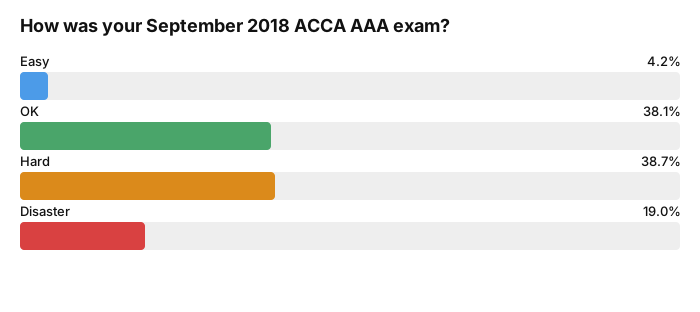
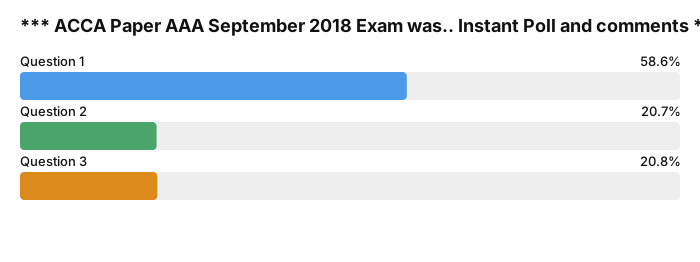
AAA*** ACCA Paper AAA September 2018 Exam was.. Instant Poll and comments ***
I suggest all those complaining read Robertoh posts. Seems like virtually the only person on here who had the right technique and used it.
Fact is I haven't seen the exam but have just written an answer to Q1 that will get 25 marks minimum. Based only on what requirements say.
So if I can do that without reading a single word of the scenario that is apparently too long, why isn't every student doing it too?
Having poor exam technique is not the examiner's fault and if you keep blaming everyone else you will never improve.
Paper was reasonable ... Examiner almost covered areas from core areas of P7 ... but the paper was way too lenghty , i dont think it anyways justify to be a 3 hr paper from any means . lets see now what will happen ,
Paper was reasonable ... Examiner almost covered areas from core areas of P7 ... but the paper was way too lenghty , i don't think it anyways justify to be a 3 hrs paper from any means . lets see now what will happen , May we all pass this time IN SHA ALLAH , Prayers & good luck to everyone !
Exactly - the marks are split over the entite paper, not just q1. Q2 and Q3 weren’t that lengthy and very do-able.
Its meant to be hard and time pressured so that you focus on the key areas. I’m “lucky” to have done a number of post grad professional level qualifications and if you think the ACCA are time pressured I would urge you to look at Joint Insolvency Exam Board papers. 3 in 3 days back to back, 3.5 hours per paper.
Its as much technique as knowledge in my opinion (for what it is worth!).
Good luck with remaining exams everyone.
@sokty said: What I learn is that if the misstatement is more than 60% of PBT, it should be adverse. So less than 60%, I think still Qualified.where did you get that 60% from? I have never heard of it. Adverse is where the misstatement is pervasive, which usually means it affects most of the balances in the FS (or affects the overall view that shareholders would take when reading the FS). If a mistake meant that a $5m profit should in fact be a $4m loss (i.e. it entirely wiped out profit) then maybe, but generally if there is only 1 mistake a qualified "except for" opinion is almost certainly the right option.
raoul7370, I would suggest you see the exam paper first before passing such self- righteous judgements on "every student".
You wrote an answer to a question you have not seen, most likely in the comfort of your study space and without the inevitable exam nerves. Simulate the real-life experience and you may not be so confident of your top-notch exam technique.
I believe every student goes into the exam hall with a game plan of how to apply the best possible exam techniques, but you cannot say that you know "exactly" how things will turn out until you have actually sat in the exam hall and faced the real thing.
If ACCA needs to be called out and given constructive feedback from students who "actually" wrote the exams, then, by all means, we would do that. You cannot just put down the experience of an overwhelming majority of students on here to "poor exam technique".
Yes, some students may have better pressure-coping and exam technique skills than others, but I believe the real taste of the pudding is in the eating.
@raoul7370 said: where did you get that 60% from? I have never heard of it. Adverse is where the misstatement is pervasive, which usually means it affects most of the balances in the FS (or affects the overall view that shareholders would take when reading the FS). If a mistake meant that a $5m profit should in fact be a $4m loss (i.e. it entirely wiped out profit) then maybe, but generally if there is only 1 mistake a qualified "except for" opinion is almost certainly the right option.To raoul7370: So Examiner separate all the misstatements without giving us chance to say if all misstatements are aggregated. So in isolation, I still think the unrecodred provision is Material rather Pervasive as it affects only 2 balances, again in isolation. I aggree with Kaffie that u did not fit for this exam but u scolded all the candidates. U may not have how pressurised to us in exam. I hope u could understand and not blame us anymore.
Maybe someone can benefit from my technique. From my own experience at professional level starting wth question 1 is a disaster, you will be fresh and you can get carried away on question 1. I usually start with the most easiest and shorter and quickly bury it below 40minutes then go to Question 1 and start with shortest parts and even if l spend time there l shld make sure l finish it THEN write a conclusion so that it is a complete report to get FREE PROFESSIONAL MARKS. Then finish with the remaining question even if 20minutes is left l start with small sections then if l do not hv time to read the final part l just write an answer from the moon - like l did not hv time to read that part talking about LEASE and l just guessed it is a DISPOSAL AND LEASEBACK and l said the assets should not be removed from the ASSET REGISTER For assets sold and leaseback. Therefore removing writing off the assets will understate the Assets and UNDERSTATE liabilities.
//Maybe someone can benefit from my technique. From my own experience at professional level starting wth question 1 is a disaster, you will be fresh and you can get carried away on question 1. I usually start with the most easiest and shorter and quickly bury it below 40minutes then go to Question 1 and start with shortest parts and even if l spend time there l shld make sure l finish it THEN write a conclusion so that it is a complete report to get FREE PROFESSIONAL MARKS. Then finish with the remaining question even if 20minutes is left l start with small sections then if l do not hv time to read the final part l just write an answer from the moon – like l did not hv time to read that part talking about LEASE and l just guessed it is a DISPOSAL AND LEASEBACK and l said the assets should not be removed from the ASSET REGISTER For assets sold and leaseback. Therefore removing writing off the assets will understate the Assets and UNDERSTATE liabilities. // Whether it is an easy question or not you have to spend the time on reading long paragraphs and decide.
@kaffie said: raoul7370, I would suggest you see the exam paper first before passing such self- righteous judgements on "every student". You wrote an answer to a question you have not seen, most likely in the comfort of your study space and without the inevitable exam nerves. Simulate the real-life experience and you may not be so confident of your top-notch exam technique. I believe every student goes into the exam hall with a game plan of how to apply the best possible exam techniques, but you cannot say that you know "exactly" how things will turn out until you have actually sat in the exam hall and faced the real thing. If ACCA needs to be called out and given constructive feedback from students who "actually" wrote the exams, then, by all means, we would do that. You cannot just put down the experience of an overwhelming majority of students on here to "poor exam technique". Yes, some students may have better pressure-coping and exam technique skills than others, but I believe the real taste of the pudding is in the eating.Oh, I probably should have said. I am not a student. I am an award-winning tutor who has taught advanced audit for 22 years, and I have also marked the P7/AAA exam in the recent past. I am not on here to show off - I am trying to offer help, because it is clear that the majority of those posting to this thread need it, and big time.. I am here because the same skills and technique have been required for this exam for the entire 22 years I have been teaching, and the majority of students either have never been told them, or have ignored them. The result, at every sitting, is the discussion above - the ONLY reason students face time pressure is not knowing what they are doing. I fail to see how an exam which asks the same question types sitting after sitting is "unfair". And for the record, I wrote my passing answer in half an hour (I time myself for all my answers, to make them realistic). The very fact you say I should see the paper before commenting shows the problem. No I don't need to see it, because the scenario is not the key to passing this, it is the requirements. I do of course take the point about exam nerves. And these can disrupt in a major way. But that is the whole point of having a technique - nerves typically come from a sense of panic, but having a technique you know will work should reduce this panic to a minimum. My posts are written in the full knowledge I am likely to upset some students. It is my hope to try to move the debate away from "unfair exam" (which it most certainly is not) to "can we find a great way of attempting these questions, despite what can be some big scenarios". Those who pursue the "life is unfair" approach are going to fail over and over again I'm afraid.
Whilst I do think the question felt long, was it actually any more content heavy than past questions like Adams Group (specimen from Jun 14) or Sunshine Hotels (winter 17)?
The acquisition element of the question was almost copy and paste from CS Group in June 2012.
Until I get results I will reserve making too many comments, but exam technique from both Kaplan and my own past paper analysis work really helped disseminate and focus the key aspects I wanted to talk about for ROMM. And most importantly after I hit the time I set myself I moved on having written about 10/11 ROMM using the MAR (materiality, acc treatment and risk of MM) approach.
@robertoh said: Whilst I do think the question felt long, was it actually any more content heavy than past questions like Adams Group (specimen from Jun 14) or Sunshine Hotels (winter 17)? The acquisition element of the question was almost copy and paste from CS Group in June 2012. Until I get results I will reserve making too many comments, but exam technique from both Kaplan and my own past paper analysis work really helped disseminate and focus the key aspects I wanted to talk about for ROMM. And most importantly after I hit the time I set myself I moved on having written about 10/11 ROMM using the MAR (materiality, acc treatment and risk of MM) approach.Based on what you have written on this thread, I would be astonished if you score less than 65. Very sensible comments.
Dear Colleagues
I think we should file a petition for P7 at ( [email protected] ) for not completing the paper on time due to it being extremely long because :
1-It is the 1st trial for ACCA in introducing the new format compulsory exam and i think a
trial version of the exam should be tested by the examiner itself ( asssuming that
she have full technical knowledge to answer all the questions ) to assess only timing
required to :
Firstly: Reading time 4 Exhibits of Q1 + 2 others questions each is spitted in a)+b)
sub questions and each a) &b) is spitted into 2 main points
Secondly : Planning time to answers the overall the question & imagine in
mind the main points sequences before the pen touch the paper
Thirdly : Writing time the correct answers in full details to get full mark of each risk
to proof to examiners that i understand the requirements as
recommended by ACCA in technical articles
A part from time for thinking in technical knowledge of the core question ,Reading
+Planning +Writing i think need fairly 4 hours
3-Assuming that a candidate knowledge cover 90 % of the corrects answers , i.e. he is ready to pass and cover the syllabus by a 90% , he also must got panic , blacked out , exhausted when reaching Q 3 due to lack of time required to 1-Think in 10% lack of Knowledge 2-Reading 3-Planning 4-Writing
4-The issue of time shortage especially in Q1 outweigh outweigh the pretended benefits of time saving because students have no longer to read 3 questions to opt 2 out of 3 .
ACCA must review it point of view with an expert in setting exam techniques NOT ONLY expert in advanced audit materials
5-For those who compare timing of ACCA exams to others post grad professional qualifications , i think it is cost -benefit criterion which mean that CFA exam timing is extremely severe however its reward is more promising , so it can t be compared to other qualifications
6- I think most of us can pass by at least 50% if they answers verbally or even by KB in a Computer Based Exam to avoid hand writing waste time which make our hand paralyzed by end of 3 hours , consequently , ACCA in fact is testing our hand writing skills + our rest muscles rather than core knowledge
7-The suggested solution is extending time to 4 h under new exam format or examiners give some compensations and reduce correction criteria for this session
and people wonder why the ACCA pass rates are so low...
All exam papers are "trial sat" to ensure they are fair and reasonable. I suggest anyone who thinks they might not have passed puts their energies into changing their preparation for next time, rather than putting the blame on everyone except themselves.
Of course, I saw this coming (any experienced P7 tutor would have done). I was talking with the examiner late last week and forewarned her that thanks to so many students having appalling technique for this paper, a long story with numbers on Q1 was going to make matters worse (I suspect she was expecting it too to be honest).
Rest assured the pass rate will not change much, which should mean that nobody has any more or less chance of success than they would have done under the old format.
@ashrafaziz said: Dear Colleagues I think we should file a petition for P7 at ( students@accaglobal.com ) for not completing the paper on time due to it being extremely long because : 1-It is the 1st trial for ACCA in introducing the new format compulsory exam and i think a trial version of the exam should be tested by the examiner itself ( asssuming that she have full technical knowledge to answer all the questions ) to assess only timing required to : Firstly: Reading time 4 Exhibits of Q1 + 2 others questions each is spitted in a)+b) sub questions and each a) &b) is spitted into 2 main points Secondly : Planning time to answers the overall the question & imagine in mind the main points sequences before the pen touch the paper Thirdly : Writing time the correct answers in full details to get full mark of each risk to proof to examiners that i understand the requirements as recommended by ACCA in technical articles A part from time for thinking in technical knowledge of the core question ,Reading +Planning +Writing i think need fairly 4 hours 3-Assuming that a candidate knowledge cover 90 % of the corrects answers , i.e. he is ready to pass and cover the syllabus by a 90% , he also must got panic , blacked out , exhausted when reaching Q 3 due to lack of time required to 1-Think in 10% lack of Knowledge 2-Reading 3-Planning 4-Writing 4-The issue of time shortage especially in Q1 outweigh outweigh the pretended benefits of time saving because students have no longer to read 3 questions to opt 2 out of 3 . ACCA must review it point of view with an expert in setting exam techniques NOT ONLY expert in advanced audit materials 5-For those who compare timing of ACCA exams to others post grad professional qualifications , i think it is cost -benefit criterion which mean that CFA exam timing is extremely severe however its reward is more promising , so it can t be compared to other qualifications 6- I think most of us can pass by at least 50% if they answers verbally or even by KB in a Computer Based Exam to avoid hand writing waste time which make our hand paralyzed by end of 3 hours , consequently , ACCA in fact is testing our hand writing skills + our rest muscles rather than core knowledge 7-The suggested solution is extending time to 4 h under new exam format or examiners give some compensations and reduce correction criteria for this sessionI wouldn’t waste your time to be honest mate.
@kaffie said: raoul7370, I would suggest you see the exam paper first before passing such self- righteous judgements on "every student". You wrote an answer to a question you have not seen, most likely in the comfort of your study space and without the inevitable exam nerves. Simulate the real-life experience and you may not be so confident of your top-notch exam technique. I believe every student goes into the exam hall with a game plan of how to apply the best possible exam techniques, but you cannot say that you know "exactly" how things will turn out until you have actually sat in the exam hall and faced the real thing. If ACCA needs to be called out and given constructive feedback from students who "actually" wrote the exams, then, by all means, we would do that. You cannot just put down the experience of an overwhelming majority of students on here to "poor exam technique". Yes, some students may have better pressure-coping and exam technique skills than others, but I believe the real taste of the pudding is in the eating.May God bless you for this. You spoke my mind.
On the contrary , we don t search a peg on which to hang mistakes , and try to find excuses to ourselves , we just feedback the first attempt of new exam format to the examiners otherwise the main issues will remain unchanged , particularly , i found consensus on timing issue on this new format
Personally , I benefited from your opinion very much which say that too many figures and long story mean too many risks to select from with minimum reading of the full story and i will try to apply this approach next time to focus my energy to pass and not to blame others
@raoul7370 said: and people wonder why the ACCA pass rates are so low... All exam papers are "trial sat" to ensure they are fair and reasonable. I suggest anyone who thinks they might not have passed puts their energies into changing their preparation for next time, rather than putting the blame on everyone except themselves. Of course, I saw this coming (any experienced P7 tutor would have done). I was talking with the examiner late last week and forewarned her that thanks to so many students having appalling technique for this paper, a long story with numbers on Q1 was going to make matters worse (I suspect she was expecting it too to be honest). Rest assured the pass rate will not change much, which should mean that nobody has any more or less chance of success than they would have done under the old format.On the contrary , we don t search a peg on which to hang mistakes , and try to find excuses to ourselves , we just feedback the first attempt of new exam format to the examiners otherwise the main issues will remain unchanged , particularly i found consensus on timing issue Personally , I benefited from your opinion very much which say that too many figures and long story mean too many risks to select from with minimum reading of the full story and i will try to apply this approach next time to focus my energy to pass and not to blame others
the "main issues will remain unchanged" - I agree, the main issues not being the exam paper (which is fine and has nothing wrong with it), but being with an unwillingness of many students to take advice on how to improve their performance.
This thread could be a lot more constructive if the focus shifted away from moaning and on to how it could possibly be that I can write a passing solution to Q1 without having seen the scenario. Surely that could be rather helpful no?
Hi everyone
Most of you spoke about individual report effect but in kit lots of questions where an aggregate impact needed. Leases impairment and the otherone should be added then calculate materiality and write about effect.
Paper was long enough the old examine pattern was good.
Good luck every May Allah bless you..
Q1a was for 24 Marks and it involved the utilization of Analytical procedures to assist in the evaluation of Audit risk ( RoMM and DR ) excluding audit risk related to disclosure and goodwill impairment within the case.
Question 1 for 50 Marks was too long to read , plan and put together within 105 minutes even with the best exams techniques.
I agree with most of you that the questions were within reach but too lengthy and time consuming.
I also agree with the technique of moving on. But you cant keep moving on when you yourself know you've not done enough to achieve a pass on a question.
Even when you know everything , writing it down does take time.
For Q 2 - Provision and Contingent Asset
The error correction in the question was incorrect; In addition to recognize a Liability and a contingent asset, the error also affected the Statement of Profit or Loss; therefore Dr. Expenses Cr. Liability and Dr. Contingent Asset & Cr. Other income of 1,200,000.
After all the info given in Q 1, i decided not to read the entire thing. So As i was answering the question i read a little in order to get the audit risk and moreover, answer the requirements.
@raoul7370
A lot of what you are saying goes back to what my lecturer was saying. You don’t need a text book for this exam, knowing a little about a lot and being able to apply it well using good technique is key.
My lecturer preached the same thing, technique is crucial.
I personally have ZERO complains at the length of the paper having sat it yesterday.
I came in with a plan for doing the questions inside the allocation I had for them. 1 hour 30 to answer Q1 and 45 a piece for the others which included extra reading time too.
I have no complains about time pressure. If I do get less than 50 on October 15 it is because I didn’t know enough SIMPLE. I wrote down enough points to more than pass in the time I gave myself to do the questions and I answered every part of every question.
I am going to join the controversial side of such a debate and say yes I agree those complaining about time really didn’t do enough to practice their time management and plan for how much time to spend on each part to each question. They could more than likely do with practicing more mock exams and questions under exam conditions in general to perfect their ability to draw out enough points in the timeframe given.
It is more than possible. I am one piece of proof of that to come from yesterday’s exam. Is it easy? Of course not! It is not meant to be or everyone would pass. But that is why you need a good strong game plan and plenty of practice of said game plan before going into the hall.
I couldn't understand what examiner looking for, students knowledge or harassing ? Such a long questions reading and absorbing itself required min 45 minutes! Disappointed and still struggling for my final paper.
Dear raoul7370,
Maybe 22+ year experienced tutors/markers/examiners should pay a visit to real life from time to time as they seem to be totally missing the point:
”There are not 15 mins of reading time. Haven’t been for years. By the time 15 mins were up, you should have had 6 ratios calculated for 2 years and Briefing notes set up and have 9 marks minimum in the bank.”
Audit should not be about how many marks you have in the bank, a good auditor should perform a proper understanding of the client, through meetings/discussions with client management and personnel SUPPORTED BY THE analytical review performed. In exam conditions this means that it should not be enough to just calculate random ratios, you have to spend TIME to understand what are the most relevant ones for your client/client industry e.g. there is no point in computing inventory turnover if the balance is immaterial as you are dealing with a services company - you can learn this by reading the question, not just the requirement.
”The key is to provide 18 marks of answer, not answer the entire scenario (where she provides too many risks so that everyone will find some, not to overload you)”,
”The moment you see a new sub acquired, that is overseas, even if story says same year end, they use IFRS and have same acc policies, and even with story saying ignore disclosure risks (I did not do the exam but am told it said that?), you have at least 4 audit risks (initial GW, impaired GW at y/e, forex retranslation, pre v post acqn reserves calc). That is 8 marks if well explained. Add on 6 for ratios, 3 for Prof Marks, and surely there are 4 standard goodwill tests on any company and you have 21 already having barely touched the scenario (if at all). No controls testing, and use of IA staff, must be worth at least 2 easy marks? That’s 23 and still haven’t read the story that everyone will always say is too long.”
”As I said to one of my class, if you think you have too many risks be happy. Shows you know what you are doing. Just go with those you are most comfortable explaining and ditch the rest. Has always been like this, and I don’t understand why so many students think they have to cover every available point”.
In real life an auditor should consider ALL the significant risks that the client is facing, not just the most obvious ones and most certainly not just the ones that he has time to look into or the ones that he is most comfortable with/understands. Again this means TIME spent understanding the client. Risk assessment should mean likelihood, impact, prioritization, thus TIME. There is a reason for that time resource prerequisite when accepting an audit, don't you think?
”Fact is I haven’t seen the exam but have just written an answer to Q1 that will get 25 marks minimum. Based only on what requirements say. So if I can do that without reading a single word of the scenario that is apparently too long, why isn’t every student doing it too? Having poor exam technique is not the examiner’s fault and if you keep blaming everyone else you will never improve” ”The very fact you say I should see the paper before commenting shows the problem. No I don’t need to see it, because the scenario is not the key to passing this, it is the requirements.
many students having appalling technique for this paper”
This here is actually the biggest issue - you see, a proper audit exam would not allow passing it without reading the question, exam technique should not be the key to passing, professional judgement and scepticism should be the key. The equivalent in real life means do the minimum work in the time assigned, do not extend audit procedures if you have a riskier client, thus sacrifice quality. As long as you get the big fat fee/50% mark, it is ok.
”All exam papers are “trial sat””
By whom? Tutors, students, auditors? Skilled in exam technique or in audit?
”But if you have fallen foul to overrunning due to a failure to do the above, worry not (well not too much). So many people will have done the same, and surely ACCA want a pass rate no worse than 30%”, ”Rest assured the pass rate will not change much, which should mean that nobody has any more or less chance of success than they would have done under the old format.”
This is just sad, I always suspected pass rate manipulation as there was no change in trend except for cases in which the examiner or exam structure changed e.g. the artificial increase for P3 up to 56% before the merger with P1.
To conclude, if this exam would practice what it preaches, maybe we would not see so many audit failures involving qualified professionals...
I think professional papers especially AAA should be at least 3h 30m. The paper was not so difficult but time forced me towards the end to give partially detailed answers so I could grab some marks across the paper instead of focusing on one question. I hope the examiner really looks into the issue of time, it was a marathon.
I totally disagree that knowledge should be the end all of this paper and technique shouldn’t play a key role. Sure 80% of the syllabus is coverd in other exams!!
We’re supposed to have strong brought forward knowledge for this exam more than any other. Including all the IFRS standards in P2. Standard are crucial in AAA. But there are absolute no new ones to learn in AAA that you shouldn’t already be very familiar with from P2! That is only a hint at how the majority of knowledge should already be in your head before studying AAA if you are serious about learning and being an educated accountant.
There are only a few new ‘AAA exclusive’ topics such as Money Laundering and Auditor Liability, but even they aren’t commonly examined. All the commonly examined stuff stems from stuff you should already have a good knowledge of from previous papers.
And in the real world, technique is crucial in audit as well. There is a lot of work in auditing now days to do an acceptable, high quality audit. Having the skills to perform a time efficient audit that is worth the time and money, while not sacrificing any of the quality that you absolutely need to provide, is arguably the biggest challenge audit firms face and with so much competition for fees it only gets harder.
So how appropriate then that in the biggest and final Audit exam before you qualify, your ability to manage your time efficiently while not sacrificing the quality of your answers should be one of the biggest challenges in the exam.
Welcome to the real world, folks.
IT WAS SO LONG. As would be professionals, what were we being tested on.. Speed? Yes that's why that exam WS all about. Speed.
Which auditor can analyse all that in 3 hour and produce professional feedback? No wonder the pass rates will continue being that low.
The questions were familiar. But without professional analysis from a woud be auditor, pass rates will be low again this year.
Professional paer like auditing needs professional analysis . and not being tested on .speed
I am really sick and tired of the exam technique topic that tutors and examiners are so keen of and keep bringing up. Nobody uses this exam technique in real life, hopefully. In 10+ years working in both internal and external audit, I had my share of time pressured audits. Thank God that I didn't use the exam technique recommended of not reading anything about the client, blankly computing ratios and cherry picking the risks that I'm most comfortable with, or the usual standard risks for the respective type of engagement. Understanding and risk assessment usually took about 25-30% of the time allocated to the engagement. In a highly regulated, rapidly changing environment it is crucial to invest enough time to understand what you are assessing, instead of applying pre-defined knowledge. It could be possible that a risk which affects many similar companies from the industry is not relevant for the audited company, or that the audited company faces uncommon risks for that industry.
Regarding money laundering, maybe it should be a big deal for this exam with some requirements of applied knowledge instead of just defining money laundering / stages of money laundering. The number of fines applied by regulators is constantly increasing and there are some recent cases in which the fine value was so huge (several hundred million euros) that the regulator actually had to consider if the company will be able to pay it. Being able to identify ML is more important than being able to define it in my opinion.
Topic lockedNew replies are closed.