ACCA Forums
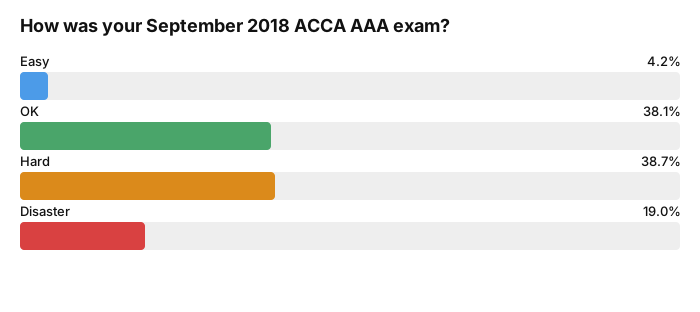
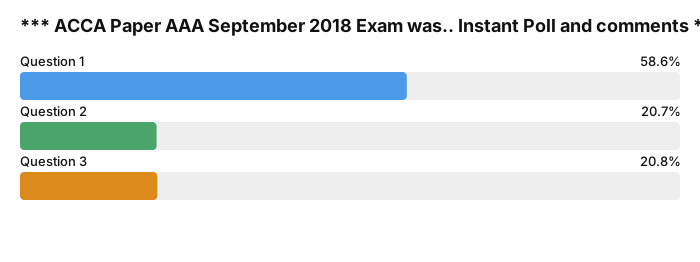
AAA*** ACCA Paper AAA September 2018 Exam was.. Instant Poll and comments ***
I just wanted to emphasize that audit should be about reading, understanding, applying professional judgement, being sceptic. This is what matters most, not just exam technique.
AAA Q2 Impairment test, there was no impairment. however, the fall in revenue due to the new competitor would call for disclosure of "going concern" issues. Therefore an "Emphasis of matter" paragraph is needed. Unmodified Opinion Emphasis of Matter.
Alaya, may I ask are you a tutor, student or a former student who has completed the qualification?
Lemmy, I believe there was an impairment as both value in use and fv less costs to sell were below carrying value.
It was 24 marks for audit risks exludimg comments on disclosures (i.e. segmental reporting etc)
I think it was a new client. It mentioned at the beginning that “...we were assigned for the audit of...” and in past exam audit risk qs this setence was treating the client as a new one.
I pray so too.
Fingers across for pass.
With all due respect alaya I think you are missing the point.
All those things you mentioned are being adequately examined. But so is your ability to think and come up with solutions fast as well. If you really, really know them well and to a high standard, pulling out at least half enough information from Q1 to score 50% in the 90 minutes allocated to it should really not be a problem for you. When you know stuff as well as you are expected for this exam it should be second nature for you.
Robertoh I am a student. I also happen to know a quite a few FCCAs through the nature of my work and it is sad that most of them don't even remember the basics about IAS. If I talk to them and say for eg IAS12 requires this and that, they immediately ask what is this IAS about?. Also none of them remembers any of the exams passed for eg that P7 is audit.
I agree with being able to think fast and to finding solutions quickly. But there is a huge difference between fast and under pressure. ACCA means under pressure not fast.
Alaya, did you write this paper? If you had to attempt,it, am sure you will appreciate what we are trying to say
@alayanic18 said: Dear raoul7370, Maybe 22+ year experienced tutors/markers/examiners should pay a visit to real life from time to time as they seem to be totally missing the point: ”There are not 15 mins of reading time. Haven’t been for years. By the time 15 mins were up, you should have had 6 ratios calculated for 2 years and Briefing notes set up and have 9 marks minimum in the bank.” Audit should not be about how many marks you have in the bank, a good auditor should perform a proper understanding of the client, through meetings/discussions with client management and personnel SUPPORTED BY THE analytical review performed. In exam conditions this means that it should not be enough to just calculate random ratios, you have to spend TIME to understand what are the most relevant ones for your client/client industry e.g. there is no point in computing inventory turnover if the balance is immaterial as you are dealing with a services company - you can learn this by reading the question, not just the requirement. ”The key is to provide 18 marks of answer, not answer the entire scenario (where she provides too many risks so that everyone will find some, not to overload you)”, ”The moment you see a new sub acquired, that is overseas, even if story says same year end, they use IFRS and have same acc policies, and even with story saying ignore disclosure risks (I did not do the exam but am told it said that?), you have at least 4 audit risks (initial GW, impaired GW at y/e, forex retranslation, pre v post acqn reserves calc). That is 8 marks if well explained. Add on 6 for ratios, 3 for Prof Marks, and surely there are 4 standard goodwill tests on any company and you have 21 already having barely touched the scenario (if at all). No controls testing, and use of IA staff, must be worth at least 2 easy marks? That’s 23 and still haven’t read the story that everyone will always say is too long.” ”As I said to one of my class, if you think you have too many risks be happy. Shows you know what you are doing. Just go with those you are most comfortable explaining and ditch the rest. Has always been like this, and I don’t understand why so many students think they have to cover every available point”. In real life an auditor should consider ALL the significant risks that the client is facing, not just the most obvious ones and most certainly not just the ones that he has time to look into or the ones that he is most comfortable with/understands. Again this means TIME spent understanding the client. Risk assessment should mean likelihood, impact, prioritization, thus TIME. There is a reason for that time resource prerequisite when accepting an audit, don't you think? ”Fact is I haven’t seen the exam but have just written an answer to Q1 that will get 25 marks minimum. Based only on what requirements say. So if I can do that without reading a single word of the scenario that is apparently too long, why isn’t every student doing it too? Having poor exam technique is not the examiner’s fault and if you keep blaming everyone else you will never improve” ”The very fact you say I should see the paper before commenting shows the problem. No I don’t need to see it, because the scenario is not the key to passing this, it is the requirements. many students having appalling technique for this paper” This here is actually the biggest issue - you see, a proper audit exam would not allow passing it without reading the question, exam technique should not be the key to passing, professional judgement and scepticism should be the key. The equivalent in real life means do the minimum work in the time assigned, do not extend audit procedures if you have a riskier client, thus sacrifice quality. As long as you get the big fat fee/50% mark, it is ok. ”All exam papers are “trial sat”” By whom? Tutors, students, auditors? Skilled in exam technique or in audit? ”But if you have fallen foul to overrunning due to a failure to do the above, worry not (well not too much). So many people will have done the same, and surely ACCA want a pass rate no worse than 30%”, ”Rest assured the pass rate will not change much, which should mean that nobody has any more or less chance of success than they would have done under the old format.” This is just sad, I always suspected pass rate manipulation as there was no change in trend except for cases in which the examiner or exam structure changed e.g. the artificial increase for P3 up to 56% before the merger with P1. To conclude, if this exam would practice what it preaches, maybe we would not see so many audit failures involving qualified professionals...BIG CHAPEAU TO Alaya Very reasonable & open-minded arguments and very convincing debate From examiners point of view, the intensive , exaggerated and excessive focus on the exam techniques to pass and collect points through minimal reading in very tight timings conditions take us away from the overall aim of the ACCA qualification which is producing a final product " Qualified Accountant/Auditor " who can deals and challenge in real life situations "And in the real world, technique is crucial in audit as well. There is a lot of work in auditing now days to do an acceptable, high quality audit. Having the skills to perform a time efficient audit that is worth the time and money, while not sacrificing any of the quality that you absolutely need to provide, is arguably the biggest challenge audit firms face and with so much competition for fees it only gets harder " In fact , in real world , this pretended exam technique promote heavily the time efficiency at the expense of sacrificing the audit quality ”All exam papers are “trial sat”” "By whom? Tutors, students, auditors? Skilled in exam technique or in audit?" This is true , any proof by which ACCA can substantiate this statement ?? i mean to be tested by expert in exam sitting Not expert in audit only ”There are not 15 mins of reading time. Haven’t been for years. By the time 15 mins were up, you should have had 6 ratios calculated for 2 years and Briefing notes set up and have 9 marks minimum in the bank.” Every thing in life is subject of changes to reflect current , recent situations , events and circumstances , why this holy and sacred 15 minutes will be forever constant and not flexible to changes according to the new format ? Why not to study extension of time to 45 instead of 15 if there is wide consensus that is too short ? If this poll & other surveys on any accounting forums are waste of time and useless as many argues and nothing will change by the ACCA . Why ACCA conduct any survey / scanning or what will the benefit of any feed backs ? This will lead a rigidity in policies , and in approaches which will keep ACCA back in comparison with other bodies
Thanks for answering Alaya.
Is this your first attempt at sitting the exam?
Hopping that corrector take into consideration that the length of 5 Exhibits of Q1 under new format is much more hard than time saving gained by avoiding reading 3 optional scenario to select 2 from
@gladys2001 said: Alaya, did you write this paper? If you had to attempt,it, am sure you will appreciate what we are trying to sayYes, I attempted AAA. I left the exam hall with a terrible headache and my fingers were hurting from so much writing. It was frustrating because there was 0 time for reading, 0 time for thinking, 0 time for analysis. I wouldn't have complained, but reading the sarcastic comments of raoul7370 provoked me. I realised that I wasted my time studying the syllabus and practicing questions, I should have studied exam technique instead.
Hmmm!!! what an exam and question in particular was agonizingly long! Spent more than 40 minutes trying to get my head around it as the requirements were so overwhelming. Managed to do well in question 2 and part of question 3; it will be marginal pass or failure for me but God is in control.
i missed the figures then. you know time issues. if my memory serves me right, there was mention of recoverable amount(found by the Client) which was equal to the carrying value. hence no impairment. correct me if i am wrong.
For FV you need to deduct the costs to sell which were listed - excluding the additional reorg costs. This took the value below £3.6m by £85k
If you don't like my comments on technique failings (which are designed to help students ignore the nonsense being spouted on here about the paper being too long, which are at risk of making everyone think the paper is impossible, which is the opposite of the truth), then ignore them and continue to use whatever other technique you think appropriate.
I am not being sarcastic. I am trying to help. The comments on here about the exam being too long, unfair etc are nonsense, and will put students off doing this paper in the future for no good reason. I have a professional duty to put right these comments. It is in the public interest, in my humble opinion.
For the record Alaya, I could not agree more about the failings of the audit industry, and have been published writing on this very subject. But an exam can only set a base, and it cannot test real life human behaviour. The real world audit quality (or lack of) has nothing to do with exams, it has to do with real world pressures and real world human failings. I cannot imagine any exam that can test that effectively, unfortunately.
(Alaya, if you want to send your thoughts to ACCA, I would certainly not try to deter you - valid points).
There is a reason I (and well prepared students) can produce good quality answers quickly. It is because we have already thought about them many times in the past. There is no lack of thought - just that we had already done it in practising many past papers.
And let me be very clear (apologies for the Theresa May impression) - I would certainly read all of the info given. My point is that I can get a pass BEFORE reading it, and then add to my answer or tweak certain points as I read it. Of course all the info should be read!!! Just get some safe points down first, that's all I am saying.
You cannot change the exam process. You can however work efficiently within the framework forced upon you. And that is why exam tutors (I teach university audit courses in a very different manner) do what we do.
I am totally in agreement with your comment. In the real world, you don't perform analysis and other examination under such pressure. To me these exams are impractical and more speed testing than knowledge. If I had just about one hour more, I definitely could ace the paper....study like hell and now all I can depend on is God to deliver me.
Rogman 288....If you really know audit like you are portraying, you would know that sufficient planning time is critical to good quality audit. It would be a quality control issue for a partner to accept an engagement with such tight deadline where they would not be able to obtain sufficient and appropriate evidence to support their opinion. This exam did not give sufficient time for us not even to think about what we already know. We spent time putting the whole syllabus in our head, we need time to retrieve the relevant information for the exam. Even Microsoft excel freeze with overload.
"You cannot change the exam process. You can however work efficiently within the framework forced upon you. And that is why exam tutors (I teach university audit courses in a very different manner) do what we do."
we, students, are the stakeholders right? I believe we can change it considering we have high interest and high power (it is ultimately us, who pay for exams)?
is exam technique for the sake of tutors making money?
this is strange to some extend, that even managers in big4 fail but tutors without practical experience in audit pass...
Everyone is forgetting this is an exam! Pass the exam, get your certification then use your morals, knowledge, EXPERIENCE, to make a positive contribution to the profession.
The exam is a means to an end like all exams you have sat.
I dont drive my car like I did on the test but does that mean I shouldnt drive?
@druck said:
[we, students, are the stakeholders right? I believe we can change it considering we have high interest and high power (it is ultimately us, who pay for exams)?]
- so exams should be super easy - no? because all students want to pass! :)
[is exam technique for the sake of tutors making money?]
You can have 15 minutes lecture about exam technique.. read an article.. even on this site there are some.. do you think exam technique is some dark art!?
[this is strange to some extend, that even managers in big4 fail but tutors without practical experience in audit pass...]
maybe you need both.. knowledge and a good approach ..
Different approach (in the exam/or at work) for different scenario (exam/work) seems like a common sense..
It is strange you are trying to shoot a messenger, who is trying to help you pass the exam!!!
to: loloacca
Exam shall test knowledge.
Exam can be difficult.
Clear enough?
To be fair, Q1 was too lengthy and tricky even though students dont know it's tricky - but not that tough. Qs 2 & 3 are fairly ok for students who received better lectures or prepared well.
A lot of students who sat AAA are either not working or not working in audit firms. You need a mind and experience of audit engagement partner/audit manager to quickly finish the questions.
These are works auditors do for over a month in clients' office - with lots of audit staff. But they give the whole stuff to ACCA student to finish under 3 hours.
I feel if business risks were tested in Q1, it would not have been messier the way it was in audit risk because audit risks dwell more on corporate reporting/accounting standards.
May be that's why the examiner diluted Q1 with two other questions which are a bit ok.
Students should have started from Q2 and 3 and grab maximum points which is closer to 37 marks and then go on to scavenge for 20 marks in Q1.
@jwhyte said: Rogman 288....If you really know audit like you are portraying, you would know that sufficient planning time is critical to good quality audit. It would be a quality control issue for a partner to accept an engagement with such tight deadline where they would not be able to obtain sufficient and appropriate evidence to support their opinion. This exam did not give sufficient time for us not even to think about what we already know. We spent time putting the whole syllabus in our head, we need time to retrieve the relevant information for the exam. Even Microsoft excel freeze with overload.I absolutely agree planning is crucial in audits. And it is in this exam, too. Like I said previously you need to go in with a game plan. But not just that, you need to go in with plenty of practice of that game plan already under your belt. I sat four mocks before the exam all under exam conditions. 3 from the BBP kit and another from my college. When I was doing that exam, it was virtually like sitting it a fifth time. And I sucked hard my first two mock attempts believe me. Like raoul hinted, once you have plenty of practice under your belt you know exactly how to go about answering the question requirements before reading a thing. Then it's all about highlighting and plucking as many points as possible from the scenario presented and explaining them well. I am not going to be arrogant and pretend I know it all, I don't, and it is not in my nature. I could even still get less than 50 come October if I am unlucky. However, if I am reassured of one thing before then it is that I have done what many students on here failed to do. Writing as many points as I wanted for each part of each and every question. I planned how I could achieve this, practised it at home, then did it on the day. It is not just audit you have to do this in but all the papers. It is just more important than most. But my plan, practice, and follow said practised plan on the exam day has worked for every paper so far. I have scored 84 in P3, 65 in P2, 69 in P1 and 51 in advanced Taxation. And practising your technique to get knowledge onto your answer paper as best as possible was very important to score well for all those exams, too. With all due respect to those complaining about the time, you just didn't prepare enough to be able to manage it.
No it was not a new client. they had been auditing the client for five years and it was their first audit of PFI.
Be realistic, boot licking does not work for ACCA optional papers
The exam was very long, Q1 in particular and the question was also tricky as some statements needed to be read more than once to get the true meaning. there was high possibility that some students may have understood it differently and answered it in a wrong context.
i agree with those who said that we have to highlight our concerns with the examiner to set realistic exams which test Knowledge and application under professional conditions. we just talked about time pressure and how it affects the quality of audit. in the same note it affects the quality of exam answers.
LETS WALK THE TALK
Let's be practical & look forward to Dec 2018 session
i extract from this useful debate 2 points as possible solution of almost impossible P7 exam :
1- { Students should have started from Q2 and 3 and grab maximum points which is closer to 37 marks and then go on to scavenge for 20 marks in Q1. }
Begin with Q2 & Q3 while you are still fresh mind as its scenario is shorter than Q1 to guarantee at least 30 out of 50 points in 1st 105 minutes
2- { I sat four mocks before the exam all under exam conditions. 3 from the BBP kit and another from my college. When I was doing that exam, it was virtually like sitting it a fifth time. And I sucked hard my first two mock attempts believe me. }
Try mock exams under real timing & under real exam conditions , specially , try Q1
mocks only under 90 Minutes 4 times at least before sitting an exam as most of the complaints arise from Q1
CAN ANY ONES ADD TO THESE POINTS TO HELP TO PASS NEXT TIME ?
I have now seen the actual paper (both INT and UK versions).
There is no problem with doing Q1 first, and to those saying it is too long, I was surprised (given comments on here) about how NOT long it is.
Now before the usual suspects moan, let me explain:
- The intro page, and requirements (Exhibit 1) take only 2-3 minutes to read and digest. Almost all of the marks are for predictable, frequently-asked requirements, and students should have techniques, tried and tested, to use immediately on these.
- Only 1 paragraph needs to be read from Exhibit 2 to be able to get going on the integrated reporting request. OK, this means you do not know it is a listed company yet, but there are plenty of other obvious E+PI marks from reading virtually nothing.
- Only a couple of paragraphs need to be read from Exhibit 5 to answer the audit strategy bit. No testing of controls (examined before, including on my mock exam, just saying) is an F8 level point. Using client's staff to assist audit of a subjective area, far from a high level point to test. And also makes receivables an audit risk, if they go ahead.
There is only 1 exhibit which is large, and that is the FS. So leave it till last. Common sense. Just use it for some ratio calcs, then get out of there. Even saying that, the notes to the FS are usually the best place to find useful audit risk info, not the numbers, and the notes are in nice bite sized chunks.
Add to that the huge amount of this exam which is amazingly similar to the specimen paper (which I sense a lot of students did not know existed, let alone had practised), and I think this paper is fairly generous. If anything, I think the accounting in the other questions is the harder technical bit.
One more point. Exams are NOT about knowledge, nor should they be. A parrot can memorise things. And now we have the internet, knowledge is far more freely available. To be useful in an office you need an ability to apply that knowledge under time pressure.
Oh and 1 more point. Students are a stakeholder, correct. But the aim of exams is surely to be part of the preparation that supplies useful people to the accountancy profession, thus protecting accounting firms and their clients and those who use financial statements. The exam process is to test you. It is not FOR you, if you get my drift.
Please be clear - I have complained about things in exams in the past and will continue to do so. But I cannot see anything to complain about for this paper at this sitting. Those complaining about time, length of paper, are hideously under-prepared, whatever they may believe.
Tough but fair, which is what it should be each time.
Good luck for results day everyone.
Topic lockedNew replies are closed.