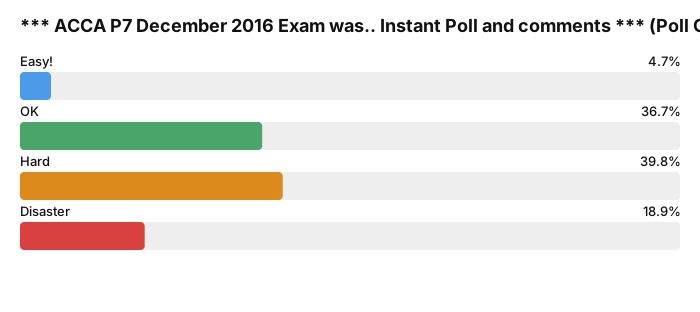
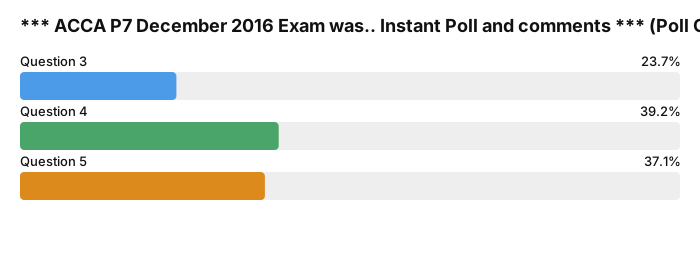
AAA*** ACCA P7 December 2016 Exam was.. Instant Poll and comments ***
Exactly
I lost all marks in audit risk which is my fav area in complete paper
Thank was a very good summary. On that basis. I award you a pass. I think we did the same options. I am hoping for a pass myself.
All the best dude
Seem fine. would add high fixed cost plus using risky derivatives as an hedging tool.
@kolkleen said: I also thought about that, considering the fact that the last two brands did not make up to 10% of revenue. The requirements of IFRS 8 were a bit hazy but had to put something downGlad to know that I wasn't the only one to write about segment reporting. I felt justified cos it was a Listed company & IFRS 8 is mandatory which means that there could be a risk of not reporting the segmental results correctly. Personally,I felt it to be relevant cos segment reporting is what goes into the financials & get published as well..
@nurse said: I found the questions manageable but couldn’t do justice thanks to lack of time :((( Reading takes like 15min so no point in making the exam 3h15min IMO. WHY pushing students to do something in 3.15pm when this time is not sufficient? What is the point i dont get it. It took me 25 mins to read it first time and second time i had gone back and had to read again. So it is not sensible. Extend the time to 3.30 or 4.00 or don't ask to many details question. The first question took me like 1.5h and i had like 1.5 hours for the rest . I have messed up question 4 and 5 as I didn’t have time ? Feeling terrible because it was an easy one on a few accounting standards. :((((( very disappointed.....Is this a rehash of my reply in page 1? :P
You are asking to me or someone else??
@trebreh said: Thank was a very good summary. On that basis. I award you a pass. I think we did the same options. I am hoping for a pass myself. All the best dudeYou said this to me or someone else??
Questions 2, 3 and 4 are up on ACCA:
https://www.accaglobal.com/content/dam/acca/global/PDF-students/acca/p7/exampapers/int/p7int-2016-dec-q.pdf
@xamii said: Exactly I lost all marks in audit risk which is my fav area in complete paperLol....Yes question one was my favorite question dealing with business and audit risk.....all that changed yesterday!!!
@xamii said: Anyone guide me about the risks which i identified in RMM NEW CLIENT(RAMM PROCEDURES) IFRS8 LISTING COMPANY ISSUE 30M LOAN UNDRRSTAte LIABILITIES UNDERSTate EXP BUSINESS RISK: 1 supplier Change regulations Difficult to acquire new runway due to space Theft issue Are these ok???? Or all RMM wrongNew client risk is detection risk nd the ques asked for ROMM, it means only control risk nd inherent risk
Time was a killer allright. It takes so long to decipher the questions. Nothing in the real world puts you under that sort of time pressure. No problems with the paper but by the time you construct an answer in the format the examiner wants, you are goosed for time. Makes you wonder would you just be better off using bullet points.
Hi everyone,
- First question was about:
a) Business risks (10 marks) - I described things, mentioned above by the others (one supplier, going concern, political restrictions, limited rights and some others.
b) RoMM (10 marks) - also described things, mentioned above (loan, rights, inventories, so on)
c) Procedures in order to get understanding of the Internal control of the group (4 marks) - just wrote 4 points in order not to spend to much time on the question which costs only 4 marks
d) Ethical issues (7 marks) - do not like ethical questions, so just wrote about self-review and advocacy threats and moved to the second question.
- Second question was about audit evidence, additional procedures required from an auditor and was asked to consider what matter need to be communicated with TCWG and management:
a) Assets held for sale (9 marks).
Evidence get by the auditor is not sufficient. I wrote that more procedures required in order to obtain it (such as plan of disposal, meeting minutes, where there is a decision of disposal of assets, to analyze if the disposal will be in 12 month period, to recalculate the depreciation (not only arithmetic check), analyze if the assets are recorded under IFRS 5, are the proper disclosure in the FS and some others). I am not confident about the matter to communicate to TCWG, but I mentioned about the lack of knowledge of management and absence of quality control procedures in the audited firm)
b) Capital expenditure (7 marks).
Also not appropriate evidence. Weaknesses in internal control authorization and segregation were need to be communicated under ISA 265.
b) Payroll expenses (9 marks).
Not enough evidence. Spoke here about outsourced services (type 2 report, the nature of communication between the service organization and audited company, existence of control of information get from the service organization before putting it in the FS and so on). Also mentioned about procedures: detailed and analytical (trends) on payroll expenses, which need to be performed by the auditor. The matter to communicate: the audited company do not check the information, provided by the service organization and there is absence of some employees in the payroll list (also recommend some procedures on this matter).
- Question Four was about ethical and professional issues on the described matters:
Here I wrote about the fact, that the group management and group auditors may have something to hide, so scepticism need to be applied. I said that the component auditor need to obtain in a formal way a letter of continuous support from parent and even the FS of a parent in order to analyze if it can really help the subsidiary. Also mentioned about the legal case of a parent company, that it is not a problem of a parent company but also a problem for subsidiary, because id the parent company will have a problem in future, it will not be able to provide financial support to the component and GC issue arise once again. I wrote about possible intimidation threat from group management to group auditor, because the group audit partner asked the component auditor not to modify the report. Finally I mentioned, that if there was no formal letter and no information regarding the legal case, the component auditor need to modify the report. If the management of the client will continue to insist not to modify, the auditor can seek legal advice and may even decide to resign the engagement (do not know exactly, but if no - no marks will be take off).
I divide my answer in 3 parts, as asked in the question (6 marks for skepticism, 14 marks for ethical and professional issues identified and responded).
- Question Five was about the KAM:
a) Describe the useful of KAM (transparency, review audit procedures, more reliable report and some others) and the problems for auditors (first year of such reports, no standards what need to be included as KAM, nothing about the place in the report (except - close to the opinion) and some others) - 8 marks.
b) To decide implications of the 3 matters on audit report:
1st (4 marks) - it is KAM (as properly disclosed, a lot of time used by the auditor, used of valuation specialist, lot of judgments, material amount, significant risk determined by the auditor)
2nd (4 marks) - not KAM, it is a misstatement, but not material (I think so - less than 1% of total assets and revenue). Do not include sign risks and judgment, not material, no necessity of using specialists and so on. So not a KAM, not modified.
But I have doubts regarding my answer to this point.
3d (4 marks) - it is KAM and my answer was very similar to the point one.
Maybe someone write something similar or not?
To me overall, the paper was quite fair. I was happy reading the first part of question 1 where business risk was asked but definitely found it challenging to come up with more than 6 points. Not sure how many points is needed.
Then the part b on material misstatement was fair as i talked about : Goodwill impairment (IAS 36), Borrowing Cost (IAS 23), Derivatives - IFRS 9 (Complex in nature) and the recognition of license cost (IAS 38) - As there were non monetary exchange.
For part c was on the audit procedures/evidence relating to controls an i talked about : Sighting the organisational chart, reviewing the standard operating procedure and reviewing the controls of inventory movements.
For part d was on ethical issues : I raised points on objectivity of the audit assignment and that additional tasks may be a threat to objectivity. I also mentioned that it is fine to take up such assignment but a seperate team needs to be assigned...
Question 2 :
(a) Assets held for sale : Talked about verbal confirmation on the assets to be sold is not concrete and should have further evidence such as advertisements to sell or an S&P
(b) Capitalisation of asset : Cant remember what i wrote but was focusing on the controls and mentioned that the purchase to pay system needs to be walked through and reviewed again (something along that lines)
(c) Payroll Expense : Using the work of an outsourced entity ISA 402 - Third party confirmation is important and need to deal directly as there could be possible manipulation in the payroll file provided by the management on behalf of the payroll company
Question 3 : PFI (skipped)
Question 4 : I found this question attempted was rather the weakest of the lot. I went on to define professional sceptisicm under ISA 200 and how the component auditor needs to question the possible collaboration by the leagal team and the group auditors. And i cant remember anything else that i wrote.
Question 5 : (a) Why is there a need for KAM? I wrote that it is to bring more emphasis on the face of the audit report for the users to be able to make decisions (along that lines)
What are the problems faced in the KAM? I wrote that items listed there requires high judgements and may to be too complex for users to understand. Then i also mentioned that it is difficult for auditors to estimate on the relevance and accuracy of the item.
(b) What is the impact on the audit opinion.
All of whish i computed the materiality first.
i. Goodwill
I wrote that the audit opinion will be unmodified but with KAM paragraph stating that the impairment test has been carried out with the valuers confirmation and that there is no impairment for that year.
ii. Provision lawsuit
There was a lawsuit at the component level and the report was unmodified. So i mentioned that at the group level there is a need to modify the report as the provision was not done as per IAS 37. The report will be modified with the basis of opinion stating an "except for" since the item is material and not pervasive (IAS 705).
iii. Was it disposal? Cant remember
I computed the materiality and found that the disposal was only 0.8% of the total assets and hence was not material to the financial statements. However a disposal was a matter to be brought to the attention of the stakeholders and so under ISA 706 Emphasis of matter and other matters paragraph, it should be highlighted.
I dont know how i am going to fair in this sitting, just hopefully some miracle happens :) All the best on your results guys!
@saajan said: New client risk is detection risk nd the ques asked for ROMM, it means only control risk nd inherent riskI.diecuss the new client with the point.of. view of high inherent risk
The p7 was not difficult at all, but it was hard. The duration was not fair at all, especially for the Question 1. I cannot just agree that, anybody can finish the Q1 within 63 minutes. That alone can cause students to panic in the exam.
Going forward I think it will be a wise decision to leave Q1 till the end, rather than starting with it.
Nevertheless, may Allah bless what we were able to put down, amin
Hi guys,
I see a number of you discussing risk of material misstatement (Q1b)
I am not going to discuss the whole paper but please note that the question wanted 4 "SIGNIFICANT" risk of material misstatements.
These are risk that require special audit attention and involves risk relating to fraud, complex transactions, related party transactions, transactions involving high degree of subjectivity.
So, for example fuel derivatives as a risk would qualify as a significant ROMM as it should be done in accordance with IFRS 9/ IAS 39 which is a complex standard for both management and the auditor
Inventory would also qualify as it related to fraud (misappropriation of assets). Though the amount of inventory stolen was immaterial at about $12 500 the scenario stated that management were worried that the problem might be broader which then meant that as an auditor you needed to consider the possibility of inventory stolen being material. Thus your inventory being overstated and inventory write off understated
Having mentioned the above, this makes risk like the IAS 23 borrowing costs that I see a significant minority of you talking about, being not relevant to what was asked. (i.e interest to be capitalised not a complex calculation, not estimations, no fraud, etc).
Again IAS 23 is made more irrelevant to fact that IAS 23 relates to assets being constructed, were capitalisation of interest is over the construction period. Information in the scenario said the aircrafts were purchased from a supplier, which means the was no period over which the company needed to capitalise the interest.
IFRS 8 was also not relevant as this is a disclosure requirement and the question explicitly instructed you not to include risks relating to disclosures
Operating segments is not an allowable ROMM, as it is purely DISCLOSURE related.
It doesn't change the figures within the financial statements.
the exams not fair in respect of the time given!!! if your given more time its doable....
really gutted if i have to sit it again!!!
hate question 1 as it throws you off for the rest of the exam as takes too much time to do.. but this q 1 was annoying, the disclosure bit through me off....
couldn't really find that many business risks as usually compared past exams, but now reading from above im upset these never came to me earlier.... ahhhh
last sitting q1 was fair, i passed it but failed the paper cause i spent too much time on it..
honestly if i just get 50% ill be happy, don't need anything more than that!!!
ya Allah please help me
all the best to you guys and gals too
this was one of the toughest P7 papers i have ever seen,and to top it off Question ! consumed too much time,wasnt such a tough question but too time consuming. Question two b was rather tricky,the options were terrible,especially the 5th one were all the scenarios seemed fine,can anybody tell me what they wanted us to do here as barely reading the texts would not get u marks here. Terrible paper
Q 1 took most of my time.
Q3 On cashflow looked friendly but upon realising i only had less than an hour to go opted for Q5 since a relevant Technical article on KAM was issued just before exams under the heading New auditors report.
Looking forward to a gentleman's pass Godwillingly.
@mogorosi said: Hi guys, I see a number of you discussing risk of material misstatement (Q1b) I am not going to discuss the whole paper but please note that the question wanted 4 "SIGNIFICANT" risk of material misstatements. These are risk that require special audit attention and involves risk relating to fraud, complex transactions, related party transactions, transactions involving high degree of subjectivity. So, for example fuel derivatives as a risk would qualify as a significant ROMM as it should be done in accordance with IFRS 9/ IAS 39 which is a complex standard for both management and the auditor Inventory would also qualify as it related to fraud (misappropriation of assets). Though the amount of inventory stolen was immaterial at about $12 500 the scenario stated that management were worried that the problem might be broader which then meant that as an auditor you needed to consider the possibility of inventory stolen being material. Thus your inventory being overstated and inventory write off understated Having mentioned the above, this makes risk like the IAS 23 borrowing costs that I see a significant minority of you talking about, being not relevant to what was asked. (i.e interest to be capitalised not a complex calculation, not estimations, no fraud, etc). Again IAS 23 is made more irrelevant to fact that IAS 23 relates to assets being constructed, were capitalisation of interest is over the construction period. Information in the scenario said the aircrafts were purchased from a supplier, which means the was no period over which the company needed to capitalise the interest. IFRS 8 was also not relevant as this is a disclosure requirement and the question explicitly instructed you not to include risks relating to disclosuresHow about opening balances? the client was a new audit client? even fraud may not be a significant risk if its not material. You make a good point but there may still be inherent flaws in any answers. let the examiner decide.
First and the third scenario are fine with the audit opinion but additional para of KAM were to be updated. This is what I wrote..
Time pressure
@mogorosi said: Hi guys, I see a number of you discussing risk of material misstatement (Q1b) I am not going to discuss the whole paper but please note that the question wanted 4 "SIGNIFICANT" risk of material misstatements. These are risk that require special audit attention and involves risk relating to fraud, complex transactions, related party transactions, transactions involving high degree of subjectivity. So, for example fuel derivatives as a risk would qualify as a significant ROMM as it should be done in accordance with IFRS 9/ IAS 39 which is a complex standard for both management and the auditor Inventory would also qualify as it related to fraud (misappropriation of assets). Though the amount of inventory stolen was immaterial at about $12 500 the scenario stated that management were worried that the problem might be broader which then meant that as an auditor you needed to consider the possibility of inventory stolen being material. Thus your inventory being overstated and inventory write off understated Having mentioned the above, this makes risk like the IAS 23 borrowing costs that I see a significant minority of you talking about, being not relevant to what was asked. (i.e interest to be capitalised not a complex calculation, not estimations, no fraud, etc). Again IAS 23 is made more irrelevant to fact that IAS 23 relates to assets being constructed, were capitalisation of interest is over the construction period. Information in the scenario said the aircrafts were purchased from a supplier, which means the was no period over which the company needed to capitalise the interest. IFRS 8 was also not relevant as this is a disclosure requirement and the question explicitly instructed you not to include risks relating to disclosuresThere is a risk in both ways. If the asset is under construction, there is a risk of not capitalizing financial expenses over the cost of under construction airplanes, leading to overstatement of expenses and understatement of non-current assets. If the asset is ready for use, there is a risk of capitalizing financial expenses .... and so on. (this part is related to fraudulent financial reporting due to management bias) I guess stating that the loan was specifically borrowed for financing the airplanes transaction is so obvious there is a risk associated with interest.
Topic lockedNew replies are closed.