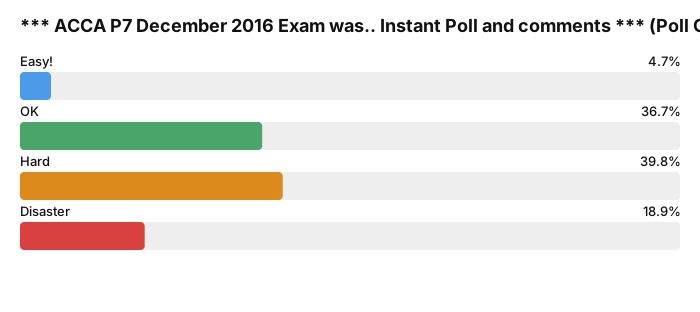
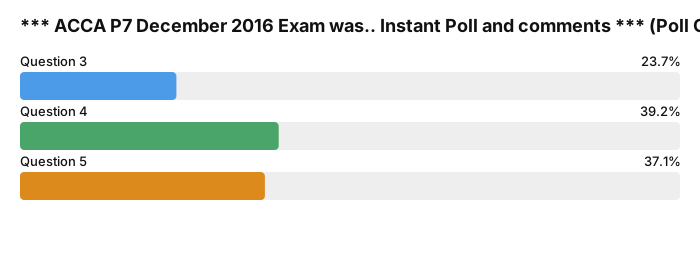
AAA*** ACCA P7 December 2016 Exam was.. Instant Poll and comments ***
extremely time pressured. I am not too sure what is the rationale behind asking the candidates to do a lot in so little time
There couldn't have been borrowing cost as a qualifying asset is one that takes alot of time to get ready.
I wrote international version and i thought it was fair.
1.Group audit
A.Required an evaluation of business risks facing an Madness airline group
-new government regulation on landing times
-landing rights are very difficult to secure
Etc
B.Four significant risks of material mistatement
-Five new aircrafts purchased
-recognition of landing rights
-non cash transaction where the landing rights were exchanged with a competitor
-derivative which is recognised in current assets @$40m
-Fixed loan
-Goodwill
C.further information which can be provided to the audit team about group wider controls
D.ethical issues involved
This was 35 marks worth.
2.a.assets held for sale and discontinued operation
b.capital expenditure
c.payroll expenses
The question required to evaluate appropriateness and sufficiency of audit evidence,recommendation of further audit procedures and information to be communicated to those charged with governance about deficiencies in internal control.
3.Cashflow.did not attempt
4.several issues between the component auditor and group parter .The subsidiary was no longer a going concern.Yet a letter of support was not provided except for a verbal confirmation.The parent was facing legal woes.With a litigation pending .The partner refused to provide copies of legal representations.The management declined meetings and explanations.The partner was pushing the component auditor to issue an unmodified report regardless of lack of evidence which could trigger a potential disclaimer.
5.KAM
b.Audit report..I left 4 good marks here and was dissapointed..This was probably the easiest question in this exam
I was so regretted that I escaped Q3 to complete Q4. After I conducted half of Q4 I started to realize that Q3 might be more easier to get scores(once you get the calculation right, with another one or two sentences to explain, you are guaranteed to get some scores.), while Q4 is very hard to get the right answers since I do not quite understand the request of the question.
Anyone has same concern like me?
I woke up four times at Sunday night because I have diarrhoea that night, so I do not have a lot of energy to finish the test. And my head is not very clear at the test center, so I think that I might choose the wrong question to answer. Just hope for the best.
Revenue recognition is presumed to be a significant risk for sure.
I found this Dec16 sitting was rather fair but slightly challenging in the aspect of having to read the first question's case study numerous times. Here are my take on this paper :
Question 1 : This question most certainly burnt my stamina in trying to understand what the examiner was trying to say with regards to the license and the rights of landing. It took me some time to digest. The briefing note format was rather standard and i highlighted the points as below :
a) Business Risk - I managed to come up with 6 points that includes the competitors advantage, limited supply of license can cause a going concern issue, new regulations, fuel prices may vary....
b) Material Misstatement Risk - Recognition of license cost (IAS 38), Goodwill impairment (IAS 36), Derivatives Accounting (IFRS 9) - Complex in nature, Borrowing Cost (IAS 23)
c) Audit procedures relating to control - Reviewing the organisational structure, reviewing SOP's and walkthrough process of the purchase to order system.
d) Ethical issues - A non assurance audit engagement will cause a threat to objectivity and imply a self review and self interest threat (along that lines). Safeguard is to have seperate engagement team to handle.
Question 2 was on the completion of audit and to comment on the audit evidences (ISA 500)
a) Assets held for sale - Verbal confirmation on the existance of the assets to be held for sale is not a strong evidence. Further evidences like S&P agreement, board of minutes meeting is necessary. Control issues on the incompetence of the human resources department needs to be vet through since the finance director and the staffs does not have the necessary competence to review the journal that needs to be posted.
b) Capitalisation process - Talked more on the control process where there was no proper authorisation. Cant really remember...
c) Payroll expenses - Using the work of an outsourced entity ISA 402. There is a need to communicate directly with the outsourced entity instead on relying on the report provided by the management as there might be some manipulation in the figures. The evidence is not suffcient and the payroll report provided directly from the payroll services will be more reliable.
Question 3 : PFI (Skipped)
Question 4 : I defined professional scepticism under ISA 200 and went on to describe the responsibility of a component auditor and the potential colloboration that can take place between the legal team and the group auditor. This question remained vague to me and was the weakest amongst the rest.
Question 5 : Why there is a KAM in the audit report? I went on to explain that KAM will bring a highlight to the users on the key issues. This gives more deeper explainations on the close call matters and should be seperate from the EOM and OM.
What are the difficulties in KAM disclosures? I went on to explain that the use of judgements and estimates is high and may not be accurate. Also the complexity and and relevance of the disclosure is also hard to determine. And if the KAM is understandable by the users.
b) Impact on the audit opinion - I started off by computing the materiality for each of the section below
i) Goodwill
I mentioned that since there is indeed no impairment on the goodwill and the amount is material to the financial statement and that it have been confirmed by the valuers and auditors, then an unmodified report should be issues but should contain a KAM paragraph under ISA 701.
ii) Provisions
Since the component auditors did not modify their report nor perform an adjustement, then the report issued by the group should be modified under ISA 705 with the basis of opinion paragraph inserted as "except for" one item since the provision is material and not pervasive with having sufficient and appropriate audit evidences.
iii) Disposal
As per the materiality computation, this items represented 0.8% of the total assets and hence its not material to the financial statement. Therefore, a unmodified opinion should be issued but with this item of disposal being highlighted in the Other Matters Paragraph under ISA 706.
I found this paper rather challenging and tiring till the end. Lets all hope for the best in this sitting :) All the best in the results guys!
I am not sure if i understood the question correctly, but i tried to make sense out of the materiality as well since the question provided with some assets and profits figures. I guess although there were already work done, we need to base our opinion on that to derive at the type of report to be issued commenting on the materiality as well? I am really not sure :(
well it was rough for having stayed away from exams for a year plus. alot of question practice would have done it for me.. am sure March i will be more than ready
i agree with most of what you said.Probably enough to secure a pass.I left the last part of the audit report - marks due to time .I thought service organisations applied to outsourced payroll service thus the Thornhill would require both report 1 and report 2 directly from the auditor and management of the service organisation.Also a direct confirmation from the auditor at service organisation about any significant matters which may suggest that the controls over payroll are not working effectively.With the permission of the client, deploying part the team to perform test of controls or substantive procedures on the payroll.Enquiries of management at client on the processes and procedures of hiring and authorisation of cash payments for casuals.
I totally forgot to mention Type 1 & 2 report although i revised it. That would have gained me some marks as well! But i did mention about the hiring process and the controls in the human resource department. Lets hope for a pass! i dont need anymore marks above 50 :)
I am also trying to get a grasp of how you guys used borrowing costs under IAS 23.I didnt see any evidence that the previously purchased 5 planes did not get landing rights.I thought maybe your assumption was that since they will take long before use then IAS 23 is relevant.5% $300 fixed and secured on assets right?Because IAS 23 is very popular on self constructed assets which are capitalised over a long time which wasnt the case.Unless if the assumption is that the landing rights will delay the use of the aircrafts thus for the mean time they have to be capitalised under IAS 23 then I cannot argue.The fair value of the derivative was recorded at $40 m in current assets.I wasnt so sure here.
you have every single chance to pass this paper
On Q1 what was everyone's take on the note about not basing your answer on disclosure in part (b) about material missstatements?
Did most people base their answers on valuation?
Think I confused disclosure with treatment which put me off using the obvious ones like nca, gw and dep'n.
Would op bal's and transposition for consolidation have scored anything here?
I used the fact that the year end of the financial statement was on 31 March 2017 but the loan was secured on 1 July 2016. So the risk here was that, the borrowing cost might have been capitalised for 1 year instead of 9 months. I also mentioned that the finance cost might be overstated. Not sure if i am on the right note.
To me, disclosures are more related to standards involving related parties, non adjusting events, contigent assets and liabilities. I guess it was the examiners hint on not commenting on accounting issues relating to those matters? But GW, NCA can be measured reliably and will have a direct impact on the financial statments itself?
based on the answers from my fellow colleagues here am in the region of 20 to 27%
I looked at Q3 and went to skip then realised it was PFI and the notes to the CF prompted a lot of marks.
Q3a.
Evaluate the appropriateness of the cash flow forecast and suggest further audit procedures to perform. (14 marks)
Appropriateness.
-Sale of investments: Held at FV of $350k yet management have recorded a sale at $500k in two years time.. optimistic.
-The company have negative projected CFs for the next 2 and a half years and expect the bank to loan $1.5m when the current loan expired and is repaid.. unlikely.
-Two more than I am struggling to remember!
Further procedures.
-Review prior performance of investment shares to confirm whether $500k is reasonable.
-Inspect all bank correspondace for evidence of previous defaults or mispayments of loan.
-Review competence of the CF preparer, look at credentials etc.
-Review sales forecasts to confirm the reasonableness of the cash receipts from customer.
Q3b.
Evaluate the matters to consider in respect on the loan from Mr J. Stewart. (6 marks)
-Related-party transaction
-All parties to be adequately disclosed regardless of whether transactions occurred or not
-Disclose all related party transactions
Further procedures
-Obtain RPT list from the prior period and investigate any discrepancies / additions
-Discuss with management their procedures for recognising a RPT
-Inspect notes to FS to confirm all disclosures are appropriate and adequate.
I thought it was a tough paper. Reading the latest article about KAM a few more times would have helped with Question 5a.
7 marks for ethics was a lot of marks in my opinion. For me, I would have preferred a split of 12 marks for Business Risk and 8 marks for RMM, instead of the 10/10 split.
Q2 was tough, with IAS265 last being tested in June 2008 if I'm not mistaken! But this was after the ACCA had published an article in April 2008, so I felt this was tough.
Q3 on the forecast, was a very open question in my opinion, and I think we may be given a few choices for our answers in the template answer. I picked up things like, the instrument was worth $365k at y/end, but was expected to generate income of $500k in 2 yrs to match the loan repayment. Inflation had been taken away for salary, instead of being added I think.
I did Q3 because I thought it looked easy, but when i was working on it I got the feeling that the CF Forecast was very basic / high-level and said almost nothing on any future trends or plans / investments, all in- and outflows staid the same except for inflation. So I questioned whether the forecast was suitable for going concern / assumptions appropriate...
I was wondering about that too.
The landing rights that were exchanged on a non-cash basis, what was the right treatment? I waffled on valuing and taking any difference between the new rights and the one they gave away to P&L
Does anybody know what the right treatment should have been? I'm loathe to pick up the P7 text book again unless I find out I have failed.
Q1. Landing rights exchange on a non cash basis? what is the appropriate treatment?
really? I am so regret that I do not have a chance to do Q 3. Instead I did Q4 &Q5. You give me a little relief.
same as derecognition of non current assets with a loss or profit on disposal recognised in profit or loss.Landing rights appear under intangle NCA and are armotised over their life.Any accumulated armotised should be removed from the books.
Do you really think they want us to pass?
How would they make more money if we don't keep writing the exams.
Sad but true :-(
Plus that is what makes us proud and adds VALUE once we have passed.
Yes, the exam is designed and meant to be Hard. Not designed to be easy at all :-)
I found the questions manageable but couldn’t do justice thanks to lack of time :(((
Reading takes like 15min so no point in making the exam 3h15min IMO. WHY pushing students to do something in 3.15pm when this time is not sufficient? What is the point i dont get it. It took me 25 mins to read it first time and second time i had gone back and had to read again. So it is not sensible. Extend the time to 3.30 or 4.00 or don't ask to many details question.
The first question took me like 1.5h and i had like 1.5 hours for the rest . I have messed up question 4 and 5 as I didn’t have time ? Feeling terrible because it was an easy one on a few accounting standards. :(((((
very disappointed.....
Anyone guide me about the risks which i identified in RMM
NEW CLIENT(RAMM PROCEDURES)
IFRS8
LISTING COMPANY ISSUE
30M LOAN UNDRRSTAte LIABILITIES UNDERSTate EXP
BUSINESS RISK:
1 supplier
Change regulations
Difficult to acquire new runway due to space
Theft issue
Are these ok????
Or all RMM wrong
@xamii, why were operating segments a risk? Not following your thought there.
I had the $300m loan, is it in line with IFRS 9 financial instruments, as the loan and interest payable were both material.
Landing rights, I read this to mean a licence and talked about being valued as per IAS 36 with impairment due, which would be material.
Inherent management bias due to being a listed company, would be tendency to overstate profit and assets due to manipulating subjective elements of the financial statements. Also talked about new audit requirement.
Fuel derivatives - this was an easy one! As $40m, this was material! this could easily be misstated if team not experienced enough.
Business risks:
Did it say there was only one supplier? I did not take this from scenario, only that they had ordered and received the 5 planes, they could use others for future purchases.
Change regs - yes I had this one
Difficult to acquire landing rights:- this does not mean new runways or anything physical, just the licence to use certain times and routes.
Theft issue - said this was not material but reputational and could become a problem if developed.
Fuel issues - I mentioned this big risk as 30% of costs, so v material and relies on consistent oil supply and subject to price rises.
Providing you argued using good explanations you should be ok.
Operating segment risk is that
The company may not be follow the rules and didnt segmented the business properly
And my remaining risks are not right?
same here. Did not have time to recover from that so i just moved along
@xamii said: Operating segment risk is that The company may not be follow the rules and didnt segmented the business properly And my remaining risks are not right?I also thought about that, considering the fact that the last two brands did not make up to 10% of revenue. The requirements of IFRS 8 were a bit hazy but had to put something down
Topic lockedNew replies are closed.