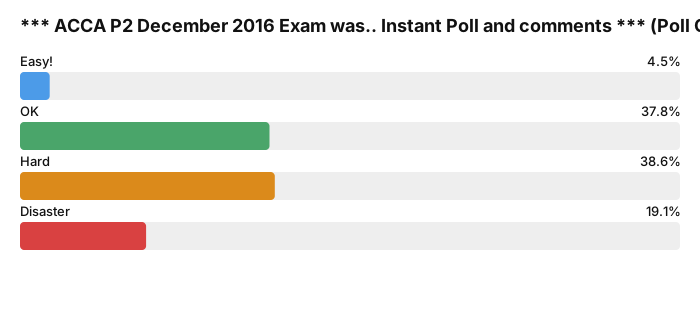
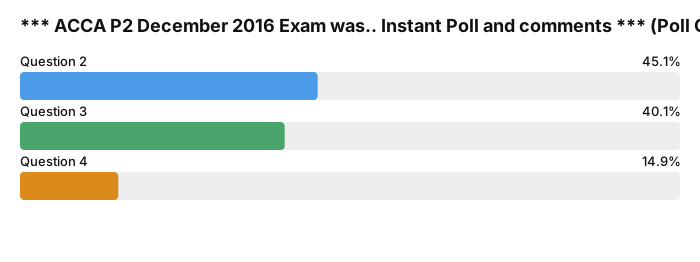
SBR*** ACCA P2 December 2016 Exam was.. Instant Poll and comments ***
@seanog91 said: Correct me if I am wrong and I do not want to panic you but see below : The functional currency for Minor was Euro as they sold to the competitive market in Euro. this is the main criteria of 21. they only bought goods in dollars from the parent but converted to euro in Portugal. Also, ther was no Active market in the scenario so we can not use level1. We have to use Level 2 as they were all listed companies. The definition they had for an inactive market was wrong as well. I agree to you. The functional currency for minor was euro. one of the reason was that too that its local govt determine the price for the products imported from its parent.
was the question about gains on losses on pension schemes as in defined contribution plan or defined benefit scheme? I think i messed that one up big time cause i thought it said the increase was in the 'final' salary? so treated the whole thing as actuarial gains and losses and so should be on OCI not PL.
aw i'm screwed
P2 was OK, I could answer every question, rushed to get at least a written page or more on each of question 2. a, b and c as well as 3. a, b and c.
Question 1 was so-so, the disposal calculation was a bit of a fail and didn't know much to much about 1. b but wrote a lot of stuff in the hope of a mark or two.
I am hoping for a pass, I really put a lot of time into preparation for the exam.
@almoosawi4 said: Just quick question, Q1 (b) it was asking about P&L vs OCI and recycling process. Or it was about types of pensions?I know 1C) was about the pension scheme and how the directors were worried about increase from 10-15 and how they planned to use creative accounting to have the pension costs go through oci which would increase operating profit and this is what their bonus was on, basically think you had to say the scenario and then talk about it being unethical ect. 1)b) I literally had no idea what this wanted, something about different Ifrs for small entities. 0/8 for me
@kevikraze said: I know 1C) was about the pension scheme and how the directors were worried about increase from 10-15 and how they planned to use creative accounting to have the pension costs go through oci which would increase operating profit and this is what their bonus was on, basically think you had to say the scenario and then talk about it being unethical ect. 1)b) I literally had no idea what this wanted, something about different Ifrs for small entities. 0/8 for meI didn't know much about it either... I assumed to explain items such as service costs that are SPL items and actuarial re-measurement that was a OCI item. Then stated that it will be OCI and not reclassified to PL because the entity will never benefit from it as the financial gain or loss will stay in the pension fund but it increases the value of the business hence we recognise it... but I don't know if that's correct. I hope the marker thinks it is.
@kevikraze said: I know 1C) was about the pension scheme and how the directors were worried about increase from 10-15 and how they planned to use creative accounting to have the pension costs go through oci which would increase operating profit and this is what their bonus was on, basically think you had to say the scenario and then talk about it being unethical ect. 1)b) I literally had no idea what this wanted, something about different Ifrs for small entities. 0/8 for me1 b) I thought it was about P&L vs OCI and recycling and I started to write about the technical artical. https://www.accaglobal.com/an/en/student/exam-support-resources/professional-exams-study-resources/p2/technical-articles/pl-oci.html
Hi everyone. Glad you all got on well. Bits were tricky but actually I thought it was quite a fair exam. I liked the number of SFP workings in the I/S and I kept thinking of the easy marks for proportioning the sub and associate for 9/12 and 3/12 respectively. I think my NCI working was total rubbish. I thought the ethics question, principle currency and related party questions were opportunities to score really well. There was nothing in the exam that I had never ever come across before, but unfortunately you can't remember everything, so I blew a few marks I really should have got!! I do not know I/S and particularly OCI that well so didn't like 1b at all. I just didn't get the strong hints they were making about the pensions, so I totally bluffed it, but just tried to use the question to answer it and hoped for application marks. If I was doing it again I would have spent a lot more time on the technical articles. I used the Revenue 5 step model for the inventory order in question one. The total sales were $22m (including the credit note) there or there abouts, so I proportioned each sale to the total and just said when they would recognise each sale- one was within a week etc. I used 3 booklets as one time I got 49 in an exam and I promised myself it would never ever happen again!!! If I have to write just one sentence on the end of every question for the last ten minutes that's what I do!!!!!
In 1(a) I calculated loss on subsidiary disposal in CP&L because net assets od Ginny at disposal date increased significantly. At acquisition they were 114, next year 118 and at disposal plus 9/12 * TCI 48. For the building I assumed that 2 floors are PPE (owned-occupied by parent and by Boo-for group purposes BOO is also treated as owned occupied), remaining 8 floors as investment property. I calculated depreciation for PPE part only and revaluation gain for PPE included in OCI, revaluation for investment property in P&L.
Provision for repair I reversed-it is not in line with provision definition.
My main concerns regard revenue part-I think that discount should be included in price determination, opposite entry would be CR provision as customer will meet contract target.
Credit notes I also included as decrease of revenue.
1(b) here I mainly focused on accountign treatment and mismatch of showing remeasurement in OCI and rest of effects in P&L.
1(c) typical ethical question-I wrote taht directors are concerned to act ethically and honestly, about faithful presentation, about self-interest etc.
Question 2.
(a)Functional currency-I believe it should be dolar, yen, dolar. The third company is acting more like distribution centre and it's prices are determined by Suntory.
(b) and (c) I don't remember tchem well
impairment of intangible assets and depreciation based on economic useful life
(c) related party-I write only few sentences as normally writing definiton who and what is related party would take me 20min...
question 3
(a) fair value measurement of financial asset. Company used level 3 inputs while level1/2 were available and thanks to this overstated assets.
(b) I don't remember-maybe I will wrote later about it
(c) it was about valuation of net assets of acquired subsidiary and the fact that acquirer recognized gain on bargain purchase. I wrote that this may be indicator that fair value of net assets was not correctly measured as it was based on level 3 input cost-approach (cost of replacement). It would be better to use market-approach or income approach based on DCF method.
For the revenue part - I thk discount should be included as per IFRS 15 step 3.
So the revenue should be 6000x960 + 7000x1000
They didn't purchase over 15000, no further discount should be recognised
For investment property, only 8/10 should be resognisd = 96 x 8 / 10
And two floor PPE = 81 x 2 / 10
Not sure if I rmb the number correctly
And the deprciation part I assume it is recorded correctly as per question said.
@kakahh said: For investment property, only 8/10 should be resognisd = 96 x 8 / 10 And two floor PPE = 81 x 2 / 10 Not sure if I rmb the number correctly And the deprciation part I assume it is recorded correctly as per question said.Had the same idea, but divide it by "8" 2/8 & 6/8, I don't know what happen to me when calculating
Minor definitely dollar, was just an extension of parents.
For p and l got the difference in disposal to what they recorded so stated down to FV adjustment.
Investment property I put two floors for ias 16 as parent and their sub used them. Then rest to ias 40. So 1.2 to oci and 4.8 to p/l.
For fire damaged out through 6m as impairment loss and another 3 to balance transaction out.
For sales I didn't give discount as they didn't reach sales target. As already recorded 6m I put another 6.76m through revenue.
Hard notes which looked easy but tricky.
Best thing I done was all theory first and spent one hour on the numbers and got it finished on time. I seen people round me start on the numbers and still on it over 95/100mins plus later. So more than half the time for 1/3rd marks.
Does anyone know when we get the results?
I think the results are out on 16th of January.
Cheers Neil.
For goodwill as well I reduced to 18 and worked out impairment loss of 1.8. Thy what everyone else done?
@glasgowceltic67 said: Cheers Neil. For goodwill as well I reduced to 18 and worked out impairment loss of 1.8. Thy what everyone else done?Yes I originally calculated the goodwill in investment in Ginny to be $18m and the question mentioned the 10% impairment so adjusted for that $1.8m similar to you
IFRS 15 Revenue from Contracts with Customers was issued by the IASB on 28 May 2014 and applies to an entity's first annual IFRS financial statements for a period beginning on or after 1 January 2018.
@kakahh said: For the revenue part - I thk discount should be included as per IFRS 15 step 3. So the revenue should be 6000x960 + 7000x1000 They didn't purchase over 15000, no further discount should be recognisedIFRS 15 Revenue from Contracts with Customers was issued by the IASB on 28 May 2014 and applies to an entity's first annual IFRS financial statements for a period beginning on or after 1 January 2018.
@glasgowceltic67 said: Cheers Neil. For goodwill as well I reduced to 18 and worked out impairment loss of 1.8. Thy what everyone else done?I did the same by reducing the Goodwill to 18 Mn and charging 1.8 Mn to the P & L. There was a similar past paper question where the net assets as at acquisition date was adjusted in retrospect.
ACCA posted the questions online. If tutor has any comments ?
@shahimk said: IFRS 15 Revenue from Contracts with Customers was issued by the IASB on 28 May 2014 and applies to an entity's first annual IFRS financial statements for a period beginning on or after 1 January 2018.thanks for your info but I thk early application is permitted and it looks applicable to me :<
What's this about some people's question 1b being about IFRS for SMEs?? I didn't have any questions about SMEs in my paper?
Different variants that was 1(b) in the Irish variant I did.
This is if you took the UK variant (i.e. New UK GAAP, FRS102 etc.)
@stanners1 said: What's this about some people's question 1b being about IFRS for SMEs?? I didn't have any questions about SMEs in my paper?This is if you took the UK variant (i.e. New UK GAAP, FRS102 etc.)
Have you guys noticed that ACCA published a technical Article just days before the exam (3 days) which was examined. I find this very disappointing and do not understand why no effort was made to publish this article any earlier, especially given that all exam papers are written well in advance!
.
I tried answering Q4 because Q3 is difficult for me (except the level disclosure).
Cant really remember the questions. For the principle i wrote something like providing a future expected credit loss so that entities would have sufficient buffer to protect themselves in the event of adverse market conditions.
I wrote the 3 stage general approach in which stage 1 refers to performing assets and not credit impaired upon origination. 12mths ECL to be provided at this stage. Stage 2 relates to significant deterioration in credit quality, to provide lifetime ECL. Stage 3 to is the impaired assets, lifetime ECL as well as to adjust the revenue recognition using a credit adjusted EIR.
Simplified approach allows entities to adopt a simpler method. This is by providing a lifetime ECL, eliminates the monitoring of credit quality. But the requirement is that the assets does not have a significant financing component and is not more than 12 mths.
Method for significant deterioration include change in price, credit spread, internal/external ratings, cross-defaults, mia/dpd.
Securitize loan. Originate at stage 1. Then transfer to stage 2. There was increase in credit risk due to market conditions affecting the repayment capability. Loan ratio to collateral also increased. The borrower also no longer deemed as low credit risk. But provision amount could be zero due to LGD portion(property value-collateral coverage against loan)
Clean loan. Originate stage 1(not credit impaired upon origination). Then remained at stage 1 as there is no change in pd rate. 12months ECL would be the 20% of gross loan expected loss if the loan defaults, as assumed no ammortisation and ignore time value of money. Nothing to do about the approx of lifetime pd(this is just to help if you think the loan significantly deteriorated).
Any person who clear about Part b of Q3
Explain me how you treat that 1..
What standards is used in P2 Q3 Part bq
Q4 included a question related to financial asset... What was the answer...
Topic lockedNew replies are closed.