
Please vote in our Instant Polls about the ACCA F5 March 2018 Exam
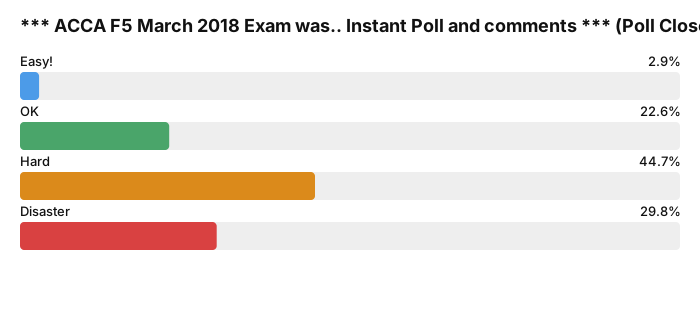 Post your comments about the ACCA F5 exam below
(comments will open after 5pm UK)
 Post your comments about the ACCA F5 exam below
(comments will open after 5pm UK)
@vinxi said: Even when division A had external demand it didn't sell those units at 14 to be. As far as I remember n that was the point I notes that after fixed cost addition there was a too high price charged for transfer which couldn't be acceptible when there's no external demand also it cannot be considered as minimum too even it was more than divi b could get from external. But still rule is to add cost incurred when no external market n that includes fixed cost . That's what is bothering me..God knows what was the correct minimum transfer price. Ppr was hell bad for me overall.Div A had always had external damand-200 000 units. They were selling at fool to it and only what they had extra up to their max capacity (350000)they were selling to div b. That was the problem- div b wanted more, bcs they were able to sell more and they were making bigger profit. Thats why they had external supplier at the same price. Q was if there was no such supplier, what would be min transfer price, but i think they meant fair for both div's... you know- goal congruence, wats best for the company as a whole...
@viscera said: #all I just want to say one thing.. Acca are getting unfair with the question asking style, their provide us with very few information's and expects us to answer these question us making the right asumptions... How can that even be possible... in the Transfer pricing question part (b) they were asking that how much to sell internally and externally with the optimum benefit to the company and then in the question it was clearly written that Div B wants 150,000 of adaptors because it wasn't utilizing its full production capacity, even with the demand of battery be like 180,000... Div A had 200,000 external demand as the question was taking me ... it was clearly showing that Div A is full filling both Div B demand and External demand completely.. The i ask from the acca whats the point of asking this kind of question, are u guys trying to confuse us, or u guys dont have any other thing left to askI absolutely agree with you.The ultimate objective should be the learning by testing concepts. Not confusing candidates to make mistakes. And confusing on things which are not part of the syllabus but based on a IQ level which varies from person to person.I was thinking as once told by my tutor such low quality questions can only be seen in BPP and Kaplan kits but now ACCA is also following the same path.
@chrisj1 said: Did anyone have a question on tables and chairs in section B? One question was how many tables should be produced in quarter 1, limiting factor was 25m3 of oak each table used 5m3....however, 4 tables was not an option so I selected the maximum demand.If i remember correctly i thought the question ask how many chair should be produced. It was only one scare resources material and unlimited labour so you are correct it is a limited factor. First you would have to rank the product based on return per scares resource. Chair was rank second, therfore table would be first. I dont remember how many unit but i remember that only 12 meter was available for chair only and each chair use 0.2 meter Therfore 60 chair should be produced 12÷0.2 = 60
@odean20 said: If i remember correctly i thought the question ask how many chair should be produced. It was only one scare resources material and unlimited labour so you are correct it is a limited factor. First you would have to rank the product based on return per scares resource. Chair was rank second, therfore table would be first. I dont remember how many unit but i remember that only 12 meter was available for chair only and each chair use 0.2 meter Therfore 60 chair should be produced 12÷0.2 = 60Yes 60 chairs is the correct answer.....
@natss said: In question 31 I calculated learning rate 96% 400*32*r5=10368 r5=0.81 r=96% How did you get 90%?The second batch takes 360 hours The first batch takes 400 hours Therefore divide 360÷400 = 90% Or 1 batch take 400 hours 1 batch take 320 hours Add both batch and divide by 2. That is (400 +320)/2 = 360 hours An then divide by the 1 first batch 400. That is 360÷400 = 90%
@odean20 said: If i remember correctly i thought the question ask how many chair should be produced. It was only one scare resources material and unlimited labour so you are correct it is a limited factor. First you would have to rank the product based on return per scares resource. Chair was rank second, therfore table would be first. I dont remember how many unit but i remember that only 12 meter was available for chair only and each chair use 0.2 meter Therfore 60 chair should be produced 12÷0.2 = 60yea right ans is 60
@dipta3308 said: can anyone tell how u guys calculated the 31 question variance?That was a trick question. First you would have to calculate the revised standard using the learning rate of 85% The question say after three month ( the 2 batch) the the product reach a steady state. My reason was that i should find the nth batch of the remaining 14 batch (16 batch - 2 batch) Y=400× 2 batch^0.234 Y=340.109 hours Total hours for 2 batch (340.109 × 2 batch) = 680. 22 hours Y= 400 × 1 bacth ^0.234 =400 hours Total hours for 1 batch (400 * 1) = 400 hours Therfore the nth batch is ( 680 - 4000) = 280.22 hours Batch 3 onward would take 280.22 hours Month 1-3 would take 680.22 hours Month 3-6 would take 3923.08 hours ( nth batch 280.22 × the remaining 14 batch) Total hours work 4603.3 hours Revise standard is 4603.3 hours × $16 = $73652.80 Original standard is 400 hours × 16 batch × $16 = $102400 Planning variance is $28747.2 F Revise standard is 4603.3 hours × $16 = $73652.80 Actuall hours worked is 5184 hours × 16 =$82944 Operational variance is $9291.20 A
@odean20 said: That was a trick question. First you would have to calculate the revised standard using the learning rate of 85% The question say after three month ( the 2 batch) the the product reach a steady state. My reason was that i should find the nth batch of the remaining 14 batch (16 batch - 2 batch) Y=400× 2 batch^0.234 Y=340.109 hours Total hours for 2 batch (340.109 × 2 batch) = 680. 22 hours Y= 400 × 1 bacth ^0.234 =400 hours Total hours for 1 batch (400 * 1) = 400 hours Therfore the nth batch is ( 680 - 4000) = 280.22 hours Batch 3 onward would take 280.22 hours Month 1-3 would take 680.22 hours Month 3-6 would take 3923.08 hours ( nth batch 280.22 × the remaining 14 batch) Total hours work 4603.3 hours Revise standard is 4603.3 hours × $16 = $73652.80 Original standard is 400 hours × 16 batch × $16 = $102400 Planning variance is $28747.2 F Revise standard is 4603.3 hours × $16 = $73652.80 Actuall hours worked is 5184 hours × 16 =$82944 Operational variance is $9291.20 AYou are making me confused because isn't the number of batches is 32 and actual hours worked is 10,384? It's stated in the case
@tuanpm102 said: You are making me confused because isn't the number of batches is 32 and actual hours worked is 10,384? It's stated in the caseThe question say for six month sept to February that would be 16 batch. I can be wrong