
Business Structure, Management Accounting and Change

5 Business change
5.1 Types of change
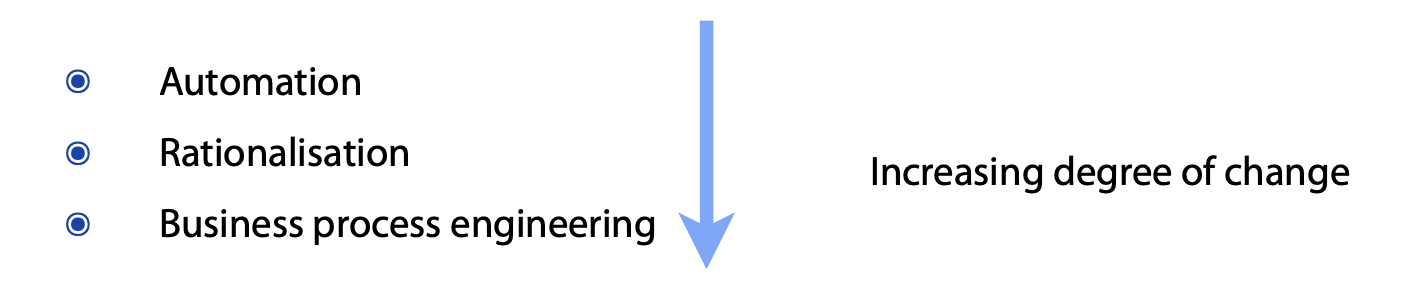
Changes can be categorized as:
5.2 Automation
Doing by machine what had previously been done manually. Examples include:
Wage and salary calculations
Receivables processing
Supermarket stock ordering
These changes should improve performance through saving labour costs, increased processing speed (so fewer delays), greater accuracy and improved management information. For example, the receivables ledger has been computerised it is possible to easily obtain management reports such as aged analysis and sales analyses.
5.3 Rationalisation
Improving performance by carrying out a process in a more logical way to reduce bottle-necks and increase efficiency. For example, asking airline passengers to check-in on-line, and to print (or have sent to a smart phone) their boarding cards. Airlines are experimenting with self-printing of luggage tags at the airport and also with labelling luggage in a completely different way, such as each piece having an electronic identifier tag.
5.4 Business Process Reengineering
Business process reengineering involves re-thinking and radically re-designing of the way an organisations processes operate.
It is not simply attempting to improve the existing way of doing things, but starting almost with a blank piece of paper and designing how best to operate the business. The starting point it to determine what the desired outcome is of the organisation and then to design how best to achieve it.
It focuses on maximising customer value and removing non-value adding work.
A leading advocate of business process reengineering – Michael Hammer – claimed that most of the work being done does not add any value for customers, and that this work should be removed, rather than simply speeded up, using technology. Information technology in particular has been used primarily for automating existing processes whereas it should be used as a way of making non-value added work obsolete.
Business process reengineering opportunities can be identified by the following approaches:
Zero-based: if you were starting the business now, how would you choose to organize it?
Simplification – eliminate duplication and redundant steps
Value-added analysis – remove non-value adding activities
Gaps and disconnects – check flows between departments
5.5 McKinsey’s 7S model
This model represents organisations using the following inter-related elements. To carry out a strategy successfully, consideration has to be given to getting each element correct:
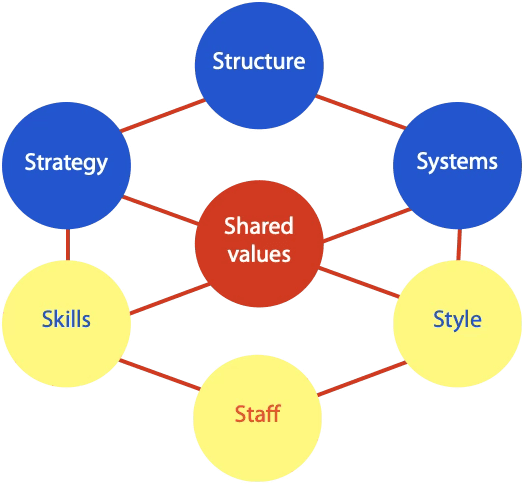
Strategy
Plans on how to reach identified goals and for dealing with the environment, competition, customers, new technology and so on
Structure
The way the organisation’s units relate to each other: centralised, functional divisions, divisionalisation, tall/narrow or wide/flat, decentralised (the trend in larger organisations); matrix etc.
Systems
The procedures, processes and routines define how work is to be done: financial systems, quality control systems, recruitment, promotion and performance appraisal systems, information systems, safety procedures.
Skills
Distinctive competences of personnel or of the organisation as a whole.
Staff
Numbers and types of personnel within the organisation.
Style
Cultural style of the organisation and how key managers behave in achieving the organisation’s goals. For example an organisation could adopt a role culture or a task culture.
Shared Values
What the organisation stands for and what it believes in. Central beliefs and attitudes.
The upper three elements on the dark background are the ‘hard Ss’ , meaning that they are relatively easy to describe and define. Many organisation focus too much on these because they are easy to define and describe.
The lower three on the white background and the central element are the ‘soft Ss’ and are less easy to describe and define. Therefore, these tend to be ignored.
Additionally, all the elements are all inter-dependant so that changing one will affect others. For example, the introduction of a new production system will probably affect skills structure, style and staff. It could even have an impact on strategy if it allowed, for example, more flexible production.
5.6 The value chain
This model represents organisations by setting out the activities they carry out.
Firm infrastructure, technology development, human resources and procurement are known as support activities (mostly indirect-costs). The other activities are primary activities.
By carrying out these activities organisation can manage to make profits. However, it is essential for the organisation to know what gives the right (or ability) to make profits.
Why do customers pay enough to allow a profit to be made? It might be because:
The organisation possesses knowhow that customers pay for
The organisation offers flexibility
The organisation offers economies of scale
The organisation take on risks
Whatever it is that customers value is the key to an organisation’s success and its performance there needs to be carefully managed. The organisation also has to be careful about changing or removing activities or performance that customers value. If an organisation is left carrying out tasks that are not valued by customers, how will the organisation survive? Short term performance improvements in one area might lead to long-term performance decreases in another.
5.7 Business change and performance measures
When a business undergoes a change almost certainly it will be important for it to change its performance measures: different aspects of performance will now be important. For example:
Automation: fewer people, more machinery. The cost of running the machines will be more significant and wage costs less so. Increased production speeds and higher quality output might be expected. It might be important to measure how quickly the machinery can be reset to allow the production of different products. Customers will probably see flexibility and speed of response as being important.
Rationalisation: the prime result of rationalisation is to reduce bottlenecks, increase flow rates and so increase processing efficiency. These qualities should be measured.
Business process engineering: potentially radical changes. For example, some processes could be outsourced. If so, a cost comparison is needed between the old method and the new. The efficiency and performance of the outsource company need to be assessed too. If a non-value-adding process is removed the company would need to monitor improvements in cost and time but must also to ensure that removing the process does not, for example, have an adverse impact on quality or the reliability of order-processing and the despatch of goods.
Similarly, for alterations to any of the value chain components. For example, moving to a just-in-time system for raw materials should decrease inventory costs but there is a risk that production will stop because the company has run out of components. These effects should be measured.
Page 3 of 3