
Business Structure, Management Accounting and Change

4 The information needs of different business structures
4.1 Functional structure
One of the common structures found in medium-sized organisations is the functional structure. This means that people within an organisation are organised by function. So, for example, there is a finance department, a manufacturing department, a sales department, and so on.
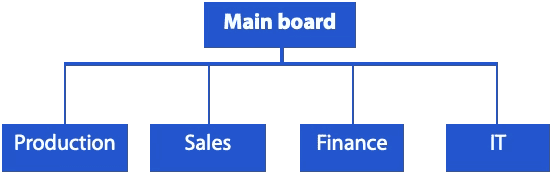
The advantages of such a structure are:
The organisation gains economies of scale
Each of these department is likely to be large enough to be headed by a well-qualified manager
Staff within each department are dealing with like-minded individuals with similar skills and motivation.
The disadvantages of such a structure are:
As the organisation grows, each of the functional departments can become very powerful and can begin to concentrate on their own interests rather than those of the organisation as a whole. This is sometime known as a silo mentality in which departments do not wish to share information others in the same company. This type of mentality will reduce efficiency, morale and company performance.
It is not easy to identify where profits and losses are made eg are production costs too high sales too low or has not enough been spent on research and development.
Information needs of functional structures:
Because top management in functional organisations is centralised, data from each department needs to be aggregated before top management can review and give feedback on it.
The aggregation can introduce delays in responding to the information. In addition, top management needs the skills to deal with many departments, markets and issues.
4.2 Divisional structure
As organisations grow they will often develop a divisional structure, where each division has its own functional departments and where the divisional manager has a degree of autonomy.
Divisions can be on the basis of:
Products.
Geography.
Type of customer.
The advantages of such a structure are:
Divisional managers are more motivated as they are provided with performance targets that are easier to define, measure and evaluate.
Decisions are made ‘closer to the action’ so that faster decisions can be made.
Divisions can specialize. For example, the N American division can concentrate making goods to suit that market, pricing them competitively and countering the competition there.
Junior managers have more responsibility and get training for more senior positions in the future
The disadvantages of such a structure are:
Head office management may need to restrict the autonomy of divisional managers, which can reduce motivation and cause dissatisfaction
Divisional managers are concerned about their own division’s performance rather than that of the organisation as a whole, which can lead to a loss of goal congruence.
Poorer coordination.
There can be transfer pricing issues.
There can be some duplication of service departments eg to finance departments.
Information needs of divisional structures:
Each divisional manager needs information about the performance of his division – aggregating the data from each department within the division. This aggregated information is then passed upwards to head office.
Head office does however need to aggregate the information received from each division in order to assess the overall performance of the organisation.
4.3 Network (or matrix) structure
An example of this may be found in firms of accountants, where there may be managers responsible for each individual office within a country, but at the same time there may be managers responsible for different activities in all offices throughout the country.
As a result, an employee working in the tax department of an office in one town will be reporting both to the manager of that office, and to the nationwide tax manager.
Another example is that of employees being assigned to a project.
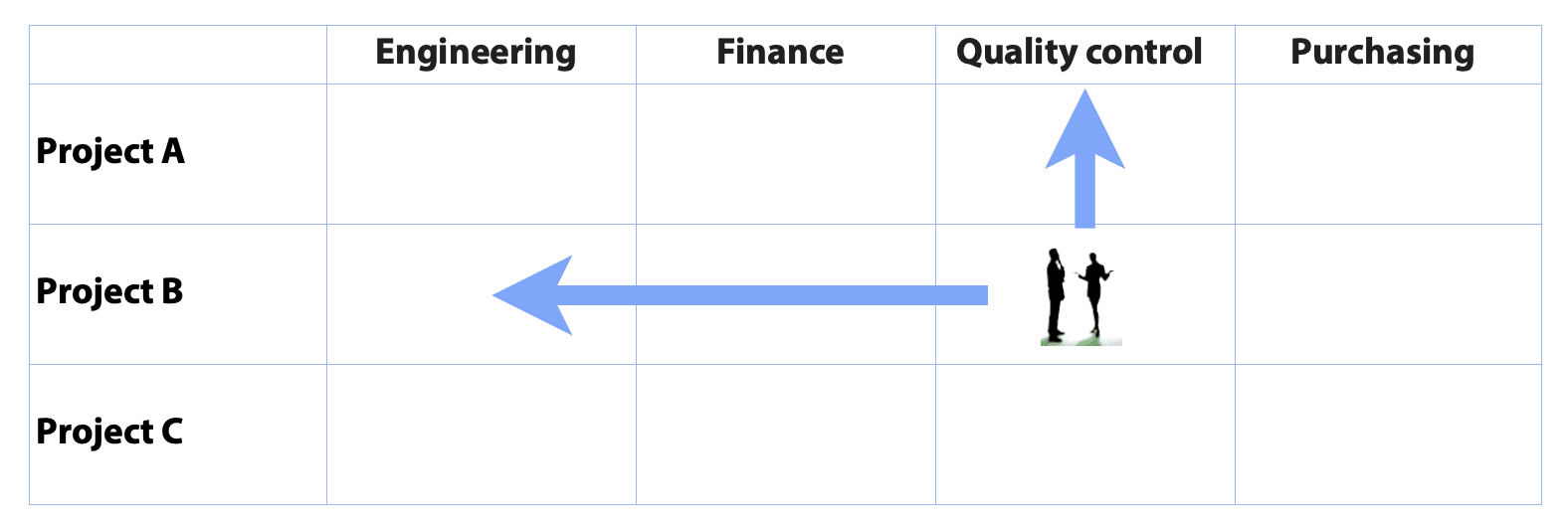
These employees are responsible to both the project leader of project B and to the quality control manager.
The advantages of such a structure are:
Communication is encouraged between various departments and activities
Employees are encouraged to be more concerned for the organisation as a whole instead of simply there geographical division
The disadvantages of such a structure are:
There can be conflicting pressures brought to bear on employees by the different managers to whom they report (but that might happen even in a conventional structure.
There can be confusion over which boss has the ultimate say.
Information needs of network structures:
Data needs to be aggregated in two ways – both for the manager of the division and for the manager of the activity.
As with a divisional structure, the aggregated information is passed upwards to head office, and head office need to be able to aggregate it in order to assess the performance of the organisation as a whole.
4.4 Information needs for service organisations
You will be familiar with the information needs of manufacturing organisations. Indeed, you just have to go down the typical variances found in an operating statement:
Sales: Volume, price and mix
Materials: Usage, price and mix
Labour: efficiency rate idle time and mix
Variable overheads: expenditure, efficiency
Fixed overheads: expenditure, volume
Service organisations conduct many different types of business such as:
Accountancy
Advertising
Legal
Consultancy of all sorts
Training
Travel
The many business types mean that their information needs are diverse but, assuming we are dealing with a profit-seeking organisation, they must ultimately look at information that analyses their revenue and their costs.
As with manufacturing organisations, revenue will depend on price and volume of work. The price will depend price per unit provided (such as a seat on an aircraft or price per hour charged to clients). The volume depends on units sold (like passengers or hours charged).
In service organisations, material costs are usually very low. Most will be employment costs and fixed overhead costs (such as office rent or aircraft leasing costs). Variable overheads might be significant if a lot of travel to clients is needed.
To manage these costs suitable metrics will need to be invented. For example:
Labour: hourly rate, team mix, idle time, time taken compared to budgeted time for a job.
Fixed overheads: expenditure, cost per chargeable hour
There are no hard and fast rules as service businesses are so varied, so think what you might be interested in if you were a manager and had to explain why your department’s profit is lower than expected.
Page 2 of 3