

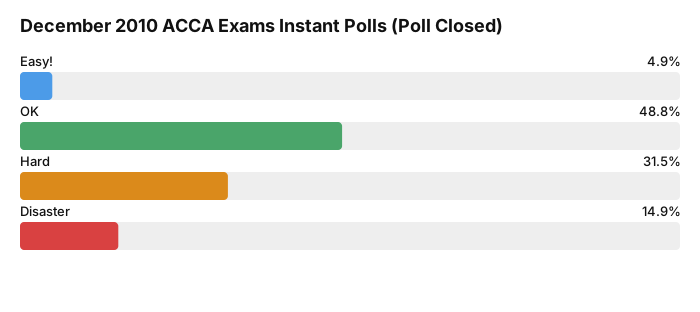
SBRPaper P2 Dec 2010 exam was
 Former user15y ago#31
I also thought cash flow notes were tricky. Given the time I had I completely ignored two notes and continued from there. Hope it was enough done.
hmm... over rall the paper is OK... for me...
I dint prepare well in Statement of Cash Flows , just study the format in casf flow only. Cz i dint expect CF wil come out.
i answer Q2 Share Based Payment but the question is quite tricky. I jz try my best to answer the a/cthg treatment as i know for SBP.
Answer for Q4, this is the only question i felt confident. But not sure what they ask in Q4(a) the approach for IASB to implement IFRS for SMEs.
Hopei wil pass lah ~
I agree that the paper is adequate. Share based payment is not my topic so I've chosen SMEs. Hope for 50 at least. I think that the pass rate for this paper will be above average.
By the way the tips are helpful. Thanks to OpenTuition!
Former user15y ago#35The Kaplan final assessment paper prepared me for the Cash Flow question. The IFRS2 question was a bit tricky. The other option i attempted was the SME question which i hope was done ok. i too am hoping for 50
Former user15y ago#36:)
Thanks, Mike, for tips :) am glad it was a CFS. :)
Anyhow, i did it quite messy and without full success..
Thanks, Mike, for tips :) am glad it was a CFS. :)
Anyhow, i did it quite messy and without full success..
Former user15y ago#37Lack of significant influence indicated that it should be treated as a trade investment... it cant be an associate... :S
Cashflow was though tricky... Overall acceptable exam...
Cashflow was though tricky... Overall acceptable exam...
Former user15y ago#38Manair: I said associate. Significant influence indicated by 2 board members and some resolutions needing a unanimous board vote. Also there was a consulting team on secondment from G. advising the management of Manair. Obviously 19.9% was a deliberately borderline associate/investment holding.
It was a 'discuss' type question, so if you wrote something and backed it up with rationale, examples and standards, it should earn marks.
So, what about the non redeemable bonds treated as equity....?
It was a 'discuss' type question, so if you wrote something and backed it up with rationale, examples and standards, it should earn marks.
So, what about the non redeemable bonds treated as equity....?
Former user15y ago#39Q3 - b) I wrote it was an assiociate. They believed that there was no signifinat influence but it was possible to demonstrate significant influence based on facts from the question. In my opinion IAS 24 was not relevant here as they asked how it should be accounted for and not how disclosed.
c) Preference Shares - Normally they are debt as per IAS 32 but it this question there was participation in regular dividends as well so i used the the old trick. It was a compund instrument. Liabllity = present value of future preference dividend payments and equity is the balancing figure.
No idea if its OK but sounds samart :)
Former user15y ago#40cashflow as expected and did somewhat good rast was good hope to get over insha ALLAH......
In part b of Q1 did it ask about the INdirect method or direct method? The cashflow was done using indirect method ( i hope) and then i have went onto to talk about indirect method in part b.
Have i misread and it was asking about direct method? As someone said earlier Kaplan book states that direct method wouldnt be examined. Maybe they meant in the form of making up cashflow stat
Have i misread and it was asking about direct method? As someone said earlier Kaplan book states that direct method wouldnt be examined. Maybe they meant in the form of making up cashflow stat
Former user15y ago#42I too recall its said discuss "Indirect Method"....?? thats the route i went down anyway.
Just spoke about manipulation of adjusted cashflows for bonuses, finance, loans etc....
Just spoke about manipulation of adjusted cashflows for bonuses, finance, loans etc....
i had to double check with online kaplan text and this is what sit says:-
The direct method shows operating cash receipts and payments. This includes cash receipts from customers, cash payments to suppliers and cash payments to and on behalf of employees. The Examiner has indicated that the direct method will not be examined and is not considered further within this text.
The direct method shows operating cash receipts and payments. This includes cash receipts from customers, cash payments to suppliers and cash payments to and on behalf of employees. The Examiner has indicated that the direct method will not be examined and is not considered further within this text.
Former user15y ago#44I was of the impression it was Indirect Method, anyone else help with this??
Former user15y ago#45Hi there. Yes the cash flow was calculated using the indirect method and the later theory part was to discuss both the direct and indirect methods with regard to how useful they are to users
Former user15y ago#46Q3: a trade investment IAS 39. Why? because not any influence on the company and its operating & financial policies. Just 2 board members - it is not so significant.
Q4: the trick of a questions was that IFRS for SME were introduced in July 2009 but not date when they become effective (UK wants them on 1 Jan 2012). Additionally the definition what is SME: depends on national regulators/governance. I hope this is what they wanted to hear from us.
Q4: the trick of a questions was that IFRS for SME were introduced in July 2009 but not date when they become effective (UK wants them on 1 Jan 2012). Additionally the definition what is SME: depends on national regulators/governance. I hope this is what they wanted to hear from us.
misspiggy, did the question in part b actually say direct method and discuss? i cant remember!!
Former user15y ago#48Yes...I think the phrasing was....discuss the directors view that the indirect method is more informative for users than the direct method.....something like that.....I wish they let us keep the papers! It is very hard to remember or assess how you actually did.
Former user15y ago#49There is practically nothing to say about direct method though as it is only 3 numbers so if you said the benefits of indirect I would guess you got the vast majority of the marks
did anyone else do Q2 and Q4? Q3 just looked like so much text to read!!
i had hoped pensions would come up so when i saw it in Q4 that made up my mind to do that one even though it was only for 5 or 6 marks.
Q4c What did you put about the R+D? I could only think to say that it should be expensed in the year it occurs. dont think that is right
i had hoped pensions would come up so when i saw it in Q4 that made up my mind to do that one even though it was only for 5 or 6 marks.
Q4c What did you put about the R+D? I could only think to say that it should be expensed in the year it occurs. dont think that is right
Former user15y ago#51albax694: research expenses must be expensed, development expenses must be capitalized if there are met 6 criterias: PIRATE.
Former user15y ago#52I had made a mistake by writing with attempting the paper with blue pen. Is any body tell me is this mistake will have any impact on my marks / result
Former user15y ago#53I think research and development is given to calculate the amortization cost of Intangible assets and adjust in Operating activities.
Former user15y ago#54I knowdelepment cost must be capitalised, I think I capilised the Research cost as well, oops. I made a huge mistake by saying the Financial Instruments for SMEs all are measured at FV--should be Amortised cost. Couldn't sleep at all by such a HUGE mistake.
Former user15y ago#55i classed the legal cost of 3a as contigent liability, not provision as measurement wasnt relaible, completely mucked up deferred tax treatment in cashflow.
sme threw me a bit and completely avoided it
sme threw me a bit and completely avoided it
Former user15y ago#56This paper was a whole lot fairer than June's. I was wondering why the pilot paper featured cash flows but not yet examined. Hope to pass as this is my final paper. Hope we did well. Enjoy the holidays and let February take care of itself.
Former user15y ago#57I did the Cash Flow question quite nicely. Did Q2 & 3 in section B, didn't even touch SME question :P
All in all, it was a fair paper, and I hope to pass it in 50s, if not in 60s :(
All in all, it was a fair paper, and I hope to pass it in 50s, if not in 60s :(
Former user15y ago#58Question: Were the franchise rights in Q3 (c) suffering from impairment???
Former user15y ago#59@albax694 said:
did anyone else do Q2 and Q4? Q3 just looked like so much text to read!!
i had hoped pensions would come up so when i saw it in Q4 that made up my mind to do that one even though it was only for 5 or 6 marks.
Q4c What did you put about the R+D? I could only think to say that it should be expensed in the year it occurs. dont think that is right
For RnD SME are allowed to expense out in the year in which they occur, development cost are not required to be capitalized as per IFRS for SME.
Former user15y ago#60I did Q2,it seem short & easy for share base payment, but is nothing much to write.
Q4c i have treated Development cost as expenses under IFRS for SMEs.
Q4c i have treated Development cost as expenses under IFRS for SMEs.