

Skip to contentSkip to search
Kaplan Publishing: Black Friday countdown

AFM*** P4 June 2011 Exam was … Post your comments here and vote in Instant Poll ***

Oopentuition15y ago
Please share here with community your comments about June 2011 P4 exam.
What came up? How did you do? How did this paper compare to previous exams?

Vote in our Instant Poll
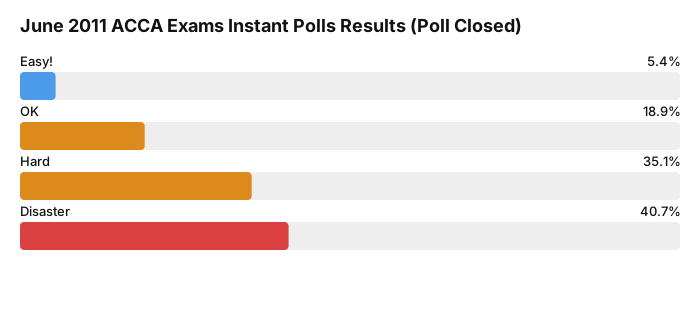
*** P4 June 2011 Exam was … Post your comments here and vote in Instant Poll *** poll results
Former userFormer user15y ago#61
Pretty much horrible paper on the first sight but i think as you try to read and grab things up many us would had managed.....
Q1. i think in part a of the report he was requiring you to calculate present value of free cash flows till perpetuity of fodder co, add this up with the value of pursuit company which was given and then compare this sum with the value of the combined company.......if the value of combined company was less than the sum, than the acquisition was not beneficial for shareholders of pursuit co. i think the combined value was less than the sum of individual......we had to find growth rates by this formula: sales revenue 3=sales revenue(1+g)^3. limitation included: CAPM limitations, growth rate assumptions, constant margin assumption, real options ignored etc.........than what we had found out in part as value of fodder, add 25% premium and deduct from cash reseves of pursuit co to find out how much using bond finance was required.......i hope ive done it right......
Q4 was quite confusing only to the extent of timing of cashflows.......i took 7 in year 0, 7 in year 1, 35 in year 2, and all the cash inflows from year 3 onwards.......this way i got a negative npv of 2.99............than i took present value of cash inflows as Pa, and present value of investment as Pe, t as 2, and got 6.44 as value of option to delay, and i concluded that if option was incorporated in valuing project positve npv of 4 would result, and talked about its limitations and change of decision in part b.
Q5. Didnt had enough points, my head got absorbed till this point:
a) Fishermen interests, may give them employment
b) share options, agency problem
c) water pollution
d) wildlife

Q2. was a bit confusing except part a and c......in part a we just had to use bid forward rate, i futures we had to find expected lock in rate.....i think basis was 0.0008 and 0.00016 at closing date........options required call options.....and was a detailed working......
PLEASE GIVE FEEDBACK
Ppeksun8315y ago#62
@magyverlast said:
Pretty much horrible paper on the first sight but i think as you try to read and grab things up many us would had managed.....
Q1. i think in part a of the report he was requiring you to calculate present value of free cash flows till perpetuity of fodder co, add this up with the value of pursuit company which was given and then compare this sum with the value of the combined company.......if the value of combined company was less than the sum, than the acquisition was not beneficial for shareholders of pursuit co. i think the combined value was less than the sum of individual......we had to find growth rates by this formula: sales revenue 3=sales revenue(1+g)^3. limitation included: CAPM limitations, growth rate assumptions, constant margin assumption, real options ignored etc.........than what we had found out in part as value of fodder, add 25% premium and deduct from cash reseves of pursuit co to find out how much using bond finance was required.......i hope ive done it right......
Q4 was quite confusing only to the extent of timing of cashflows.......i took 7 in year 0, 7 in year 1, 35 in year 2, and all the cash inflows from year 3 onwards.......this way i got a negative npv of 2.99............than i took present value of cash inflows as Pa, and present value of investment as Pe, t as 2, and got 6.44 as value of option to delay, and i concluded that if option was incorporated in valuing project positve npv of 4 would result, and talked about its limitations and change of decision in part b.
Q5. Didnt had enough points, my head got absorbed till this point:
a) Fishermen interests, may give them employment
b) share options, agency problem
c) water pollution
d) wildlife

Q2. was a bit confusing except part a and c......in part a we just had to use bid forward rate, i futures we had to find expected lock in rate.....i think basis was 0.0008 and 0.00016 at closing date........options required call options.....and was a detailed working......
PLEASE GIVE FEEDBACK


Honestly, the paper is not technically complex. It is fairly easy, however tricky and very time consuming to absorb the information given.

I have attempted the paper the same way you are.

Q1) calculated the fcf of fodder co. and then the combined firm. However, I am not sure did I miss out or there is really no operating profit margin given for Fodder Co. but for combined company it is 30% of sales. For the Fodder Co. I got the value of the firm of approximately $104m++, while value of the combined firm at $366m. Hence there is synergy which concluded that the acquisition is beneficial.

Q2) Fairly straightforward too. The basis risk is 0.0080, and the remaining basis risk is 0.0080/5 = 0.0016. However, didnt finish part d), just managed to get half of part d). For part a), forward contract is the most benefit.

Q4) I got the same answer as you, although I made quite a lot of mistake in the beginning, cuz I missed out that the cash flow is start from Y3. However, cancelled it, and corrected. I have discounted the investment too, 7+7+35, although now I doubt whether should I discounted it or take the full cost.

Q5) Stakeholder - fisherman welfare
wildlife
the strategic fit of the project
political risk.


Hope to get 50% though.
Ppeksun8315y ago#63
@nomie200031 said:
what did you guys do for the depreciation it wasn't increasing at the same rate as revenue and other op costs so i guess for fodder we had to do depreciation calculations separately Then the other thing i found weird was it said the beta equity for combined company should be wighted based on market values of two companies respectively. where was the market value for fodder it was unlisted ..


The depreciation is same as the replacement value, so there is no adjustment made to the FCF. The market value for Fodder Co. is calculated using FCF.
Ppeksun8315y ago#64
@nomie200031 said:
thnx peksun but technically fcf is not market value is it? examiner shouldnt have used the word market value.
No it said taxable depreciation was dependent on the operating levels. For operating levels we had to take new investments based on additional revenues. We had to calculate extra investments and then we had to calculate taxable profits based on them. because we have to adjust for taxation too in FCF. the question was talking about taxable depreciation which was going to rise in years 1-4 based on operating levels and additional revenue. that was pretty complex. Actually the examiner purposefully used ambiguous wordings. I spent so much time on q1 hoping to do as good as possible. After that when i asked for time as there was no clock there i found only 90 minutes left i had no idea how the 90 minutes were passed. and then i panicked and couldnt concentrate on anything just messed up because i had already realised i was more than half an hour late for question one.


There is no way to calculate the depreciation, as there is no % given. I assumed that tax is 28% of the operating profit. For the additional assets, it is depend on the increament of the operating revenues. Market value = Present value of FCF for the first 4 years + terminal value after 4 years. I am no longer hope for 80% tho..just hoping for 50% lol...
Nnicolat7715y ago#65
I am sorry I chose P4 now as I have just sat it for the 3rd time! What a joke and waste of energy. Its always as confusing as the last sitting, no matter how much I prepare for it. I think its time to move on to tax or auditing, which are both depressing.
Ffreeminder15y ago#66
Agree with Murat, didn't used gearing/ungearing betas in Q1 as well. I think it was needed there, but probably i am mistaken.

About Q4 I have read some similar questions in BPP Kit, and logic was as follows.
Co will go for development costs (7+7) if value of real option is higher that this development costs. So it was needed to reconcile 7+7 discounted with value of options of future cash flows in 2-6 years, where Pa was doscounted income and Pe was discounted costs. IMHO
Former userFormer user15y ago#67
I COULD NOT UNDERSTAND QUESTION 2 . IT WAS DIFFICULT FOR ME. CAN SOMEONE STILL PASS WITHOUT ATTEMPTING THAT 30 MARKS QUESTION? I NEED A RESPONSE
Ssomewherelse15y ago#68
I did ungear to get asset beta... Didn't the question say the combined beta was weighted asset beta of the two company, then to get the cost of capital for the combined company???
Former userFormer user15y ago#69
Well, the purpose of finding asset beta is to use it to find the "ke" of the base NPV. This is in fact an APV method that we will need to use the asset beta to discount the free cash flow to equity. After finding the free cash flow to equity we need to use the dividend growth model to find the value of the firm(s), discounted using ke. This is a type 3 aquisition since the aquisition disturb the business risk and possibly the financial risk. If the capital structure is maintained at Pur.... something Co. can't remember, then we don't need to use APV method, only the risk adjusted WACC. In this case, ungearing and regearing is necessary. If the beta is assumed to be the combined firm beta, we can't use this combined firm beta to find the Fodder's value alone. I guess.
Former userFormer user15y ago#70
@magyverlast said:
Pretty much horrible paper on the first sight but i think as you try to read and grab things up many us would had managed.....
Q1. i think in part a of the report he was requiring you to calculate present value of free cash flows till perpetuity of fodder co, add this up with the value of pursuit company which was given and then compare this sum with the value of the combined company.......if the value of combined company was less than the sum, than the acquisition was not beneficial for shareholders of pursuit co. i think the combined value was less than the sum of individual......we had to find growth rates by this formula: sales revenue 3=sales revenue(1+g)^3. limitation included: CAPM limitations, growth rate assumptions, constant margin assumption, real options ignored etc.........than what we had found out in part as value of fodder, add 25% premium and deduct from cash reseves of pursuit co to find out how much using bond finance was required.......i hope ive done it right......
Q4 was quite confusing only to the extent of timing of cashflows.......i took 7 in year 0, 7 in year 1, 35 in year 2, and all the cash inflows from year 3 onwards.......this way i got a negative npv of 2.99............than i took present value of cash inflows as Pa, and present value of investment as Pe, t as 2, and got 6.44 as value of option to delay, and i concluded that if option was incorporated in valuing project positve npv of 4 would result, and talked about its limitations and change of decision in part b.
Q5. Didnt had enough points, my head got absorbed till this point:
a) Fishermen interests, may give them employment
b) share options, agency problem
c) water pollution
d) wildlife

Q2. was a bit confusing except part a and c......in part a we just had to use bid forward rate, i futures we had to find expected lock in rate.....i think basis was 0.0008 and 0.00016 at closing date........options required call options.....and was a detailed working......
PLEASE GIVE FEEDBACK


i got the same answers in q4 as u. but i couldn't do q1 well, even i didn't calculate wacc for the combined co. lets see what happens.
Former userFormer user15y ago#71
Horrible


time allocation wanst appropriate specially for Ques 1
Former userFormer user15y ago#72
Demanding paper in terms of time.

Q1 fcff. Calc value of Fodder using FCFF (excluding interest) for years 1 0 4 and then perpetuity based on yr 4. calc value of combined entity using fcff again. This less value of Fodder and marke value of acquiring company equals +ve/-ve value.
Think it was marginal in terms of whether acquisition made sense.
Spent way too long on this question to the detriment of Q2.

Q2 - found difficult - didn't attempt all parts as left this one until the end.

Q3 - Maculay duration. Think was ok. Calc yield of bond using IRR.

Q4 - Options. Little tricky about timing of cashflows.Wasn't 100% what was Pa and what was Pe. I calc a -NPV value so I reckoned that Call Option to delay would be +ve.

All will be revelaed when solutions posted on acca site
Former userFormer user15y ago#73
l dont know why you guys are complaning ,the questions are not that bad at all. Q4 and Q5 are so easy l can do it in my sleep. Q1 a bit complicated but if u break it down you will see how good the question really is. Those who have study hard and go through pass question should not find this paper too difficult at all.
Former userFormer user15y ago#74
@nomie200031 said:
Well for q1:
First we had to calculate FCF (not FCFE) so we had to calculate after tax FCF before deducting interest costs and after adjusting taxable depreciation. First complication was about tax allowable depreciation. It wasnt growing at the same rate as revenue (6%), as the question said tax allowable depreciation was dependent on operating levels and for each additional $ of revenue 18 cents of new investment had to be made (kind of asset turnover $1 revenue on 18 cents of assests, $1/0.18=5.55). So first we had to calculate additional investment in each year from 1-4, based on that we had to adjust for tax allowable depreciation in those years and investments had to be deducted to get FCF in years 1-4. Present values of those cash flows had to be added along with the pv of perpetuity of FCF from year 5 onwards incorporating the growth rate in the formula. Then we had the Value of the total firm (Debt + Equity) of fodder.
Second we had to calculate the FCF of combined company using incremental cash flows as given. These cash flows had to be discounted at the WACC of combined company. Beta assets of two companies had to be weighted according to the market value of the two companies. Market value of predator was known that wasnt a problem. the value of fodder calculated from FCF had to be adjusted with the market based gearing levels given in the question for fodder to calculate value of equity and from those two market values we had to estimate asset beta of combined company. Then we had to adjust that asset beta based on what was told in the question that the capital structure of combined company wouldnt change from the predator company, so we had the gearing level of predator and we calculated beta equity of combined company. After weighting for cost of debt and cost of equity of combined company we had WACC. Then we had to discount the already calculated FCF of combined company based on that WACC. It gave us the total value of combined firms (debt +equity). Then we had to calculate the current total value of predator from its share price and market value of debt which was given in the question. Then we had to add this total (D+E) market value of predator and the total value of fodder (D+E) we had calculated from FCF. The sum of this had to be compared to the total value of combined companies calculated from combined FCF. This would have told us whether the acquisition was adding value to the shareholder or not.

I want to have some feedback guys dont know how the examiner could have expected us to do all this for one part and the problem was without the first part how would you comment on the later parts. thanks

I think you had to take an average of asset betas of both cos using their market values (for pursuit it was given and for fodder you found out using fcf) and than regear that to pursuit cos gearing level since it was stated that combined companys gearing would be the same as gearing of pursuit company!
Former userFormer user15y ago#75
i am with u guys..
Former userFormer user15y ago#76
sorry i deleted my post by mistake
First we had to calculate FCF (not FCFE) so we had to calculate after tax FCF before deducting interest costs and after adjusting taxable depreciation. First complication was about tax allowable depreciation. It wasnt growing at the same rate as revenue (6%), as the question said tax allowable depreciation was dependent on operating levels and for each additional $ of revenue 18 cents of new investment had to be made (kind of asset turnover $1 revenue on 18 cents of assests, $1/0.18=5.55). So first we had to calculate additional investment in each year from 1-4, based on that we had to adjust for tax allowable depreciation in those years and investments had to be deducted to get FCF in years 1-4. Present values of those cash flows had to be added along with the pv of perpetuity of FCF from year 5 onwards incorporating the growth rate in the formula. Then we had the Value of the total firm (Debt + Equity) of fodder.
Second we had to calculate the FCF of combined company using incremental cash flows as given. These cash flows had to be discounted at the WACC of combined company. Beta assets of two companies had to be weighted according to the market value of the two companies. Market value of predator was known that wasnt a problem. the value of fodder calculated from FCF had to be adjusted with the market based gearing levels given in the question for fodder to calculate value of equity and from those two market values we had to estimate asset beta of combined company. Then we had to adjust that asset beta based on what was told in the question that the capital structure of combined company wouldnt change from the predator company, so we had the gearing level of predator and we calculated beta equity of combined company. After weighting for cost of debt and cost of equity of combined company we had WACC. Then we had to discount the already calculated FCF of combined company based on that WACC. It gave us the total value of combined firms (debt +equity). Then we had to calculate the current total value of predator from its share price and market value of debt which was given in the question. Then we had to add this total (D+E) market value of predator and the total value of fodder (D+E) we had calculated from FCF. The sum of this had to be compared to the total value of combined companies calculated from combined FCF. This would have told us whether the acquisition was adding value to the shareholder or not. and finally we had to see that the 25 percent premium on equity was more than the excess value from above or not.

I want to have some feedback guys dont know how the examiner could have expected us to do all this for one part and the problem was without the first part how would you comment on the later parts. thanks
Yeah the timing killed me and most of us. The only way to do better is to do practice under timed conditions before going to exam. Practising actual past papers in 3 hours is the key i am afraid there was no point of doing individual questions from the kit without time restrictions as in the exam we knew what to do but it was too slow.
Former userFormer user15y ago#77
q1 was lenghty and time consuming
q2 was little bit tricky..
q3 mcauley duration was diffilcult
q4 was best q's of all....
Former userFormer user15y ago#78
Most of the questions were not all that difficult. All the questions can be found in the study guide. Q1 was kinda lengthy but I did not find much problem this sitting.
Former userFormer user15y ago#79
P4... In the words of the film 13 Assassins ...Total massacre...

I am with 99% of the people here, in saying that P4 was horrible. Same scenario as everyone else. Q1 was so confusing I didn't know where to start, horrible start to the exam and totally threw me off for the rest of the paper, was all over the shop, to the point that I buggered up the timing and had little or no time for Options Calc in Q2, and the easiest Q, no. 5.

Q2 and Q4 were doable... but I made errors all over the place and couldn't justify the answer. Definite fail. So demoralised for December.
Hey ho, that's how it goes I guess...
Former userFormer user15y ago#80
ebby... pjones... delighted for you!! :)
Former userFormer user15y ago#81
I really worried for this P4 because even this paper can bring us ideal for future as reference but in practice it might not have this situation but at least provide a clear information.

Actually i try to quit my job and back to study but it hopeless.

May be can say that i not well prepare for my planning. But i do hope that it is any more can help me to improve my study and deep understand for P4. A lot of people telling that P4 is most difficult & i still insists to take this paper due to one reason. When will complete ACCA course once i have this P4 with Pass at least i have ideal or guide how to show the problem or complicated issue as long as we have a experience.

I notice that Partial Cert for ACCA did not have a market value. Difficult to get a job and negotiation power may not have it.

Doesn't anyone agreed with above statement?
Former userFormer user15y ago#82
I believed I had studied well enough but just could not apply my knowledge struggling with time just to undertsand things. I left 10 mark subquestion unsanswered in part one.
No good feeling about this one.
Former userFormer user15y ago#83
Questions marks were not well allocated. The questions needed much time to understand, as such the paper was not worth 3 hours.
Former userFormer user15y ago#84
Planned well for the paper, started with q5 which was a p3 question but also added some financial aspects such as options as a reward for managers, etc. went quickly to q4 which was black scholes but got a little bit confused with the Pe whiles the pa was straight forward. I then answered q1 which was very time pressured and i overrun the allocated time at q1. I was only able to interpolate the forward rate and also estimated the futures price at q2 when the invigilator snatched the paper away.

To me the paper was standard but very much time pressured!!!
Former userFormer user15y ago#85
I can not pass this paper due to time. I have sat it six times. I give up. Q1 what the hell springs to mind.
Former userFormer user15y ago#86
i've made a horrible exam..............
LLove15y ago#87
Please which type of question is this? Inflation here and there with too many currencies with swap at the same time, unlike before.
Too much information to interpret, I don’t think a consultant or
an Assessors can finish the paper within 3hr. This is not fair at all.
Cchisasula15y ago#88
I felt it was afair paper except that i didnt have enough time
Former userFormer user15y ago#89
It was extremely tough Paper for me. compounded by that, i wrote it with a fracture in my Arm.This P4 has delayed my graduation of ACCA and it is the only one left.
Former userFormer user15y ago#90
Okay I know I'm a bit late in contributing especially as a week on it's gone from my mind a little. Overall however I thought the exam was quite fair. In the 15 minutes reading time it seemed really daunting with a lot to take in but overall I finished in 2 hours 59 minutes, so that means it was probably perfectly timed for me. I did have to rush the second half of question 1 however but I think attempting the questions in the order I did helped.

Q4 - this was just a nice Black-Scholes model question, there were a few tricky things regarding timing however overall I thought it was manageable. I may have used the incorrect Pa and Pe as I wasn't certain but as you aren't negatively marked I just took a judgement and didn't try and second guess it.

Q2 - I must admit my memory is hazy on this. The forward contracts were obviously the easy marks that everyone on the paper should be picking up, the futures had a basis calculation to perform and the options a fair bit of calculation. Then there was the second half of the question and overall it seemed like there was a lot going on but if you isolated what you needed to do on each bit it seemed very doable.

Q1 - I came into this question with over 5 minutes in the bag time wise and overran my allotment. I do not think there was anything that we shouldn't have been able to do on here either, just ridiculously time pressured, some FCF calculations, some gearing/degearing etc. When there are 4 professional marks and you are required to write it in a report format you spend a lot of time trying to keep to this format and making it as professional as you can - this wastes a lot of time. As such I rushed my responses to the latter parts of the question, focusing my report more on the earlier, larger marks, leaving only really a paragraph or two for some of the other points - which was all there appeared to be time for.

Q5 - This seemed very much like a cross between a P1 and a P3 question and I answered it as such. I worry that I didn't put enough of a financial spin on my answer however they only asked for issues.

Q3 - I didn't answer this one because, although it seemed simple, when I looked at it in my head to begin with I was getting a counter-intuitive result, the one with the lower yield also having the longest duration. Admittedly I didn't spend very long at all looking at it I thought it would only confuse me which is the last thing you need. I thought though that if you got this straight away then it appeared to be a really easy question and I was annoyed at myself for not 'getting it'.

Although I said it was time pressured I don't think that pressure was wrong. I tried to make my mind up quickly and go with it. If the rest of the method you use is correct having made a mistake at the beginning you still get a lot of credit - much more than if you miss out marks because you spent too long deliberating.

I'm hopeful overall without being expectant, I thought it was fair so if I don't pass will just have another crack next time. Good luck to all, fingers crossed for the 22nd of August!