Skip to contentSkip to search
Kaplan Publishing: Black Friday countdown

SBR*** P2 June 2014 Exam was.. Instant Poll and comments ***

Oopentuition_teamAdmin12y ago
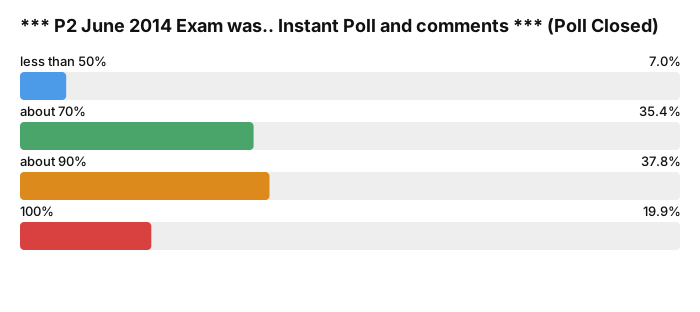
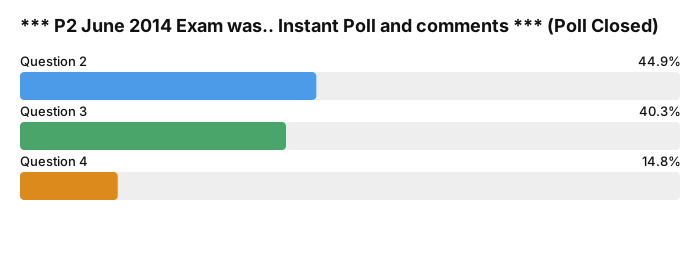
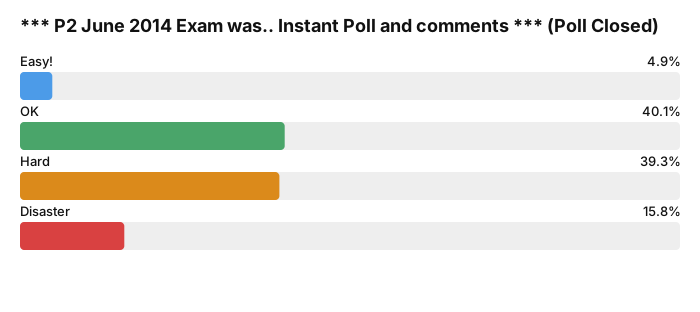
Please vote in our Instant Polls and share your comments about the P2 Exam. Please note, the ACCA have asked us not to allow posting comments before 5pm UK time. However you can vote in our instant poll immediately (Reload this page and post comments after 5pm) *** P2 June 2014 Exam was.. Instant Poll and comments *** poll results *** P2 June 2014 Exam was.. Instant Poll and comments *** poll results *** P2 June 2014 Exam was.. Instant Poll and comments *** poll results
Former userFormer user12y ago#31
In 3 A i wrote a totally different angle ! I wrote some stuff about lease (which minco gives to general public) for occupying the house. Then I focused Minco & Housing Association as being related parties and rules of transfer price... ?!
Sszparag12y ago#32
Oh my God, I went out of the classroom and thought "that was easy", but now when I read your comments I am not so sure about it :( I did sth totally different in 1b) - I wrote sth about the options given in different standards to measire assets in FV or not, but then I wrote sth about the difference between the financial value, which I interpreted as the consideration someone would like to pay for the company, and the FV of net assets, which is goodwill and about the fact that goodwill created internally cannot be recognised, so that's why there's a difference between the financial and fair value... :-/ And in 2a) I chose dinar to be the functional currency as the main current operation of the sub was to held a dinar valued bond. Hope I'll get sufficient points on consolidation.
Ttheivendran12y ago#33
Time constrain , Q4 was from tec article .
Former userFormer user12y ago#34
Was reasonably happy with Q3 before i read comments on here. 3a - didnt even suss anything other than revenue recorded early and then inventory (wip) being affected at the reporting date. Probably more standards for the 7 marks available tho. 3b - talked about provisions - said record her payments equally across the year and include a disclose for her bonus structure as theres no way to know what she may win. Didnt talk about intangibles. But im sure ias 38 is relevant because they are building their brand. :( 3c - the lease - said was operating lease because wont have it for all its life etc 3d - i discussed ifrs5 but also ias 10 as there was a major change in the way the disposal was reported between the financial statements and the reporting date. Asked the question if maybe conditions existed at the year end. Like i say i was happy before but now im now sure. Id suddenly take 12-13/25 on that!
Former userFormer user12y ago#35
Anyone remember whether Ethics 1c was about Financial controller or Finance Director?
Llunix12y ago#36
1b Fair Value vs Financial Value - I wrote that internally generated intangible assets can not be capitalised so their value is not reflected in financial statements. Also, where active market does not exist the valuation involve estimations and may vary between different valuers.
Former userFormer user12y ago#37
Both FC and FD FD showing a finance lease as operating lease is unethical. Give reasons ie usual ethics response
Yyogeeta7512y ago#38
Very tricky paper...
Former userFormer user12y ago#39
I got profit after tax 90, because I reversed (eliminated) the reversal of impairment on goodwill. I think goodwill impairment cannot be reversed as it is an increase not in purchased goowill but in the internally generated goowill.
Llunix12y ago#40
Ethics was about financial controller and his ethical dilemmas. Financial director was not agreening with the financial controller regarding the treatment of the lease.
Ddebante12y ago#41
oh Lord, i will start to study now for December's exam.
Iisrar12y ago#42
hi there how's the paper looks easy but when started took longer time to finish. plz someone tell me about q2
Iisrar12y ago#43
what you done it with q1 paragraph 2nd equity 8% sale
Iisrar12y ago#44
i am not sure but if goodwthisill impair not recover i think so no treatment required for
Former userFormer user12y ago#45
I don' t remember exactly if he included the reversal of goodwill in his statements or not. Anyone does? As for the 8% gain on sale I didn't included in the p&l as it should be considered transfer between equity holders.
Hhassanhere12y ago#46
I kind of accidentally forgot to copy the calculation of sub no. 2's calculation onto my answer sheet (I had done that calculation in reading and planning time)! Thus no entry in IS..how many marks can I loose? 5?
Aally12y ago#47
paper was not bad at all , que 1 i may have scored good marks there but i rambled for the rest of the paper . i hope its enough for a pass fingers crossed
Llunix12y ago#48
How about question 4 debt/equity. Did you classify both types of B shares as equity? That was my conclusion, I am curious how others did.
Sswaggarv12y ago#49
I concluded the the first one Cavor was debt since it invest variable amt of equity to be issued The second one is equity since a fixed amt of equity will be issued to redeem the bond
Llunix12y ago#50
I thought debt has something to do with payments on specified dates :( With both B type of shares there was no compulsory payments on specified dates.
Wwarren9212y ago#51
@Lunix for 1st company (something like cavon) it was said that A shares are ordinary shares. Payment of dividends is not mandatory. However, dividend can only be paid to B shares after payment to A shares To me it looks like A shares were not ordinary shares and they were preference dividend. However, B shares are only paid after A shares are paid dividend which gives an indication that these are ordinary shares and so are equity. For second scenario Lidan it was said that these include redemption option and the settlement can be made in cash or issue of A shares. So it looks like these were convertible bonds, as it includes the redemption option in both (equity and cash). so it is part equity and part debt. That's what I guessed in the exam. Hope it was correct. Best of luck everyone.
Iicriosphinx12y ago#52
Hi. Just confirming... in question 1 who owned the subsidiary called option? Was it Merchant or the subsidiary?
Former userFormer user12y ago#53
The group was made up of a parent and two 60% subsidiaries both controlled by the parent. Parent still controlled subsidiary one after the 8% sale as this was only a transfer of equity between owners and didn't effect the I.S. At all. Parent controlled subsidiary two for 6 months and for the other 6 months it would be treated as an associate as parent had sold 40% and equity accounting is used.
Sswaggarv12y ago#54
@ Lunix - that's what I did hope its Correct Check out ias32 Best of luck
Iicriosphinx12y ago#55
Thanks Shortt. I can finally sleep now!
Ddallandyshe12y ago#56
I thought it was very hard overt all Q1. relatively ok but allot was going on for such a short period of time. I was not sure on sbp i calculated 6 employees as only one director was expected to leave, Loss on inter-company sale- i added back to cost of sales, not sure how to adjust the $8m the ye figure Q2 was challenging, i thought a) i thought it was consolidated with information, i thought investment property then i could not finish. that was the last one i was writing on b) was not intangibles, it was not purchased, the contract was only for 3 years, the intangible recognised only if purchased? c) i thought it was confusing. leasing with other capitalisation cost of new build, I'm not sure d) i thought was asset held for sale, fair value with measurement, it was very litle time to read and think. Q4 a) was very confusing, all based on technical articles debt equity swap, was it financials instruments, current development b) was about a and b shares, b shares was option for cash settlement ????it was there obligation?? please
Former userFormer user12y ago#57
I think they wanted us to discuss the positives and negatives of FV Below is how I tackled it. wanted to discuss different levels of valuations but decided against it as time was lited. Examples of positives 1) using observable inputs esp. for level 1 inputs, The price is the one quoted on the market without adjustments. It is therefore more reliable than other measures (NRV or VIU). 2) Aids comparability as the assets and liabilities are traded on the stock market and therefore all entities on the same stock market will have the same value for the identical assets or liabilities. Negatives 1) Because it flactuates with the market, it gives different valuations of the same asset/liability at each measurement date making profits/earnings volatile. 2) Creates artifical profits and losses which may never be realised, especially if an asset or liability is held for a longer period. It's ok for Held for sale or for trade as the sale transaction would be eminent. But for long term assets, IAS16 cost or VIU could be a better determinant of value. 3) it is not applicable to all assets. For instance Inventory is held at NRV or cost. Plus those unique equipments specific tailored to an entity, FV is not the best value as level 1 and 2 observable inputs may not be available. Therefore VIU is more appropriate valuation than FV. 4) Some times company's transactions are not reflected in the price of it's shares at closure of business for the day. Therefore, on that particular day for example the advantages of a merger had not been analysed by the stock market before closure of business. 5) Share price may be affectd if there is a CSR scandal even if the underlying financial performance of the entity is not affected. For example, Marks and Spenser share price was affected when Sir Stewart Rose was appointed both as chairman of board and chief executive. Reduction in the Fair value of the share in this case had nothing to do with financial performance but rather not separating the two positions.
Former userFormer user12y ago#58
Qt 1 A) Goodwill impairment reversed till original goodwill level. 2m Adj required. Option sale gain of 24 million if I remember. Employee compensation 7.5 M in P/L 2 M in OCI Share based compensation 1.86 M in previous Year 2.345 M in current year. Current year Expense 0.5M Finance costs of 3M reclassed from P/L to OCI as it is effective portion of hedge Associate income of 1.5M (20% of 7.5M) PPE 4.56M revaluation. 1.96M OCI and 2.6M P/L B)I approached in a very weird manner. PT1 Inventories-Lower of Cost or NRV but no room for upward increase. Hence Understate FV during rapidly rising prices. PT2 PPE Cost model followed by many companies. Drastically understates fair value of Land. Pt3 IFRS 3 allows correction of some problems by allowing recognition of Intangibles and Fair value adjustments PT4 Does not allow recognition of Internally generated Goodwill. Research costs expensed understate value of Knowledge based industry companies. C) I discussed the dilemma faced by the Financial Controller. I was not sure whether they asked Finance Director or Controller. Thanks for ur responses on that. Job loss/lower share based compensation/ little bit about finance lease vs Op lease. The land portion should be fairly easy ascertain. Must make sure statements are true to substance over form. Inform CEO/CFO/Board of directors/Auditors if no resolution. 3A) Minco Revenue criteria. All contradicted by recognizing. Recognize only sale of land..which will be eliminated on consolidation. b) Tennis player:. If contract enforceable $20,000 Prepaid Intangible asset. $6,667 expensed each year. If not enforceable expense full amount. $50,000 expensed each year. May make provision for bonus if Minco contracts most of the top players and very likely it has to pay out some money each year. c) Repair and maintenance. Provision or Contingent Liability for internal repairs. Floor expansion. Leasehold improvements. Amortize over 6 years. General repairs. Nothing to be done if no significant damage Roof repair. Confirm with Landlord get estimate and book provision right away. d) PPE. W/down to 2.4M 0.12 M loss. Revalue to 2.52M only not beyond. Disclose sale in notes as it happened after period. 4A) Difference between debt and equity. Contractual payments interest and principal. Call-ability. B) Changing the two effects financial ratios/perceived riskiness/ability to get funds/Supplier line of credit c) 1) Equity as no contractual payments. Stopping Dividends of Class A stops payments on Class B. Not callable by owners of Class B. 2) Equity again. NO fixed payments. Can be redeemed by company at their option within 2 years. Even then has to pay in either cash or shares. Please comment whether any of this matches your answers. Thanks,
Former userFormer user12y ago#59
My thoughts exactly. See my answer description.
BBenjamin12y ago#60
For Lidan, I accounted the norminal value of $1 as a debt, as you have a choice to redeem at norminal or for the share's. Thus as the shares has always been above $5, the option to choose the share will be likely, therefore I choose to write that the difference will be treated as an option to convert to equity
Topic lockedNew replies are closed.