

Skip to contentSkip to search
Kaplan Publishing: Black Friday countdown

FR*** F7 December 2012 Exam *** Instant Poll and comments***

Oopentuition13y ago
Post your comments about December 2012 F7 exam.

Please vote in our Instant Poll
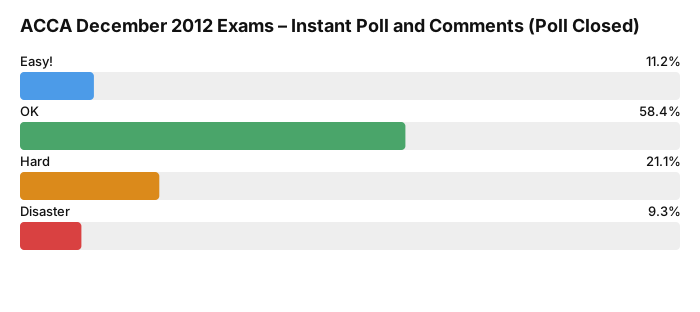
*** F7 December 2012 Exam *** Instant Poll and comments*** poll results


Please note: The ACCA has requested that no postings must be made in this forum before 15:00 GMT on the day of the exam - any postings before this time will be deleted.
Remember that you are studying for a professional qualification - do not make postings that are abusive or threatening. Anyone breaking this rule may be reported to the ACCA disciplinary committee.
Pperist198413y ago#31
@royyston said:
For tax in q2, the movement in deferred tax was a -200 or +200?

I think it was DR D.tax 200, CR C.tax 200
Wwywin13y ago#32
I got -200. Coz clo: is lower than op:
Former userFormer user13y ago#33
goodwill i also 6 million after impairment
Former userFormer user13y ago#34
how did everyone answer the financial analysis in q3 ? as in what points did you make
Wwywin13y ago#35
How to recognize for contingent liab in q1?
Wwywin13y ago#36
In q3, i pointed out the investment (in Non current Asset) which is special item. Coz of this, different result in ROCE.
Former userFormer user13y ago#37
@aneeq7 said:
how did everyone answer the financial analysis in q3 ? as in what points did you make

Financial Performance:
-Compare ROCE between the two sectors. ROCE can be calculated by multiplying the net asset turnover and operating profit margin, and this is an indication of both profitability and efficiency.
-OP margin was lower than the sector but asset turnover was higher implying better utilization of assets.
-Next, compare GP margin. GP= (Sales -COGS), so can touch a little on their sales and cost of sales.

Operating performance:
-Compare current ratio with the sector. Higher current ratio= Better able to meet their short term liabilities.
-Inventory turnover is higher than the sector, and this has an effect on the current ratio because inventory contribute to the total amount of current assets.
-Payables payment period was faster than the sector which is not advisable as this will not give them a cash flow advantage.

Gearing: D/E ratio was lower than the sector implying that it does not have that high of a financial risk compared to the sector. Higher financial risk may cause liquidation problems. Nevertheless, gearing is still high and this is attributable to the loan note that the company has taken up.

Conclusion: The company showed signs of declining profitability but operating performance was good and risk was well managed. However, a cash flow would be useful here to give a more thorough assessment of the company. A rights issue may also help to improve the situation.
Former userFormer user13y ago#38
Q1- Conso SOCI: Couldn't figure out the investment income part for dividend in associate and forgot to charge total goodwill to COGS.
Q2- Published accounts: Adjustment 1 was tricky, but the rest were relatively ok.
Q3- Ratio analysis: Messed up for average inventory turnover but the rest was straightforward. Analysis took a while and had no problem with the limitations of ratio analysis.
Q4- Theory on understandability and comparability was alright. Did workings on construction contract cos had problem showing extracts.
Q5- Relatively straightforward except for the last part.
Former userFormer user13y ago#39
it was not mid year, it was 9 months since acquisition..
Former userFormer user13y ago#40
yup 9 months, so everything pro-rate 9/12.
Former userFormer user13y ago#41
Found this exam quite easy. No problems with time what so ever.
Former userFormer user13y ago#42
:((( Overall, was a very easy paper, however did not do good, because did not practise the IS and Fin Position consolidations enough, and messed up all...
Just got it, the IS figures in Q1 should have been apportioned :(( BTW, should the deferred consolidation also be discounted for 9 months? :(( I did that way and the figures were getting pretty unfriendly.

There were some tricky notes, which I believe I will not be able to answer even with the Study Text on hand, because that was not mentioned in the study text.
1, the treatment of the new equipment in Q5. It said, that they have to apply it in 2 years, but have not done yet at year end. So should they decrease the provision, if they are not getting the benefit yet? I answered, that they should capitalize the additional expense (for filters,or...) and decrease the provision if it is probable that the filter will be applied, however not sure...

2. There was a note, saying that the company sold smth for 10m, but included 600 000 at cost costs of warranty, or smth like that in the costs and will provide service or warranty for 3 years. Sooo, what is this? how should be treated?
10 m should not be deducted from sales, imho, because the sale is valid, may be the 600 000 should be provided for??
Former userFormer user13y ago#43
In regards to revenue there was deferred income that would decrease revenue and have to be included in liabilities in SFP.
BBhimesh13y ago#44
i think that the deferred consideration did nt discounted for 9 months bcoz how did u discount lyk 1/1+r^n,where n=9 months or what ?if yes itz wrongly done mate.
Former userFormer user13y ago#45
Worked through every number and every part. I'm glad I allocated my time well and did not linger too much on the parts I wasn't sure I was doing right. There were some things I'm not sure about in all questions, but I think I've got the pass mark secured phew!

Now audit for tomorrow and financial management for the following day.
Rrazraz13y ago#46
It was not that bad. I did q1 q2 q3 pretty well and just managed up until part a of q4 . I cudnt manage the time, I was too carried away by the analysis of ratios. Guys u reckon , wud I pass? By just doin 3 and half questions ?? And yes also managed to do the last 4 marker ias37 contingent liability.
Ddan1liy13y ago#47
The deferred consideration doesn't require time apportionment as far as I understand cause it it is used in g/w calculation at date of acquisition and it comes due in one full year (31Dec12) anyway... But the discounted difference goes into finance costs ( time apportioned). - prove me if I'm wrong.
Q2 sales had to be reduced by 2 years worth of service grossed up ( 600 x 2 x 100/75). I know it now cause I got it wrong there - I deducted 3 years...
Ssuni641913y ago#48
in ques 1, goodwill calculation, how to take contingent liability? is it taken as FV adjustment or is it added with cost of Investment calculation?? and what to do with the investments received from associate? did anyone get share of associate as (2000 x 40% = 800 )?
Rrazraz13y ago#49
Cud any one plz tell me was I right in taking off the contingent liability in net assets working in q1. Do we put the associate profit 40% of 2 million in income statement.
Q2. Does the loss of 1300 go to cos in fair value-investment?
Q5 is the provision for the contingent liability provided in f/s..coz it was a government decision and is that 33% of 18000 recognised?? Thanks
Ddan1liy13y ago#50
How did you go about moving revaluation reserve to ret ear-s in Q2?
Ddan1liy13y ago#51
I have deducted contingent liability from S na in g/w calculation ( I assume it was found out by the parent company on acquisition and not yet included in S's records)
Q2 I put loss from investment of 1300 in a separate line...
Former userFormer user13y ago#52
@suni6419 said:
in ques 1, goodwill calculation, how to take contingent liability? is it taken as FV adjustment or is it added with cost of Investment calculation?? and what to do with the investments received from associate? did anyone get share of associate as (2000 x 40% = 800 )?


I got this too. I assumed the 500 was interim dividend paid and 300 was final dividend. So total dividend $800. My Income statement (Q2) balanced. I got $171,400 but I am not so such about the answer. I messed up with the goodwill for Q1 (I did not adjust for contingent liability ... so sad). I treated Q4 (Construction Contract) normally without any adjustment since it was an accounting estimate (progressively) and not an accounting policy change. Then for Q5 - (Financial Statement Extract - Environmental provision, Government Grant (this seems quite easy) I also said that the company should make provision for the air filter equipment since the legislation was passed during the year (1 April 2012). However, it should not decrease its environmental provisions because as at the end of the reporting period it is yet to acquire the air filter equipment. However, I just solved the ratios for Q3 and was about interpreting before time ran up. I quickly had to rush up the limitation to ratio analysis. I believe the company was overcapitalizing and isn't do so badly was compared to industry (sector) average. However, it profitability ratios are poor when compared to sector average but it ROCE and Current ratio (which is 1.56:1) are either higher or close to sector average. For ROCE is shows that either the company has old assets that are not contributing to sales. I pray I get the required pass mark. Missing out on the Goodwill calculation hurts so bad.
Ssuni641913y ago#53
@ justkency i am not sure about the contingent adjustment..lets hope for the best!!!
Former userFormer user13y ago#54
@suni6419 said:
@ justkency i am not sure about the contingent adjustment..lets hope for the best!!!

you have to take out the contingent liability to get the fair value of net assets on acquisition (that is the right thing to do). However, in the exam hall I didn't notice. I am glad that it was just to get goodwill. If it was to produce CSFP I guess a whole lot would have gone wrone. From wrongly calculated goodwill carried into the CSFP. I don't know if I would be enable to trace that out. Overall, I think Steve Scott was fair. Time allocation was the major issue I guess.
Ssuni641913y ago#55
dan1 liy Rev.reserve to retained earnings... i am not sure what i have done is right or wrong.anyways will tell u what i did... new value of building - old value of building/ useful life i think i got 1000 after the whole calculation.... and add this 1000 to retained earnings and deduct from revaluation surplus... i am not sure..i would like if anyone else would clear this issue... i hope u did the same way.
Bban12313y ago#56
associate profit 800, 300 goes to balance sheet (not required here) in the investment account and 500 went to P/L already booked, so I did not do anything with it, it is called equity method F3 stuff actually
Bban12313y ago#57
suni419 - I was buffled here too, because it should be the difference of the old and the new depreciation, but I could not figure out the old depreciation charge (that would have been if not revalued), so I divided the revaluation amount with the useful life - not sure
Former userFormer user13y ago#58
when do the answers come out?
Bban12313y ago#59
what was the revaluation ? (50 million - 8 million acc depr.) 42 million to 60 million is 18 million, anyone got this? they tried to mess up with the land going up 2 million, but it does not make any difference, or I got messed up, some says it is 16 million
Ssuni641913y ago#60
i got 18 million as revaluation. 2 m from land and 16 m from building
Topic lockedNew replies are closed.