
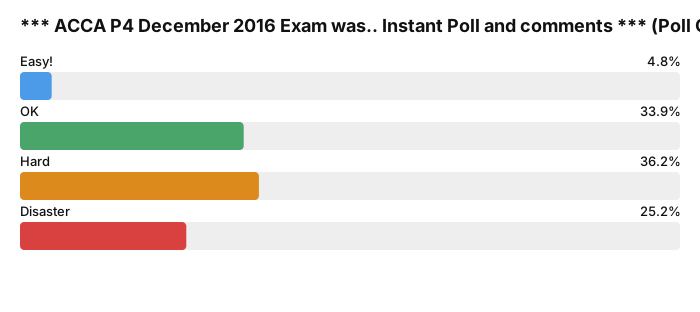
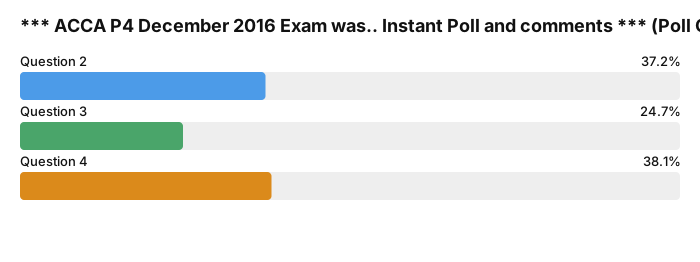
Please vote in our Instant Polls about the ACCA P4 December 2016 Exam.

@md4vies said: I thought that the question stated use market values for debt? I used The Rf +spread to calculate PV of the 4 year redeemable debt to calculate mv. Think it worked out about 1.04 * 120m. Did nobody do this?1.04? how did you get it? i thought is 105.34? using 6.2 as int rate and yield is ba2 4.7%
 Former user9y ago#64Former user9y ago#66Former user9y ago#67
@fard786 said: Did any one changed market value of equity for any of the propasal for ques 1 it was i think 360m i thought none of the proposals would affect it so i assumed it remain constant.any feedback on this would be appreciated.Thanks.Hey, yes I did the same, Market value of equity was not changing only the debt due to proposal 1 and 2 stating either increase or decrease debt. The tricky and annoying part was calculation of Cost of debt as I felt it was quite confusing especially depending on the proposal different interest rate was paid and the calculation were extremely repetitive by the third time I did it I was exhausted! lol Anyhow, I think the correct recommendation to directors was that even though more debt was taken in Proposal 2 the WACC of company has reduced further. This is in line with M&M theory, where it states debt is good for company as they have to pay tax and increases their income. I can't think from top of my head what were my WACC but I think proposal 2 had the lowest, hence I recommended that.
Former user9y ago#68@hpanchoo2206 said: Silly mistake from ny side...didnt calculate any asset beta....assumed kd same as coupon rate of 6.2%. Any idea how many marks i could lose? ?I don't think its a silly mistake, I also was thinking the same. If you have put don't your assumptions that the bonds were issued at 6.2% and no matter what the credit rating it will stay the same I don't think that's wrong, is it? I applied changed the interest rates based on credit rating which took a lot of my time on repetitive calculations but like others I felt the credit ratings were given for a reason, perhaps it was simply for discussion purpose? I hate this type of ambiguous question where it is not clear exactly what the examiner wants us to approach the question.
Former user9y ago#69@prad41 said: Hey, yes I did the same, Market value of equity was not changing only the debt due to proposal 1 and 2 stating either increase or decrease debt. The tricky and annoying part was calculation of Cost of debt as I felt it was quite confusing especially depending on the proposal different interest rate was paid and the calculation were extremely repetitive by the third time I did it I was exhausted! lol Anyhow, I think the correct recommendation to directors was that even though more debt was taken in Proposal 2 the WACC of company has reduced further. This is in line with M&M theory, where it states debt is good for company as they have to pay tax and increases their income. I can't think from top of my head what were my WACC but I think proposal 2 had the lowest, hence I recommended that.Same answer!!! However, I stated in the conclusion that the assumption of not change in share price was not realistic. Also that the increase in gearing was risky in real life.
Former user9y ago#71@sameinng said: Anyone remember question 1 first director proposal sell off the repair part how u deal with the asset beta i regear the equity beta 1.2 and to get the asset beta of the whole business and then directly minus the asset beta of the repair. Is that right i feel a bit weird here i think wrong somewhere anyone can enlighten me your explain in this part?you can't subtract directly; the question stated that the proportion of the businesses was the proportion of non-current assets. It was like a weighted average thingy. 70%X + 30% Y = asset beta of the whole company. The part that was disposed was 30% based on the question since the non-current assets reduced by 30%.
Former user9y ago#72@ninhvanquy said: I think 20% used to add in share price to determine capitalise value of Findon flightthe 20% was supposed to be used to increase the PE ratio of the combined firm. The "multiplier" in the question was a PE ratio of some sorts. you then multiply the new PE ratio by the combined FCFE of both companies. the multiplier was calculated as (9*1000)/1500=6 then increase by 20% thats 7.2 you then multiply 7.2 by the combined FCFE i.e 7.2(1500+170) = $12,024m before adding the synergy benefit.total for scenario 1 was $12,074m for me.
Former user9y ago#73Former user9y ago#76@ninhvanquy said: I think 20% used to add in share price to determine capitalise value of Findon flight
@prad41 said: Hey, yes I did the same, Market value of equity was not changing only the debt due to proposal 1 and 2 stating either increase or decrease debt. The tricky and annoying part was calculation of Cost of debt as I felt it was quite confusing especially depending on the proposal different interest rate was paid and the calculation were extremely repetitive by the third time I did it I was exhausted! lol Anyhow, I think the correct recommendation to directors was that even though more debt was taken in Proposal 2 the WACC of company has reduced further. This is in line with M&M theory, where it states debt is good for company as they have to pay tax and increases their income. I can't think from top of my head what were my WACC but I think proposal 2 had the lowest, hence I recommended that.for the 2nd proposal I think the risk free rate plus spread came to 6.2 so I concluded that the the market value was the book value. I may have been wrong in any case.
Former user9y ago#80@michellep said: Does anyone remember the Mark allocations especially for sections A?The 1st question was for 8marks (biz risk and financial risk and how they are related then risk mitigation vs diversification the second was 17 marks Ke and WACC for the current and two proposals Third was 8 marks.... effect on earnings and financial position fourth was 7 marks which was about recommendations and assumptions for b(i) and b(ii) then there was a separate question about discussing the third proposal about first evalauting the current status blah blah for 6 marks. I may have mixed up the marks from the third but I think the margin of error is small.
Former user9y ago#83@drey7000 said: I did the report for question one something like this: For proposal one, ungear equity beta with current capital structure to get about 0.85 I think. Then use the asset beta in proportion to the assets that were sold for the manufacturing division by using simultaneous equations. MV of debt was about 105, discounting at credit rating plus risk free rate. Anyway, under this proposal, the wacc was higher cause of the higher weighting of equity. Proposal 2 increased debt and assets and the overall income. Wacc was lower, and CoE was calculated simply by using the equity beta given of 1.21. Cost of debt was 6.2% tax adjusted (same as proposal 1), and we had to find MV by discounting at risk free rate plus the rating given which gave a MV of debt to be 100.01, so rounded to 100. I believe wacc came to around 9%. I recommended to either staying as is or choosing proposal 2 if their intention was to take on more projects, although prop 2 increased gearing to 49%. I think I went on to screw up part a and b considerably. They weren't hard, I just wasn't expecting them and they threw me off. For part a I explained the relationship of volatility of cash flows inherent to a business and the increased risk of defaulting from financial risk, but it was all rubbish I made up, doubt it's worth 2 marks.The discussions were more difficult than the calculations; could only briefly explain the implication of each value but didnt have enough time to conclude. I wonder what the marking scheme is like
@fard786 said: Increasing debt was proposal 2 is not it? Please enlighten me on this.Hello. I guess we are on the same page. I recommended proposal 1 because proposal 2 increases the financial risk, & also increases the cost of equity for investors,that would be it's downside. Also proposal 1 would yield an additional 6% return because 30 % reduction in assets would have lost 9 % of after tax return but the 30% reduction would have been sold at 15 % after tax, that was my justification. I screwed up wacc under proposal 1, I used the right method, but didn't consider the 70:30 ratio to calculate asset beta. Hope that doesn't cost me too much.
Former user9y ago#88Former user9y ago#89Former user9y ago#90