
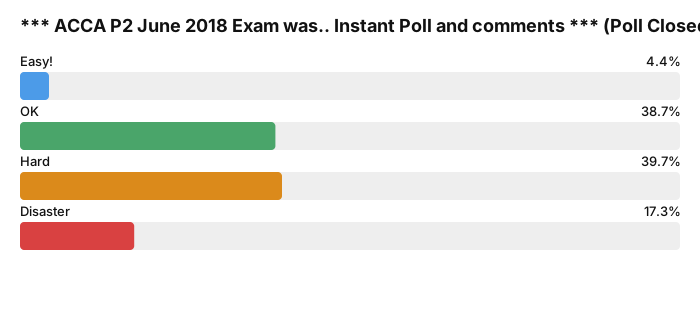
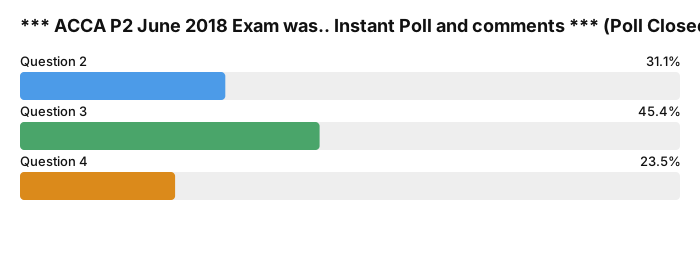
Please vote in our Instant Polls about the ACCA P2 June 2018 Exam
 Post your comments about the ACCA P2 exam below
(comments will open after 5pm UK)
Post your comments about the ACCA P2 exam below
(comments will open after 5pm UK)
@nathan488 said: I got this from IAS 37 guidelines: A constructive obligation arises if past practice creates a valid expectation on the part of a third party, for example, a retail store that has a long-standing policy of allowing customers to return merchandise within, say, a 30-day period. [IAS 37.10] Using this, I don’t believe there is a constructive obligation since there was no past occurrence, were just told they’re “willing” to settle it in case I’d go with the lawyer saying it’s not probable and thus no provision This is what I mean though, these questions are so subjectiveExactly, they are willing but that don't mean anything , they may just be crazy and uninformed and offering 7m when there is no need.
@craighughes88 said: Surely it is relevant as a lesee a finance lease goes on the balance sheet as a right of use asset? and the asset decreases as we pay rents yet the operating lease is just expensed ? Therefore i also raised ethical points surrounding them trying to increase assets by recognising intangible assets where it should just be expensed as a lease But who knows could be completely wrong I am no P2 expert lolYes you could be right no offense. But i do remember my sir saying the new ifrs 16 for lesses there is no such finance or operating lease! Hope im right
@jmmyjimmy said: Guys, what do you remember about government grants? I wrote that there has been a prepayment, which is subsequently reduced against spl. The grant can be of income nature or capital nature. Hence it can be recognised either as other income, or against the prepayment? Is it possible to recognised the grant as follows: Dr Cash Cr Prepayment ?The question said right at the end that it’s not accounted or recognised under IAS 20 grants :/ But your actual accounting seems okay. I wrote for the £4m non refundable fee TO the other entity that they need to defer the expense (deferred expense) until it’s at that date, since they’ve paid for it but haven’t yet consumed the “benefit” of these trials Then for the other free of £2m being received, I think I said to defer it as deferred income again for the similar reasons I also waffled a bit about IFRS 15 and performance obligations. At that point I had gone through an answer booklet and was just glad to have finished in time :’)
@robertoh said: Hate the autopsy after the exam...UK variant and did questions 2 and 4. Q1 - not the worst - quite fair. Annoyed that I forgot two adjustments that would have made my balance sheet balance!!!!! Did the calcs but didnt put the gain on BP to RE and didnt increase current liabilities for the provision otherwise would have balanced. Q2 - detailed and tricky but hoping a lot of theory and sensible comments using facts will pick up marks. I think the gas contract was a ROU Asset that should have been impaired as part if the CGU impairment review - not an intangible but I didnt put this in the exam which is annoying (wrote about CGU impairment review then the intangible criteria and that this doesnt meet intangible criteria so should be derec and a liability held at pv with interest payments at effective rate etc). Q4 wasnt too bad but part 4a i and ii was a bit waffly and poorly written because of the time pressure! Part 4b was very nice. The UK variant bits were nice and hoping for some easy marks but never know. Lets all enjoy the sun and get merry!!!I’m glad you feel happy over the paper! I agree with you that it was a mix of easy and hard for sure, but there were certainly rewarding areas you could’ve scored near to max marks on in my opinion. I also did the variant UK I do feel I’ve missed some core objectives of Q2/Q3 but feel I can make up the 50 marks with: - my consolidation (I did all relevant workings and was 3 off so am quite confident I should get at least 25/35 if the examiner is nice) - the 9 marker on associates and significant influence I feel was very approachable if you knew what they wanted, I mentioned: Definition of associate, what constitutes significant influence (20-50% and the factors too about attending board meetings etc) Then wrote the main difference in accounting being equity method not being allowed in FRS 102 but FVOCI is, where under IFRS SME’s, you can’t use FVOCI but can Equity account - the 6 marks on ethics of the guarantee was really nice (I mentioned about IAS 24 and IFRS 9 and how it should be disclosed by standard and then the waffle on ethics) - the other UK question on deferred tax asset was very approachable too (I mentioned the definition and the criteria to recognise a deferred tax asset. I then discussed the probability of them making future profit and referenced the economic crisis, I also then said although they’re expecting a significant profit, due to the external indicators, it’s probably impaired and thus actually may not make profit etc The above questions I feel very confident about, then the remaining ones not as much at all, but I wrote all the jargon on standards and application to the question so hopefully if I have done well on the above then I can scrap some marks on the remaining questions. I think a main indicator on passing is how well you’ve done on Q1 since that’s 50 makes worth
@lannajacques said: Disposal 10% I used 180 share capital and got a value of 48 Calculated increase to nci and difference recorded to oce Impairment 14 Goodwill sub 1 -20 something and sub 2 70 something Got a negative post profit -6 for sub 1 and sub 2 was 42 i think but these included increase in other components of equity which i seperated after Deducted 5 for contingent liability Fv plant was 80 and land 30May I ask why you take the adjustment to OCE, I took mine to RE (realistically a 0.5-1 mark difference) Every question I’ve done before has taken it to RE, I know this was a disposal in exchange for shares in another company, but the NCI portion itself I took to RE
@anonymous123 said: why financial instrument in 1a has to be at 49 ? i thought it had to be at amortised cost ? it was kept for the cash flow so it kept until maturity and then sell ? it passed the business model test surely.If held to maturity it is not sold. The question said it is sold but did not say anything about maturity so i held it at FVTPL
@jmmyjimmy said: Guys, did anyone have goodwill of: S1 - (28) S2 - 71. ???same here .hope got full marks on goodwill
@mackawara said: same here .hope got full marks on goodwillMe too
@nathan488 said: May I ask why you take the adjustment to OCE, I took mine to RE (realistically a 0.5-1 mark difference) Every question I’ve done before has taken it to RE, I know this was a disposal in exchange for shares in another company, but the NCI portion itself I took to REThe entries for a decrease in ownership without loosing control is DR cash (usually) CR NCI CR Other components of equity
@mackawara said: I got 48m consideration and calculated 10% of net assets and goodwill at year end and got 1,9 gain to equity.I did same also...phew
@almirak said: .fully agree.
@lannajacques said: My balance sheet did not balance by 35Mine did not balance by 36.
@siyaj said: I hate discussing the exam, yet i read through all of your comments, and i have some things that were similar to some of you i must say it is comforting, Quick question thou, when there is a gain for bargain based on the FV of the NCI being lower than its share of net assets where do you take this amount, surely you should not net it off against the goodwill applicable to the parent? for this reason my Goodwill was 76 Mill and not 71mill i had a hard time convincing my self i did the right thing here so for the hell of it please let me know if this treatment is wrong?Are you talking about where do you take the negative good will of Alston? Under IFRS 3, any negative goodwill (bargain purchase) should be credited to P/L immediately So I showed my negative goodwill under my parents column in retained earnings and then the positive goodwill of the other parent to the face of my SOFP