
Skip to contentSkip to search

SBR*** ACCA P2 June 2018 Exam was.. Instant Poll and comments ***

Oopentuition_teamAdmin8y ago

Please vote in our Instant Polls about the ACCA P2 June 2018 Exam
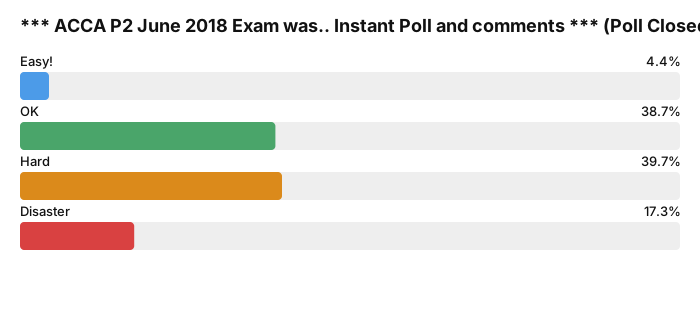
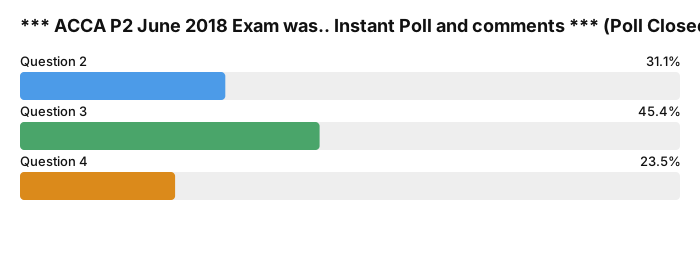
*** ACCA P2 June 2018 Exam was.. Instant Poll and comments *** poll results *** ACCA P2 June 2018 Exam was.. Instant Poll and comments *** poll results Post your comments about the ACCA P2 exam below (comments will open after 5pm UK)
Aanonymous1238y ago#31
omg you nearly killed me dude.
NNathan8y ago#32
1) for goodwill of Alston. I did everything normal, adjusted for the 5m contingent liability at fair value Then since within 12 months of measurement period, it was settled, I adjusted the difference of goodwill So my initial goodwill was around (28) then after the measurement adjustment it went to (22) or something 2) can anyone confirm if Q3 (a) (the one about medical supplying instruments at nil cost) was a lease related question or not?! Initially I was so happy since it had all the indicators of wanting you to write about finance vs operating, but I felt alsmot it was a revenue question?
NNathan8y ago#33
And for the adjustment to parent equity (disposal of 10%) I calculated my NCI as normal, took (10/original NCI holding) then added this result to my NCI since NCI has increased due to this disposal and then took the share proceeds (48 I think) - my NCI adj and the resulting figure (adj parents equity) goes to retained earnings in the parents column
NNathan8y ago#34
@jmmyjimmy said: I think that we don’t need to additionally adjust the goodwill, if no impairment occur.
Not sure if this posted or not but essentially IFRS 3 states that for any adjustment within 12 months of the acquisition date that affects goodwill due to facts at that date (ie: using provisional figures) is warrant for an adjustment to goodwill. I ageee there’s no impairment to goodwill since we were told none in the Q. But in my mind, since the liability was settled within 12 months of the acquisition date, that change should’ve adjusted goodwill
NNasir8y ago#35
@jmmyjimmy said: I calculated as follows: Consideration = 2/3 (share-for-share ratio) * 4 (market value) * 200 (shares of subsidiary) * 10% (disposed shareholding) = 53,33. Less: Increase in NCI = 10% * (Net assets at reporting date + goodwill at reporting date) = 40 (to my mind it was 40). The double entry then is: Dr Investment in associate: 53,33 Cr NCI 40 Cr RE 13,33 Does anyone agree? :(
Why retained earning not oce Like i applied the same when we get cash as we dispose off
NNasir8y ago#36
@nathan488 said: Not sure if this posted or not but essentially IFRS 3 states that for any adjustment within 12 months of the acquisition date that affects goodwill due to facts at that date (ie: using provisional figures) is warrant for an adjustment to goodwill. I ageee there’s no impairment to goodwill since we were told none in the Q. But in my mind, since the liability was settled within 12 months of the acquisition date, that change should’ve adjusted goodwill
If we include in our net assets the comtingent liability then automatically the fv of na figure goes to goodwill..why do we deduct it again
NNathan8y ago#37
@mumbaikar said: If we include in our net assets the comtingent liability then automatically the fv of na figure goes to goodwill..why do we deduct it again
I may be wrong but if I remember correctly, the contingent liability wasn’t included in the initial FVNA So you had to do the difference in FVNA and book value, that difference was due to depreciating PPE Then you had to adjust goodwill for the contingent liability. They told you the BV and FV You then bring it in at FV (5) I then also did a subsequent adjustment on my goodwill since the CL was settled within 12 months but I’m not sure if that’s correc or not
Aanonymous1238y ago#38
was it 180 share or 200. I must have looked at the wrong one :(
CCraig8y ago#39
180 was the SC 10% was 18 2/3 was 12 12*4 =48 for fv of consideration However I messed up the nci and just uses 10% of 390 (n.a. at reporting date) To give a gain on disposal of 9 48-39 =9 Section 2 and 3 seemed to both have leases? One operating and one finance? These were tricky as the lease in Q3 was for the entirety of the useful life but the lessor retained legal right The other one was the gas contract for storage now my view was they were leasing the building as it was fixed payments at regular intervals may be completely wrong but I hope I get some credit , they clearly shouldn't be capitalising as intangible asset Seemed to be lots of ethics too , one of the companies valuing the shares of the company they loaned to far too high in order to increase assets , also they wanted to go away from amortized cost when their business model prescribed it under ifrs9 which was dodgy Hope i get enough credit for the bits I did as I know as always with this exam there will always be mistakes, feel like I did much better than my previous attempt which gave me a 39 (march18)
Former userFormer user8y ago#40
i calculated with 180 too
NNasir8y ago#41
@jmmyjimmy said: I think your approach was correct.
There shouldnt be any gain/loss on disposal because the parent still owns plymouth only the shareholders are changing. No change in control
CCraig8y ago#42
Overall i thought the examiner was quite kind to us for the final P2 and will be gutted if I failed on such a friendly paper
CCraig8y ago#43
@mumbaikar said: There shouldnt be any gain/loss on disposal because the parent still owns plymouth only the shareholders are changing. No change in control
I think I definitely did something wrong with the disposal I even looked after the exam still no idea Heads fried Maybe not a gain on disposal but a change in equity I put the 9m through W5 so who knows Hopefully scrape 20 on the Q1A
YYen8y ago#44
Hi nathan588, may be I have remembered it wrong but the Contingent liability is settled in May 2018 (Not Mar 2018) as such 14 months, not within 12 months. That's why I didn't adjust FV for CL at year end. However, I may probably look at the wrong date. May and Mar ... Please anyone confirm?
NNathan8y ago#45
@yenchu said: Hi nathan588, may be I have remembered it wrong but the Contingent liability is settled in May 2018 (Not Mar 2018) as such 14 months, not within 12 months. That's why I didn't adjust FV for CL at year end. However, I may probably look at the wrong date. May and Mar ... Please anyone confirm?
Haha oh god, it might’ve been! Yes can anyone confirm?
NNathan8y ago#46
The end of the day guys, yes Q2/3 were very different and very few of the questions were direct (my favourite was the UK variant deferred tax asset one for 8 marks) But Q1 is where the main marks are: - get at least 20/35 on Q1a (which was very doable given the nice question) - smash nearly 90-100% marks on the 6 mark ethics - if you’re doing variant, then it was a very nice question to get at least 6-9 That gives you I’d say at least 30-40 Then you only need 10-20 marks out of 50 (less than 50% across both Q2/3) As long as you answered the Q’s you’ll get credit for any valid parts We can do this!
Eemmanuel8y ago#47
Hi LC in the house Q1 a) consolidated balance sheet b)Plymouth 60% subsidary or 40% associate c)IAS 24 related party loan guarantee Q3 a)IFRS 15 revenue recognition b)IAS 37 provision legal battle c)IAS 38 research costs (expensed) Q4 a)historical cost vs current cost b)single measure vs mixed measurement of assets and liability c)IFRS 16 operating lease IAS 20 $500,000 goverment grant IAS 40 investment property IAS 2 inventory
NNathan8y ago#48
I disagree with your Q3(c) I had this as general deferred income and expenses with IFRS 15, not IAS 38 And for Q3(a) even though i didn’t write revenue, I agree there’s concepts of it, but I think it was important to also write and consider about how it relates to a finance vs operating lease
EEmrah8y ago#49
Why was ppe impaired?
NNathan8y ago#50
@emrah1991 said: Why was ppe impaired?
You had to find recoverable amount which was higher of FVLCD and VIU For value in use you use the pre tax cash flows The VIU turned out to be higher and then you take that away from the carrying amount of PPE given to you in the question. DR p/L the impairment CR PPE I got 14 for impairment
EEveryone8y ago#51
As far as i remember, the liability was settled on 31 May 2018 amd the year end was 31 march 2018, which figure should be taken ?
CCraig8y ago#52
Anyone do Q2 ? The one with the company storing the gas. They must have been leasing that building but trying to recognise gas storage as an intangible asset. But unsure about this one.
Eemmanuel8y ago#53
Hi nathan i hear u Q3 a) At first I too was going to write about IFRS 16 leases. But then i realised there are two parts of this contract one with the sale of medical equipment and one with leased speacialised equipment so with these two performance obligations i went with Revenue. Q3 c) I choose IAS 38 since CUT provide information on the developement of products. IAS 38 states that research costs which are cost that do not meet recognition criteria should be expensed. It did not meet recognition criteria since it was not probable that there would be an inflow of economic benefits. But ur treatment of deferred income and expense is how i treated it so the end result is the same i guess.
NNathan8y ago#54
@laughingcoffin said: Hi nathan i hear u Q3 a) At first I too was going to write about IFRS 16 leases. But then i realised there are two parts of this contract one with the sale of medical equipment and one with leased speacialised equipment so with these two performance obligations i went with Revenue. Q3 c) I choose IAS 38 since CUT provide information on the developement of products. IAS 38 states that research costs which are cost that do not meet recognition criteria should be expensed. It did not meet recognition criteria since it was not probable that there would be an inflow of economic benefits. But ur treatment of deferred income and expense is how i treated it so the end result is the same i guess.
Yeah I see where you’re coming from for the lease aspect, it was very devious of them to word the question in that manner, hopefully they’ll be some credit for mentioning how it could be a lease but we’ll see And in respect of the last question, I can see where you’re coming from of talking about IAS 38
NNathan8y ago#55
I’m interested in what you guys said about the 9 marker on Q3 about adaption costs and provisions For the adaption costs I said it shouldn’t be capitalised under patent rights but should be capitalised under IAS 16 since it’s in relation to the actual machine (or whatever they were producing) and since it can’t be sold without it, is a directly attributable cost For the legal cases: I said both are contingent liabilities since: 1) the lawyer said it’s not probable they’ll have to pay out and under IAS 37 if it’s not probable then no full provision 2) the suing for lost profits I said is not a present obligation, I said the claim for this is entirely down to the entity suing. Because we don’t know if there’s a valid obligation yet, we will have to wait for the court case, and thus it’s a possible obligation Ultimately I said disclose both as contingent liabilities at their respective amounts given I disagree with stating it at the “average” stated by the entity
NNasir8y ago#56
@craighughes88 said: Anyone do Q2 ? The one with the company storing the gas. They must have been leasing that building but trying to recognise gas storage as an intangible asset. But unsure about this one.
I wrote about leases however here ppl are writing abt financial and operational leases which i think is relevant for the lessor. Because we were paying rents it means we are the lessee hence type of lease remains irrelevant
KKirill8y ago#57
I wrote that $7M is a provision cause there is a constructive duty and the company would probably pay it as it was its suggestion to settle both legal cases. The rest amount of $6M (5+8-7) is a contingent liability.
CCraig8y ago#58
I wrote no provision as there is no legal or constructive obligation, the lawyer said they may not have to pay so points towards no obligation but I am not sure this is right.
NNathan8y ago#59
@craighughes88 said: I wrote no provision as there is no legal or constructive obligation, the lawyer said they may not have to pay so points towards no obligation but I am not sure this is right.
I got this from IAS 37 guidelines: A constructive obligation arises if past practice creates a valid expectation on the part of a third party, for example, a retail store that has a long-standing policy of allowing customers to return merchandise within, say, a 30-day period. [IAS 37.10] Using this, I don’t believe there is a constructive obligation since there was no past occurrence, were just told they’re “willing” to settle it in case I’d go with the lawyer saying it’s not probable and thus no provision This is what I mean though, these questions are so subjective
CCraig8y ago#60
@mumbaikar said: I wrote about leases however here ppl are writing abt financial and operational leases which i think is relevant for the lessor. Because we were paying rents it means we are the lessee hence type of lease remains irrelevant
Surely it is relevant as a lesee a finance lease goes on the balance sheet as a right of use asset? and the asset decreases as we pay rents yet the operating lease is just expensed ? Therefore i also raised ethical points surrounding them trying to increase assets by recognising intangible assets where it should just be expensed as a lease But who knows could be completely wrong I am no P2 expert lol