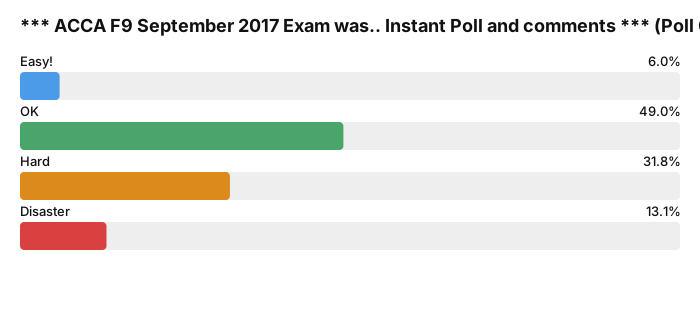
FM*** ACCA F9 September 2017 Exam was.. Instant Poll and comments ***
This confused me too! I ended up just doing 1-tax rate so 1-0.3 and used 0.7 / 7% which is probably so wrong but I had no idea what to do with it!
I think it was to do with when should you not use the same WACC for investment appraisal, I made comments about a different kind of business, or if the funding for the project wasn't included in the WACC as more debt or equity being raised would change the WACC.
For the conservative/aggressive approach, I read that to be moderate you had to cover your fluctuating assets with short term finance and non fluctuating with long term, I compared the two and it looked as though they had more long term finance than short, dependant on the fluctuating assets so I said that this was conservative approach.
Payback I also had 2.74, 2years 9 months.
I feel like most of the multiple choice questions are a blur now.
@psmill said: This confused me too! I ended up just doing 1-tax rate so 1-0.3 and used 0.7 / 7% which is probably so wrong but I had no idea what to do with it!I almost, almost did the same thing in the exam but I had a feel it'll be too wrong so I ignored it completely and just added the Mv of the bank loan without calculating its weight with the rest. Damn now I feel like using the after tax cost of capital could be right. Hopefully for your sake!
Thank you !!! Very much appreciated! ??
Hi everyone, I have just got the answer from "Ask the tutor" section reg variable loan rate:
"It depends what other information there is in the question.
If you are given the current interest rate then you would use that (obviously net of tax relief). If you are not given the current interest rate but there was other debt borrowing, then you would use the cost of the other debt borrowing.
But again, so much depends on what other information there is in the question."
Can anybody remember what was the question for 3 marks in the q3.2?(NPV question)
Have you noticed any current interest rate in the question?
no.for the loan it was variable.....so you just add the value of the loan in the total value of the debt.......Can u remember what was the question for 3 marks in the q3.2?
@demetrios21780 said: no.for the loan it was variable.....so you just add the value of the loan in the total value of the debt.......Can u remember what was the question for 3 marks in the q3.2?So for the NPV question, a) Calculate NPV (9 marks) b) Calculate Payback (2 marks) c) Discuss acceptance of projects (3 marks) d) Discuss directors views on project appraisal **I think it was something along these lines I believe I ended up writing pros and cons of both NPV and Payback** (6 marks)
@mariia21 said: Hi everyone, I have just got the answer from "Ask the tutor" section reg variable loan rate: "It depends what other information there is in the question. If you are given the current interest rate then you would use that (obviously net of tax relief). If you are not given the current interest rate but there was other debt borrowing, then you would use the cost of the other debt borrowing. But again, so much depends on what other information there is in the question."So then I assume it should have been the cost from the other loan then! It didn't mention any interest at all, I was trying to find a percentage to hold onto for dear life and found nothing! This would probably only be around a mark if it's just copying the same % over, so it shouldn't be too bad!
The question about either conservative or aggressie I chose aggressive because the question states 3M for flunctuating current asset, 4M for permanent current asset and 8M for permanent non-current asset and the company is financed by 5M short term funds and 10M long term funds....
A conservative person would finance flunctuating current asset, permanent current asset and permanent non current asset with long term funds while a moderate investor would finance all permanent asset both current and non current with long term funds while flunctuating asset with short term funds. An aggressive person on the other hand not only finance all flunctuating assets with short term funds but so also are part of permanent current asset financed by short term funds and the remainder are financed by long term fund while all permanent non current asset are financed by long term funds.
So in the question we have 10M longterm fund out of which 8M will finance non current asset, 2M will finance part of permanent current asset. 5M short term fund will finance all 3M flunctuating asset while 2M will finance the rest of permanent current asset.
So it's definitely an aggressive approach!
For the cost of bank loan we use cost of other similar loans if we r to look for a cost of debt with floating or variable rate!
so 5.6%
@shafeeibrahim7575 said: Guys can anyone remember what is the B question in the q31 wacc? Something to do with importance/instances of the wacc for the investment appraisal ?? A 3 marks theory question thank youWhy using WACC is not the most appropriate way of discounting? So assumptions for WACC (Business risk same / project relatively small) vs CAPM project specific / new project has different risk attached is better to use.
The questions states under what circumstances can WACC b used for project appraisals. In others words, it's asking about the assumptions of WACC which are project is small in size relative to the company, same capital structure and same business risk!
Is that not a moderate approach if it is in the middle?
Hi, if I am not mistaken, the second question was - should we accept or reject the project and the third - limitations of directors' benchmarks - I wrote about problems and limitations of DPBP there, as NPV was positive.
can anybody remember the question about efficient market hypothesis and the answer?????thanks in advance.
Topic lockedNew replies are closed.