
Skip to contentSkip to search
Kaplan Publishing: Black Friday countdown

FM*** ACCA F9 March 2017 Exam was.. Instant Poll and comments ***

Oopentuition_teamAdmin9y ago

Please vote in our Instant Polls about the ACCA F9 March 2017 Exam
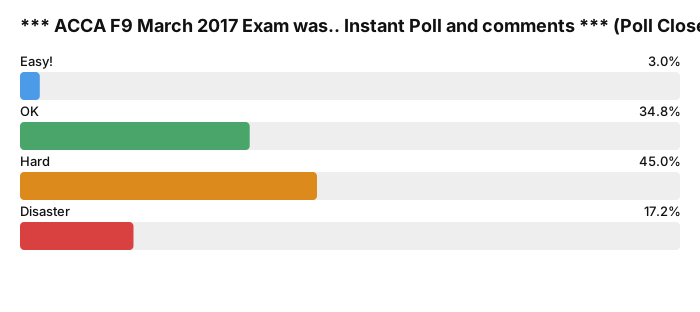
*** ACCA F9 March 2017 Exam was.. Instant Poll and comments *** poll results Post your comments about the ACCA F9 exam below (after 5pm UK time)

YYuly9y ago#151
Do u remember detail answer 5B? How much is that number?
AAqil9y ago#152
I don't remember actually :). Only I wrote my answers to the piece of paper. The answers may be wrong.
Ppinkyjovin1239y ago#153
Is 27 D)Is it economic risk-internationally... Does anyone remember??? This Question was just before calculating MMH.
AAqil9y ago#154
Yes. economic risk refers to the effect of exchange rate movements on the international competitiveness of a company. The rest of the answers mentioned wrongly
AAqil9y ago#155
pinkyjovin123, do other answers match with yours?
Ppinkyjovin1239y ago#156
Aqil,almost ... 6th Mcq is it about international fisher effect.. forward exc rate and futures pot rate..Is that the answer... Do you remember??
Ppinkyjovin1239y ago#157
@hanhnhan said: Do u remember detail answer 5B? How much is that number?
It's about inv holding period,Raw materials,wip. So and so.. 3835 option A)
SSavvas9y ago#158
Well guys i got answer d in that question. I used (raw materials/ purchases) * 365 (Wip/cost of sales) * 365 And another one ratio. I got D as an answer. I dont know if i am 100% right!
GGeshi9y ago#159
@aqillos said: Yes. economic risk refers to the effect of exchange rate movements on the international competitiveness of a company. The rest of the answers mentioned wrongly
Why transaction risk is wrong?
GGeshi9y ago#160
@aqillos said: I also, calculated shareholder return by using dividend 2014. But, I am afraid we did wrong. Because, we should consider dividend declared. Did anyone take MSCs answers? My answers was shown below: if you have any difference please share. 1 D 2 D 3 B 4 C 5 B 6 C 7 D 8 C 9 C 10 C 11 A 12 C 13 B 14 A 15 A 16 A 17 C 18 D 19 A 20 B 21 A 22 B 23 C 24 B 25 C 26 A 27 D 28 D 29 A 30 D
I think we have to use only dividend paid not declared.
GGeshi9y ago#161
Anyone remember first 3 mcqs ??
GGeshi9y ago#162
@pinkyjovin123 said: Aqil,almost ... 6th Mcq is it about international fisher effect.. forward exc rate and futures pot rate..Is that the answer... Do you remember??
Do u remember other options? And also what is the answer for least expensive rate regarding spot rate and forward rate?
GGeshi9y ago#163
@aminb001 said: Correct. Thats if its the Book Value of Equity. The option state the Market Value of Equity which is using the Market Share Price, not whats all the Balance Sheet.
What's the answer for this question? B or C?
AAqil9y ago#164
regarding quesrion 5 I remember got 3836, but do not remember whether it was in option A or B. I have looked at exam kit in relation to shareholder return. there was dividend declared, not paid. I considered dividend paid and got 22 %. hope it will not be mistake. If I am not wrong remember, option related to transaction risk mentioned accounts... something like this... I think it is translation risk... that's why I chosed economic risk...
AAqil9y ago#165
So, you mean shareholder return 22% ? Ccorrect? what about question 32? did you consider nominal wacc as discount factor in NPV ?
SSalvatore9y ago#166
I am reading a bit everywhere that dividend must be paid in the period taken into consideration
Mmumphee9y ago#167
i too thought there were too many questions on part G
Mmumphee9y ago#168
i got 2.5 years too
Ttwistedheat9y ago#169
@aminb001 said: Dividend paid is always considered. Check open tuition notes, all questions on TSR include dividend paid. Q1 was about corporate governance. Answer was option C. A is a close second but it is wrong.
I don't know if this is Mike or John (or anyone affiliated with Opentuition) but they do have the username "Opentuition Team" but they answered that the dividends declared are included in the TSR, at this link: https://opentuition.com/topic/f9-questions/
SSalvatore9y ago#170
@twistedheat said: I don't know if this is Mike or John (or anyone affiliated with Opentuition) but they do have the username "Opentuition Team" but they answered that the dividends declared are included in the TSR, at this link: https://opentuition.com/topic/f9-questions/
I will be curious to know what the correct answer is going to be. I have checked online and got different versions on this topic.
Ttwistedheat9y ago#171
I was just wonder if people included the Fixed Costs in the NPV question? I can't remember how the question was worded but I think it didn't state if the Fixed Costs were incremental or not, they just said the fixed costs were nominal. I included them because in the practice questions I've done, whenever there are fixed costs that need to be ignored we are told what the "incremental" part is, so I know to just include the incremental part and ignore the non-incremental. However in this question it just stated fixed costs so I was unsure if they were project specific fixed costs or not.
GGeshi9y ago#172
@twistedheat said: I was just wonder if people included the Fixed Costs in the NPV question? I can't remember how the question was worded but I think it didn't state if the Fixed Costs were incremental or not, they just said the fixed costs were nominal. I included them because in the practice questions I've done, whenever there are fixed costs that need to be ignored we are told what the "incremental" part is, so I know to just include the incremental part and ignore the non-incremental. However in this question it just stated fixed costs so I was unsure if they were project specific fixed costs or not.
Yes I included fc Do u remember the answer for the wacc calculation? Is it 14.7 as I included cost of bank loan aswell
Ttwistedheat9y ago#173
@gawcram said: Yes I included fc Do u remember the answer for the wacc calculation? Is it 14.7 as I included cost of bank loan aswell
Was this one of the MCQ? About book value WACC I think? If it was the one that had "reserves", I included both the reserves and the bank loan yeah. I think it was equity + reserves plus a bond plus a bank loan right? I just plugged it all into the WACC formula (remembering to add reserves to equity and adjusting for tax the cost of debt). I can't remember the answer it gave me though, but I know that's how I answered it.
SSavvas9y ago#174
The tricky part on WACC question was to exclude tax on cost of debt!!
GGeshi9y ago#175
@twistedheat said: Was this one of the MCQ? About book value WACC I think? If it was the one that had "reserves", I included both the reserves and the bank loan yeah. I think it was equity + reserves plus a bond plus a bank loan right? I just plugged it all into the WACC formula (remembering to add reserves to equity and adjusting for tax the cost of debt). I can't remember the answer it gave me though, but I know that's how I answered it.
Yes, it was a McQ What's your answer for the EAC mcq? Was it both statements true? Also the limitations of business valuation??
Ttwistedheat9y ago#176
@gawcram said: Yes, it was a McQ What's your answer for the EAC mcq? Was it both statements true? Also the limitations of business valuation??
I can't remember exactly what those questions were, sorry. If you can remember them, or some of the answer options then i might be able to tell you but right now my mind is blank!
SSalvatore9y ago#177
On dividend paid or declared this is how much I found written in the BPP's F9 book. It says about dividend paid or received and not declared. 'The wealth of the shareholders in a company comes from: - Dividends received - Market value of the shares A shareholder's return on investment is obtained in the form of: - Dividends received -Capital gains from increases in the market value of his or her shares If a company's shares are traded on a stock market, the wealth of shareholders is increased when the share price goes up. The price of a company's shares will go up when the company makes attractive profits, which it pays out as dividends or re-invests in the business to achieve future profit growth and dividend growth. However, to increase the share price the company should achieve its attractive profits without taking business risks and financial risks which worry shareholders. If there is an increase in earnings and dividends, management can hope for an increase in the share price too, so that shareholders benefit from both higher revenue (dividends) and also capital gains (higher share prices). Total shareholder return is a measure which combines the increase in share price and dividends paid and can be calculated as: (P1 -Po + D1) /P0 Where P0 is the share price at the beginning of the period P1 is the share price at the end of period D1 is the dividend paid Management should set targets for factors which they can influence directly, such as profits and dividend growth. A financial objective might be expressed as the aim of increasing profits, earnings per share and dividend per share by, say, 10% a year for each of the next five years.'
Ttwistedheat9y ago#178
In my opinion, the declared dividends thingy is just like cash vs accruals basis argument. I think, if I remember the question correctly, the declared dividends were for the year that was in the same time period as the capital growth but paid the next year, where as the paid dividends belonged to the period before but were paid in the same year as the capital growth. So if you believe that Total Shareholder Return is calculated on cash basis, you would have answered with the dividend received and if you think it should be calculated on accruals basis then you calculate with the declared dividend.
SSalvatore9y ago#179
@twistedheat said: In my opinion, the declared dividends thingy is just like cash vs accruals basis argument. I think, if I remember the question correctly, the declared dividends were for the year that was in the same time period as the capital growth but paid the next year, where as the paid dividends belonged to the period before but were paid in the same year as the capital growth. So if you believe that Total Shareholder Return is calculated on cash basis, you would have answered with the dividend received and if you think it should be calculated on accruals basis then you calculate with the declared dividend.
Exactly but this topic apparently was put in the exam without being accurately explained in the study material...
Uubongo9y ago#180
Please can i use F9 Practice and Revision kit for exams up to june 2015 for june 2017 exam coming up.
Topic lockedNew replies are closed.