
Inheritance Tax


1 Introduction
To be within the scope of Inheritance Tax (IHT) there must be a transfer of value of chargeable property by a chargeable person.
Transfer of Value
IHT is a cumulative donor-based tax. For it to arise, an individual must make a transfer of value with gratuitous intent; i.e. a gift or a sale at undervalue which results in the reduction of the donor's estate and there was an intention of a gift.
This is known as the 'loss to the donor' or the 'diminution in value' principle and applies to both:
lifetime transfers
the wealth a person leaves when they die (their death estate)
the diminution in value (loss to the donor) principle
Alan owns 60% of the shares in A Ltd. A Ltd has 100,000 £1 ordinary shares in issue.
Share valuations have been agreed with HMRC as follows:
20% | £10 per share |
40% | £15 per share |
60% | £25 per share |
80% | £40 per share |
Compute the transfer of value if Alan were to die leaving his shares to his daughter, or alternatively if he were to make a lifetime gift of 20,000 shares to his daughter.
If Alan died owning his 60,000 shares (a 60% shareholding), they would be valued at £25 per share; i.e. 60,000 @ £25 per share = £1,500,000. This figure would be included in his death estate.
If, however, he was to make a lifetime gift of 20,000 shares, the transfer of value would not be based on the value of a 20% interest; i.e. £10 per share, but would be computed as the difference between the value of his estate before and after the transfer:
£ | ||
Before the transfer | 60,000 shares (60%) @ £25 = | 1,500,000 |
After the transfer | 40,000 shares (40%) @ £15 = | (600,000) |
Transfer of Value (= loss to the donor/diminution in value) | 900,000 | |
Chargeable Property
All property to which the donor is beneficially entitled.
Chargeable person
An individual who is a long-term UK resident is chargeable on transfers of worldwide assets.
A long-term resident means that the individual has been UK resident for at least 10 of the 20 tax years prior to the tax year of the transfer.
An individual who is not a long-term UK resident is taxed on transfers of UK assets only.
2 Exemptions on Lifetime Transfers and in the Death Estate
Transfers between spouses (husband and wife/civil partners) are always exempt.
3 Exemptions on Lifetime Transfers only
There are three types of lifetime transfer:
Potentially exempt transfers (PETs); This is a gift by an individual to another individual
At the time the PET is made no IHT is chargeable.
If the donor lives for at least seven years, the gift becomes exempt and no further IHT is charged.
If the donor dies within seven years, then the PET becomes chargeable.
Chargeable lifetime transfers (CLTs) – for the TX exam this will always be a transfer into a trust.
IHT is chargeable on a CLT both:
at the time the gift is made (at lifetime rates), and
at the time of death (at death rates) if the donor dies within seven years
The following exemptions are available against lifetime transfers:
Normal expenditure out of income:
IHT is a capital tax; i.e. a tax on capital transfers. For this exemption, the donor must show a regular pattern of giving, make the gift out of excess income and must leave themselves with enough income to retain their normal standard of living.
Small gifts exemption:
Transfers of value of up to £250 per donee per tax year are exempt. Note that unlike some other exemptions, it cannot be used to exempt part of a larger gift; i.e. if the £250 limit is exceeded, the exemption does not apply.
Marriage exemption:
Transfers of value in consideration of marriage/civil partnership (i.e. a wedding present) is exempt up to certain limits:
For each of the parents to the bride or groom, £5,000.
For remoter ancestors (e.g. grandparents) and for the parties to the marriage (i.e. from the groom to the bride), £2,500.
For anyone else (e.g. from an aunt to a nephew), £1,000.
Annual exemption (AE):
The first £3,000 of the value of transfers each tax year is exempt. Any unused AE is carried forward a maximum of one tax year for use after that year’s own AE.
The exemption is allocated to gifts on a strict chronological basis; i.e. to the first gift in the tax year, even if that gift is a PET and never becomes chargeable.
These exemptions are considered in order, so the annual exemption(s) are deducted from the transfer of value last to compute the amount of the PET/Net CLT.
Compute the value of each of the following lifetime transfers:
1 | 7 June 2024 | a gift to her daughter of £4,000 |
2 | 12 August 2024 | a wedding present to her son of £5,500 |
3 | 19 September 2024 | a gift to her husband of £20,000 |
4 | 9 July 2025 | a wedding present to her niece of £3,500 |
5 | 25 December 2025 | gifts of £200 each to two friends as a Christmas gift |
6 | 25 March 2026 | a gift to a trust of a valuable painting worth £100,000 |
The gift on 19 September 2024 is exempt as a transfer between spouses.
The gifts on 25 December 2025 are exempt as they are covered by the small gifts exemption.
The gifts on 7 June 2024, 12 August 2024 and 9 July 2025 are PETs.
The gift into trust on 25 March 2026 is a CLT.
The values of the PETs/Net CLT are then computed as follows:
7/6/2024 | 12/8/2024 | 9/7/2025 | 25/3/2026 | |
PET | PET | PET | CLT | |
Transfer value | 4,000 | 5,500 | 3,500 | 100,000 |
Less: Exemptions | ||||
Marriage exemptions | (5,000) | (1,000) | ||
AE 2024/25 (CY) | (3,000) | |||
AE 2023/24 (PY)* | (1,000) | (500) | - | - |
AE 2025/26 | (2,500) | (500) | ||
PET/Net CLT | Nil | Nil | Nil | 99,500 |
*The AE for 2023/24, if not used in 2023/24, can be carried forward for one year only (i.e. to 2024/25) but must be used AFTER the AE for 2024/25. If not used in 2024/25 it cannot be carried forward to 2025/26. | ||||
4 Potentially Exempt Transfers (PET)
A PET is a lifetime gift made by an individual to another individual.
PETs are only chargeable if the donor dies within 7 years, therefore, although it uses up any available exemptions, there is no IHT liability at the date of the gift.
5 Chargeable Lifetime Transfer (CLT)
A CLT is a transfer made in lifetime into a trust.
With a CLT there is an immediate charge to tax on the net CLT (i.e. the amount net of exemptions), subject to the availability of the nil rate band (NRB). The NRB used to increase every year, but has been frozen at £325,000 since 2009/10.
The amount of tax that may be payable on the net CLT is based on the cumulative amount of transfers made by the donor over a 7 year period; i.e. the NRB is only given in full once every 7 years.
6 Calculating Lifetime IHT (CLTs only)
When calculating IHT it is important to work through the three stages methodically:
Stage 1 – transfer value (PET/CLT):
Identify the type of gift – exempt or PET or CLT
Check for any lifetime exemptions and apply any that are relevant (AE last)
The resulting figure is the PET or net CLT
Stage 2 – lifetime IHT (CLTs only)
Identify the NRB at the date of the transfer (£325,000)
Reduce the NRB by any chargeable transfers within the 7 years prior to this transfer (ignore PETs)
If there is any NRB remaining, then that amount of the net CLT is taxed at 0%, but IHT will be due on any excess.
Stage 3 – Death
If the donor dies within 7 years, then any lifetime gifts (PETs and gross CLTs) become chargeable; PETs for the first time and there may be additional tax to pay on CLTs.
In addition, any assets the deceased owned at the date of death will be listed in the death estate and also charged to IHT.
STAGE 1: Transfers
£ | |
Value of estate before transfer | X |
Less: Value of estate after transfer | (X) |
Transfer of value | X |
Less: Specific exemptions | |
(e.g. spouse/civil partner, small gifts) | (X) |
Marriage exemption (if applicable) | (X) |
Annual exemptions (current year then previous year (if available)) | (X) |
PET/net CLT | X |
STAGE 2: Lifetime IHT (CLTs only)
The Nil Rate Band (NRB) is the amount that can be gifted without incurring any IHT liability.
The NRB in the tax year of the gift should be used.
The NRB for 2025/26 is £325,000. If you need the NRB for a previous tax year, it will be given to you in the question.
The NRB must be reduced by the gross chargeable transfers (GCTs) made in the previous seven years. During the donor’s lifetime GCTs only include CLTs, not PETs.
The rate of tax on lifetime gifts not covered by the available NRB is 20%.
If the trustees agree to pay the IHT: 20%
If the question is silent, or it states that the donor pays the IHT:
The amount not covered by the NRB is treated as being net of tax at 20%.
The tax paid by the donor is therefore calculated at 20/80 (or 25%).
The gross chargeable transfer (GCT) which will be carried forward to reduce the NRB for the next 7 years is:
If the trustees pay the tax, the GCT = net CLT
If the donor pays the tax, then as the loss to the donor is the gift AND the tax, then the GCT = net CLT plus the tax.
The tax payable on a lifetime gift is due the later of:
six months from the end of the month of the gift; and
30 April following the end of the tax year of the gift.
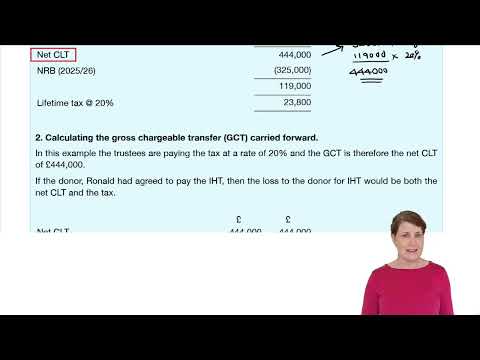
Ronald created a discretionary trust on 1 June 2025 and transferred £450,000 to the trustees. The trustees agreed to pay the IHT due.
1. Assuming Ronald has made no other lifetime transfers, calculate the IHT payable on the transfer.
Ronald | CLT | |
01/06/2025 | ||
£ | ||
Transfer value | 450,000 | |
Less: AEs | ||
– CY (2025/26) | (3,000) | |
– PY (2024/25) | (3,000) | |
Net CLT | 444,000 | |
NRB (2025/26) | (325,000) | |
119,000 | ||
Lifetime tax @ 20% | 23,800 |
2. Calculating the gross chargeable transfer (GCT) carried forward.
In this example the trustees are paying the tax at a rate of 20% and the GCT is therefore the net CLT of £444,000.
If the donor, Ronald had agreed to pay the IHT, then the loss to the donor for IHT would be both the net CLT and the tax.
£ | £ | ||
Net CLT | 444,000 | 444,000 | |
NRB (2025/26) | (325,000) | ||
119,000 | |||
Lifetime tax @ 25% | 29,750 | 29,750 | |
GCT | 473,750 |
On 16 July 2008, Betty created a discretionary trust and gave the trustees £320,000 in cash and she agreed to pay any IHT on this transfer.
On 1 August 2014, she gave £125,000 to her son as a wedding present.
On 10 September 2014, Betty gave a further £338,000 in cash to the trustees. The trustees agreed to pay any IHT due on this transfer.
Assuming Betty has made no other lifetime transfers, calculate the IHT due on each transfer and the amount of the gross chargeable transfers carried forward.
Relevant NRBs are as follows:
2008/09 – £312,000
2014/15 – £325,000
Show answerHide answer

STAGE 3: Death
On the death of the donor, there is no IHT to pay on lifetime gifts (gross CLTs and PETs) made more than 7 years prior to the date of death, but gross CLTs will still reduce the NRB until they are 7 years old.
However, any lifetime gifts (gross CLTs and PETs) made within 7 years prior to the date of death become chargeable.
PETs become chargeable for the first time
Additional tax may be due on CLTs.
The rate of IHT on death is 40% (subject to the availability of the NRB at the date of death).
Taper relief may be available to reduce the death tax (on gross CLTs and PETs) if there is at least 3 years between the date of the gift and the date of death.
Any death tax (after taper relief) due on a CLT can then be reduced by any lifetime IHT paid (either by the trustees or the donor). Note that the death tax can only be reduced as far as nil; (i.e. no refunds).
In addition, the death estate is charged to IHT at 40%.
Calculating death tax on lifetime gifts within 7 years prior to death
Death tax is calculated on each gift separately, in chronological order, as follows:
Identify all gifts (gross CLTs and PETs) within the seven years prior to death.
Start with the first gift in that 7 year period (gross CLT or PET).
Calculate the NRB available: start with the NRB at the date of death, and then reduce it by any chargeable transfers in the 7 years prior to the date of the gift.
Remember that PETs made more than 7 years prior to death are not chargeable.
Calculate the death tax at 40% on the excess over the available NRB.
Calculate and deduct any taper relief available (see below).
For CLTs, deduct any lifetime IHT paid. NO REFUNDS.
If required, state who will pay and the due date for payment.
The tax payable on lifetime gifts as a result of the death of the donor is due within six months of the end of the month of death and is always paid by the donee (the trustees or the recipient of the PET).
Taper Relief
If the donor does not survive for 7 years following the gift but does survive for at least 3 years, any IHT payable on death (gross CLTs and PETs) is reduced by taper relief. The IHT is first calculated at 40% and then reduced as follows:
Time from transfer to date of death Relief/reduction
3 – 4 years | 20% |
4 – 5 years | 40% |
5 – 6 years | 60% |
6 – 7 years | 80% |
This table is provided in the examination.
Dee died on 1 March 2026 with a death estate valued at £500,000 and having made the following lifetime gifts:
1 November 2013 | £160,000 | cash to a trust |
1 October 2015 | £120,000 | cash to her son |
1 June 2018 | £339,000 | cash into a trust |
1 September 2021 | £296,000 | cash to her daughter |
Required:
(a) Calculate the IHT payable on the lifetime gifts when they were made assuming that Dee paid any lifetime tax due.
(b) Calculate the IHT payable as a result of Dee’s death.
Show answerHide answer
7 The Death Estate

The death estate comprises all assets held on death at their open market value (MV) at that date (known as the probate value) less certain liabilities.
Any funds held in a pension fund should not be included in the death estate.
£ | £ | |
Land and buildings | X | |
Less: Mortgage (Note 1) | (X) | |
X | ||
Business owned by sole trader/partnership | X | |
Investments | X | |
Stocks and shares (including ISAs) | X | |
Government securities | X | |
Insurance policy proceeds (Note 2) | X | |
Motor cars | X | |
Personal chattels | X | |
Debts due to the deceased | X | |
Cash at bank and on deposit (including ISAs) | X | |
X | ||
Less: | ||
Debts owed by the deceased (Note 3) | (X) | |
Outstanding taxes (e.g. IT, CGT due) | (X) | |
Funeral expenses (must be reasonable) | (X) | |
(X) | ||
Less: Exempt legacies to spouse/civil partner | (X) | |
Gross chargeable estate | X |
Note 1:
If a property in the estate is mortgaged, the mortgage will reduce the property value if it is a repayment or interest only mortgage. Endowment mortgages are not deducted as they are repaid on death by the life assurance part of that mortgage.
Note 2:
The estate should also include the proceeds of any life assurance policy on the deceased’s life (as it will pay out on death). If the life assurance policy is on someone else's life (e.g. the deceased's spouse), then include the market value of the policy at the date of death (as it has not paid out).
Note 3:
The value of the estate will be reduced by any legally enforceable debts due at that date; e.g. credit card bills. Not gambling debts or verbal promises to pay.
Procedure to calculate IHT on the death estate:
Calculate lifetime IHT and death IHT on all gifts within seven years of death.
Calculate the gross chargeable estate value.
Calculate the amount of residence nil rate band (RNRB) available, if applicable (see below).
Calculate the amount of NRB available after deducting the value of GCTs (all PETS and CLTs) in the 7 years prior to the date of death.
Calculate the death tax on the excess at 40%.
If required, state who will pay and the due date for payment
Hamish died on 1 May 2025. His death estate comprised the following:
£ | ||
House | 350,000 | |
Personal chattels | 95,000 | |
Shares held in an ISA | 16,000 | |
Car | 22,000 | |
Life insurance policy on own life | 200,000 | (proceeds) |
180,000 | (MV) |
Hamish’s funeral expenses amounted to £2,500.
He left his house to his wife and all remaining assets to his daughter.
Hamish had made a lifetime gift of £100,000 cash to his daughter in September 2023 on the occasion of her wedding.
Calculate the IHT payable as a result of Hamish’s death.
Show answerHide answer

Additional Residence Nil Rate Band (as applicable to TX)
The residence nil rate band (RNRB) applies where a “main” residence is held within the death estate and is inherited by DIRECT descendants (children/grandchildren). The examiner has stated that a question will make it clear if the residence nil rate band is available. Therefore, you should assume that the residence nil rate band is only available if there is mention of a main residence.
The RNRB was introduced for deaths on or after 6 April 2017 (2017/18) and for 2025/26 is £175,000. If you need the RNRB for a previous tax year, it will be given to you in the question.
The value of the main residence for this purpose is after deducting any repayment mortgage or interest-only mortgage secured on that property.
If a main residence (after deduction of mortgage) is valued at less than the available residence nil rate band, then the residence nil rate band is reduced to the value of the residence.
Sophie died on 26 May 2025 leaving an estate valued at £850,000 which included the family home valued at £245,000. Under the terms of her will, Sophie’s estate was left to her children. Sophie's only lifetime gift was a gross chargeable transfer of £120,000 in January 2024.
The Inheritance Tax (IHT) liability on Sophie's death estate is:
£ | ||
Gross chargeable estate | 850,000 | |
Less RNRB: | Lower of £245,000 and £175,000 | (175,000) |
Less NRB: | £(325,000 - 120,000) | (205,000) |
470,000 |
IHT @ 40% x £470,000 = £188,000.
The residence nil rate band of £175,000 is available because Sophie’s estate included a main residence, and this was left to her direct descendants.
Transfer of unused nil rate bands
Note that any transfer of RNRB and/or the NRB can only be done once both spouses are dead.
Any unused proportion of the RNRB on the death of the first spouse/civil partner can be transferred for use against the death estate of the second spouse/civil partner. The transfer is available even when the spouse/civil partner died prior to the introduction of the RNRB (i.e. prior to 6 April 2017), in which case, the unused proportion of the RNRB will be 100%. This enhanced RNRB can never exceed twice the current RNRB, therefore a maximum of £350,000.
Any unused proportion of the NRB on the death of the first spouse/civil partner can be transferred for use by the second spouse/civil partner on their death. This enhanced NRB can never exceed twice the current NRB, therefore a maximum of £650,000.
Note that the enhanced NRB is used throughout Stage 3, therefore on lifetime gifts before any remainder is applied to the death estate.
Using the information in Illustration 4, assume Sophie's husband Fred had died on 10 May 2007 leaving an estate valued at £225,000 to his son and had made no lifetime gifts.
The RNRB was not introduced until 6 April 2017, therefore as Fred's death was before this date, his RNRB is deemed to be 100% unused.
The NRB in 2007/08 was £300,000 of which Fred had used £225,000 (75%), leaving the other 25% unused.
On Sophie's death, her nil rate bands are as follows:
£ | ||
RNRB: | £175,000 + 100% x £175,000 | 350,000 |
NRB: | £325,000 + 25% x £325,000 | 406,250 |
The Inheritance Tax (IHT) liability on Sophie's death estate is:
£ | ||
Gross chargeable estate | 850,000 | |
Less RNRB: | Lower of £245,000 and £350,000 | (245,000) |
Less NRB: | £(406,250 - 120,000) | (286,250) |
318,750 |
IHT @ 40% x £318,750 = £127,500.
In an examination question, the following approach should be adopted:
Compute the transfer value for each lifetime gift and deduct any exemptions.
If any CLTs have been made, the computation for Lifetime Transfers must be prepared. To compute any tax payable, it must be ascertained who paid the tax, donor or donee, to determine the tax rate to apply above the nil rate band, 20% or 25%.
On the death of the taxpayer any lifetime transfers, CLTs or PETs made within the 7 years of death are now included in the computation for Lifetime Transfers Chargeable On Death.
The Chargeable Estate is now established, and the tax thereon computed.
It may also be required to state by whom and by when the IHT should be paid.
Section A MCQ may look as follows:
You may encounter a full IHT exam question in Section C as follows, however IHT is more likely to come up in the exam as a smaller part question than a full question.

Joe Kerr died on 1 April 2026, leaving assets worth £250,000 to his wife and the remainder of his estate to his son.
At the date of his death Joe owned the following assets:
(1) His main residence valued at £300,000 upon which there was an outstanding repayment mortgage of £80,000
(2) A holiday home valued at £140,000
(3) Bank and Building Society Deposits amounting to £230,000
(4) ISAs valued at £50,000
(5) 12,000 Shares in Joe Ltd valued at £20 per share
(6) A life assurance policy with an open market value on 1 April 2026 of £125,000 from which proceeds of £140,000 were received following Joe’s death.
Joe had outstanding credit card bills of £7,000 at the date of his death and had also verbally promised to pay the medical expenses of £1,000 of a friend. Funeral expenses were £5,000.
During his lifetime he had made the following lifetime transfers:
(1) On 20 November 2019 a cash gift of £40,000 to his son on the occasion of his wedding.
(2) On 15 July 2020 he transferred £405,000 into a trust and paid the IHT due.
(3) On 8 December 2024 he gave 4,000 shares in Joe Ltd to his son. Prior to the gift Joe owned 16,000 of the 20,000 shares in Joe Ltd. Share valuations agreed with HMRC at this date were as follows:
Value per share | ||
20% shareholding | - | £8 |
40% shareholding | - | £12 |
60% shareholding | - | £18 |
80% shareholding | - | £25 |
Compute the amount of IHT payable during Joe’s lifetime and upon his death.
Show answerHide answer
8 IHT Planning
As the Chargeable Estate of the taxpayer is charged at 40% above the nil rate bands it is sensible for a taxpayer to think carefully about succession planning to minimise what may be a significant IHT liability arising upon his or her death. Thus, making lifetime transfers is the easiest way an individual may reduce the IHT liability that would otherwise arise upon death. This of course assumes that the individual has both the capacity and willingness to make such gifts during lifetime.
If an individual makes regular lifetime gifts to others out of his excess income these transfers will be exempt as normal expenditure out of income. In addition, the taxpayer has an annual exemption of £3,000 available each year and may also be able to take advantage of the marriage exemption.
Other gifts to individuals will be PETs:
no immediate IHT liability will arise, and these transfers will only become chargeable if the donor dies within 7 years of having made them.
if the individual dies within 7 years the value of the transfer is “frozen” at the time of the transfer; i.e. any increase in value is ignored for IHT purposes. It is therefore beneficial to make lifetime gifts of those assets that are likely to increase in value over time.
if the donor survives for at least 3 years then any IHT payable is reduced by taper relief.
When gifts are made in lifetime the taxpayer must also consider any CGT implications of those gifts. A chargeable gain arises on a chargeable disposal of a chargeable asset by a chargeable person. A gift is a chargeable disposal with a gain being computed based on the market value of the asset gifted. If the asset is of course an exempt asset, such as cash, a car, or an exempt chattel, then no gain will arise.
If the asset is a chargeable asset, then there will still be no CGT liability if the net gains for a tax year are covered by the AEA of the taxpayer. If gains would exceed the AEA then reliefs may be available to exempt or defer the gains from chargeability, for example the availability of private residence relief to exempt a gain or gift relief to defer a gain.
These planning issues are further explored in later chapters.
In choosing which assets should go to which beneficiary upon death it is also important to ensure that the taxpayer takes advantage, wherever possible, of exempt transfers to a spouse or civil partner and makes best use of the residence nil rate band by ensuring that a main residence, if not gifted to a spouse/civil partner is gifted to a direct descendant rather than to a beneficiary for whom the residence nil rate band is not available; e.g. a nephew.