
Self Assessment and Payment of Tax for Companies

1 Corporation tax – payment dates
1.1 Notification of chargeability
A company falling within the scope of corporation tax for the first time must notify HMRC within 3 months of the start of its first accounting period. Failure to notify chargeability to tax within 12 months of the end of the accounting period will lead to a standard penalty based on a percentage of the tax unpaid 12 months after the end of the accounting period.
1.2 Payment of tax
Corporation tax is payable 9 months and one day after the end of each accounting period (due date), with provisions for quarterly instalment payments for ‘large’ companies. Payment must be made electronically.
Interest due to the HMRC on tax paid late will run from the due date to the date of payment at a rate of 8.5% per annum.
Interest on overpayments of tax will run from the later of the due date or the date tax was actually paid at a rate of 3.5% per annum.
Under the loan relationship rules, interest received on overpaid corporation tax will be taxable as interest income and interest on tax paid late will be deductible against interest income.
1.3 Quarterly Instalments
Quarterly instalments apply to large companies.
A company is required to make quarterly instalment payments in respect of its corporation tax liability if augmented profits exceed a profit threshold of £1,500,000. Such companies being classed as large.
The profit threshold is divided by the number of associated companies as at the end of the immediately preceding accounting period. For any question involving quarterly instalment payments, the number of associated companies will be given.
The instalments are 25% of the estimated current year’s liability.
The four quarterly instalments will be made on the 14th day of months 7, 10, 13 and 16 following the start of the accounting period. Thus for the year ended 31 March 2026 the first quarterly instalment payment would be due 14 October 2025 followed by further payments due at three month intervals thereafter on 14 January 2026, 14 April 2026 and 14 July 2026.
Quarterly payments are not required if:
current profits do not exceed £10 million and
the company was not large in previous AP.
2 Corporation tax return
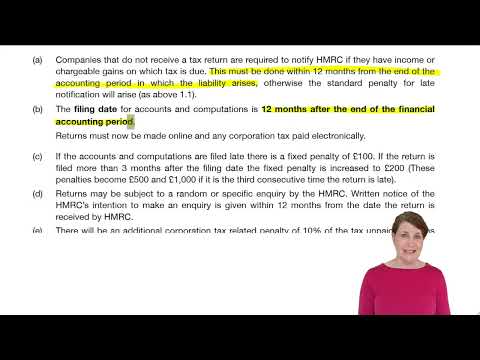
Companies that do not receive a tax return are required to notify HMRC if they have income or chargeable gains on which tax is due. This must be done within 12 months from the end of the accounting period in which the liability arises, otherwise the standard penalty for late notification will arise (as above 1.1).
The filing date for accounts and computations is 12 months after the end of the financial accounting period.
Returns must now be made online and any corporation tax paid electronically.
If the accounts and computations are filed late there is a fixed penalty of £100. If the return is filed more than 3 months after the filing date the fixed penalty is increased to £200 (These penalties become £500 and £1,000 if it is the third consecutive time the return is late).
Returns may be subject to a random or specific enquiry by the HMRC. Written notice of the HMRC’s intention to make an enquiry is given within 12 months from the date the return is received by HMRC.
There will be an additional corporation tax related penalty of 10% of the tax unpaid 6 months after the return is due, if the self-assessment tax return is more than six months late, or 20% of the tax unpaid 6 months after the return is due, if more than 12 months late.
HMRC may amend a return to correct obvious errors within nine months of the day the return is filed. A company may amend a return within 12 months of the filing date.
3 Claims
Wherever possible claims must be made on a tax return or on an amendment to it and must be quantified at the time the return is made.
If a company believes it has made an error in a return, an error or mistake claim may be made within four years from the end of the accounting period.
Other claims must be made within four years of the end of the accounting period unless a different time limit is specified.
4 Records
Companies must keep records until the latest of:
six years from the end of the accounting period
the date any enquiries are completed
the date after which enquiries may not be commenced
All business records and accounts including contracts and receipts must be kept
Failure to keep records can lead to a penalty of up to £3,000 for each accounting period affected
5 Compliance checks (enquiries)
HMRC may enquire into a corporation tax return provided that they first give written notice that they are going to enquire.
The notice must be given within a year after the later of:
12 months following the date the return is actually received by HMRC
If the return is late, 12 months following the 31/1, 30/4, 31/7, 31/10 that next follows the actual date of delivery.
An enquiry may be made due to:
A suspicion income is understated
Deductions being incorrectly claimed
Other information in HMRC’s possession
Being part of a random review process.
6 Determinations and discovery assessments
If a return is not delivered by the filing date, HMRC may issue a determination of the tax payable within 3 years of the filing date.
If HMRC believe that not enough tax has been assessed for an accounting period they can make a discovery assessment to collect the tax.
A discovery assessment can only be made if:
HMRC could not reasonably be expected to have been aware of a loss of tax and are supplied with information to draw their attention to a contentious matter such as the use of a valuation or estimate. HMRC can raise an assessment within 4 years from the end of the accounting period; this is extended to 6 years if there is a careless error or 20 years if there is a deliberate error or failure to notify a chargeability to tax.
7 Appeals and Disputes
The company can appeal against amendments to the corporation tax return.
The appeal must normally be made within 30 days of the amendment and must state the grounds for appeal.
The appeals procedure is as per VAT.
8 Penalties for incorrect returns
The amount of penalty is based on the amount of tax understated, but the actual penalty payable is linked to the taxpayer’s behaviour, as follows:
there will be no penalty where a taxpayer simply makes a genuine mistake.
there will be a moderate penalty (up to 30% of the understated tax) where a tax payer fails to take reasonable care.
there will be a higher penalty (up to 70% of the understated tax) if error is deliberate.
there will be an even higher penalty (up to 100% of the understated tax) where the error is deliberate and there is also concealment of the error.
A penalty will be substantially reduced where the taxpayer makes disclosure, especially unprompted disclosure to HMRC.