
Value Added Tax – VAT


1 VAT basics
(a) VAT is charged on the taxable supply of goods and services in the UK by a taxable person in the course of their business.
(b) A taxable person ('trader') can be an individual, a partnership or a company.
(c) A trader's supplies/turnover (i.e. sales) may be:
Standard rated – 20%
Zero rated – 0%
Exempt
(d) The distinction between capital and revenue expenditure, that applies to most areas of tax, is not generally important for VAT.
(e) Taxable supplies are those that are either standard rated or zero rated. A trader that is registered for VAT must charge output VAT on sales (including the sales of capital assets) but may reclaim input VAT on purchases (including the purchases of capital assets) and expenses.
(f) If a trader only makes exempt supplies he is unable to register for VAT and cannot reclaim input VAT (which then becomes an additional cost to the business).
2 VAT registration
2.1 Compulsory registration – the historic test
A trader making taxable supplies must register for VAT if, during the previous 12 months, the value of taxable supplies exceeded £90,000. However, VAT registration is not required if taxable supplies in the following 12 months will not exceed £88,000. These figures are exclusive of VAT.
HMRC must be notified within 30 days after the end of the period when taxable supplies exceeded £90,000.
The trader will be registered from the end of that 30 day period (i.e. the first day of following month) or an agreed earlier date. For example, if the registration limit was exceeded in the 12 months to the 31 March 2026, the business must notify HMRC by 30 April 2026 and would be registered with effect from 1 May 2026.
Note that the £90,000 threshold is an absolute limit; i.e. if a new trader exceeds the threshold in fewer than 12 months, then VAT registration is required.
Orchid Ltd commenced trading on 1 June 2025. Its sales are as follows:
£ | £ | ||||
2025 | June | 3,800 | 2026 | January | 7,000 |
July | 3,900 | February | 7,500 | ||
August | 4,300 | March | 8,100 | ||
September | 5,100 | April | 8,900 | ||
October | 6,000 | May | 10,200 | ||
November | 6,500 | June | 11,800 | ||
December | 7,900 | July | 14,500 | ||
37,500 |
The company’s sales are all standard rated.
State:
(a) When Orchid Ltd will become liable to compulsory VAT registration.
(b) The date by which Orchid Ltd must notify HMRC.
(c) The date from which Orchid Ltd will be registered for VAT.
Show answerHide answer
2.2 Compulsory registration – the future test
A trader must register for VAT if taxable supplies will exceed £90,000 during the following 30 days alone. This is regardless of any taxable supplies preceding this 30 day period. Again the figure is exclusive of VAT.
HMRC must be notified by the end of the 30 day period.
The trader will be registered from the start of the 30 day period.
Tulip Ltd commenced trading on 1 April 2026. The company’s sales are all standard rated, and its forecast taxable supplies are £96,000 per month.
State the date that Tulip Ltd must notify HMRC by and the date from which the company will be registered.
Show answerHide answer
2.3 Voluntary VAT registration
A trader may decide to voluntarily register for VAT where taxable supplies are below the £90,000 registration limit. This will be beneficial when:
The trader makes zero rated supplies. Any input VAT will be able to be reclaimed, but no VAT will be charged on the zero rated outputs.
The trader makes supplies to VAT registered customers. Input VAT will be reclaimed, and it should be possible to charge output VAT on top of the pre registration selling price. This is because the output VAT will be recoverable by the customers.
It will probably not be beneficial to voluntarily register for VAT where customers are members of the general public, as such customers cannot recover the output VAT charged. If selling prices cannot be increased, the output VAT will become an additional cost to the business.
Whether or not output VAT can be passed on to customers will also be an important factor when deciding whether to remain below the VAT registration limit, or whether it is beneficial to accept additional work that results in the limit being exceeded.
Vine Ltd has been in business for a number of years. All of its sales are standard rated. The company is not registered for VAT. At present, Vine Ltd’s annual turnover is £85,000.
The company is planning to increase its prices by 10%, however as Vine Ltd operates in a competitive market and all of its sales are to the general public, there is no scope for any further price increases. Vine Ltd’s standard rated expenses are £4,800 p.a. (inclusive of VAT).
Determine whether it is beneficial for Vine Ltd to put up its prices.
Show answerHide answer
2.4 Pre registration input VAT
Input VAT incurred prior to registration can be recovered in certain circumstances.
The circumstances in which a trader will be allowed to recover input VAT incurred on goods purchased and services incurred prior to the date of VAT registration are as follows:
Inventory and non-current assets must be acquired for business purposes, and not be sold or consumed prior to registration.
The goods were not acquired more than four years prior to registration.
Services must be supplied for business purposes.
The services were not supplied more than six months prior to registration.
2.5 VAT deregistration
A trader stops being liable to VAT registration when it ceases to make taxable supplies. The trader must notify HMRC within 30 days, and will then be deregistered from the date of cessation or from an agreed later date.
A trader can also request voluntary VAT deregistration if expected taxable supplies in next 12 months are less than £88,000.
Iris Ltd has been registered for VAT since 1990, and its sales are all standard rated. The company has recently seen a downturn in its business activities, and sales for the years ended 30 June 2026 and 2027 are forecast to be £60,000 and £49,500 respectively.
Iris Ltd can request that HMRC cancel its VAT registration because its taxable supplies during the following 12 month period are not expected to exceed £88,000.
This is provided the fall in the value of taxable supplies is not due to the temporary or permanent cessation of taxable supplies.
The company’s VAT registration will be cancelled from the date on which the request is made or from an agreed later date.
On deregistration (voluntary or compulsory), there is a deemed supply of business assets such as plant, equipment and trading inventory on which the trader has previously claimed a deduction for input VAT. The trader is treated as supplying those assets (taking account of the age and condition of the assets) to himself and output VAT on the supply must be accounted for unless the total output VAT due is ≤ £1,000.
If a business disposes of its assets and trade as a going concern, no output VAT will be charged as it will be outside the scope of VAT. This may happen on a sale of the assets and trade of the business to a third party or when an unincorporated trader incorporates their business.
The conditions for this treatment are:
the business is transferred as a going concern
there is no significant break in trading
the same type of trade is carried on by the transferee
the transferee is or will become VAT registered
Daisy is a self employed builder. She is registered for VAT. The business has been quite successful, and Daisy therefore incorporated her trade into a new limited company on 30 April 2026. All of the business assets were transferred to the new company in return for ordinary share capital.
No output VAT will have to be charged on the value of inventory and other assets on which VAT has been claimed, since the business is transferred as a going concern.
The company must be or will be VAT registered
The company will be able to take over Daisy’s VAT registration number.
3 VAT returns
VAT returns are normally completed on a quarterly basis.
Each return shows the total output VAT and total input VAT for the quarter. All businesses are now required to file VAT returns online and make VAT payments electronically and both must be done within one month and seven days after the end of the VAT return period.
For example, for the quarter ended 30 June 2026, a business has until 7 August 2026 to file its VAT return online and electronically make its VAT payment.
Following the introduction of making tax digital, most VAT registered businesses now have to use making tax digital software to keep digital records and directly submit their VAT returns to HMRC. These requirements do not apply to businesses with a turnover below the VAT registration threshold of £90,000 but which have voluntarily registered for VAT.
For the quarter ended 31 March 2026 Buttercup Ltd had output VAT of £12,400 and input VAT of £7,100.
Buttercup Ltd’s VAT return for the quarter ended 31 March 2026 should be submitted by 7 May 2026. VAT of £5,300 (£12,400 - £7,100) is payable, and this is due to be paid by 7 May 2026 along with the submission of the VAT return.
Because VAT is a self assessed tax, HMRC make control visits to VAT registered traders. The purpose of a control visit is to provide an opportunity for HMRC to check the accuracy of VAT returns.
A business may choose to submit monthly returns but would only do so if it received regular VAT repayments. This would arise where the business had standard rated purchases and expenses but made zero rated sales and hence always had more input tax than output tax and therefore would claim a repayment.
If a trader’s VAT liability exceeds £2,300,000 over a 12 month period they must make monthly payments on account of the VAT liability.
4 The tax point
It is very important to correctly identify the time of supply or 'tax point', as this determines when the output VAT will be due.
The VAT rules that determine the tax point in respect of a supply of goods are as follows:
The basic tax point is the date goods are made available to the customer or the service is completed.
If an invoice is issued or payment received before the basic tax point, then this becomes the actual tax point.
If the tax point is the basic tax point and an invoice is issued within the 14 days after the basic tax point, the invoice date will usually become the actual tax point.
Where a deposit is paid, followed later by the balance due, there will be two tax points; one for the deposit and one for the balance.
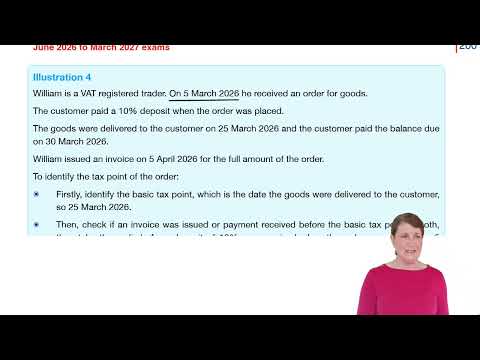
William is a VAT registered trader. On 5 March 2026 he received an order for goods.
The customer paid a 10% deposit when the order was placed.
The goods were delivered to the customer on 25 March 2026 and the customer paid the balance due on 30 March 2026.
William issued an invoice on 5 April 2026 for the full amount of the order.
To identify the tax point of the order:
Firstly, identify the basic tax point, which is the date the goods were delivered to the customer, so 25 March 2026.
Then, check if an invoice was issued or payment received before the basic tax point (if both, then take the earlier). As a deposit of 10% was received when the order was placed on 5 March 2026, the actual tax point of the deposit is 5 March 2026.
Next, check the tax point of the balance due. The tax point of the balance is the basic tax point of 25 March 2026 UNLESS an invoice was issued within 14 days of the basic tax point.
As the invoice was issued on 5 April 2026, which is within the 14 days after 25 March 2026, the invoice date is taken as the actual tax point of the balance.
5 Output VAT and Input VAT
5.1 Major points
There are several important exam points regarding output VAT and input VAT as follows:
VAT is chargeable on the actual amount received where a discount is offered for prompt payment. If the discount is not taken the VAT is charged on the full sale price and if the discount is taken then the VAT is based on the discounted price.
Relief for irrecoverable (impaired) debts is only available if the output VAT has been accounted for and paid, the debt is over six months overdue and the debt has been written off in the accounts. The relief is claimed as input VAT on the VAT return.
Input VAT cannot be recovered in respect of business entertainment of UK customers or on motor cars (unless they are used 100% for business purposes).
Input VAT cannot be recovered in relation to private use by a proprietor of a business.
Rose Ltd is registered for VAT, and its sales are all standard rated. The following information relates to the company’s VAT return for the quarter ended 31 March 2026:
(1) Standard rated sales amounted to £120,000. Rose Ltd offers its customers a 5% discount for prompt payment and half of the customers took advantage of this discount.
(2) Standard rated purchases and expenses amounted to £35,640. This figure includes £480 for entertaining UK customers.
(3) On 15 March 2026 the company wrote off irrecoverable debts of £2,000 and £840 in respect of invoices due for payment on 10 May and 5 December 2025 respectively.
(4) On 31 March 2026 the company purchased a motor car at a cost of £16,450 for the use of a salesperson, and machinery at a cost of £21,150. Both these figures are inclusive of VAT. The motor car is used for both business and private mileage.
(5) Unless stated otherwise, all of the above figures are exclusive of VAT.
Calculate the VAT payable for the quarter ended 31 March 2026 and state the due date for the submission of the return and the payment of the VAT due.
Show answerHide answer
5.2 Refund of VAT
A claim for a refund of VAT that has been overpaid is subject to a four year time limit.
6 Motor expenses

Input VAT can be recovered in full on fuel purchased by the trader even if some of the fuel is used for private journeys (either by a sole trader/partner or an employee), but to reflect the fact that some of the fuel has gone to making private journeys, output VAT must be accounted for (as if the trader had 'sold on' fuel for private journeys). Output VAT is calculated according to a scale charge based on the car's CO2 emissions.
Note: The scale charge, which is VAT inclusive, will be given to you in the examination.
Provided there is some business use, input VAT can be fully recovered in respect of repairs to a motor car.
Poppy plc is to provide one of its directors with a company motor car which will be used for both business and private mileage.
The company will pay for all the running costs of the motor car, including petrol costing £900 (VAT inclusive) and repairs costing £1,200 (VAT inclusive). The relevant quarterly scale charge is £445 for quarter to 31 March 2026 based on the car's CO2 emission rating.
State the VAT treatment of the cost of petrol and repairs for the quarter to 31 March 2026.
Show answerHide answer
7 VAT invoices
A VAT registered trader making a supply to another taxable person must issue a VAT invoice within 30 days of the relevant tax point. A VAT invoice must contain certain information.
Daffodil Ltd only sells goods, and at present issues sales invoices that show (1) the invoice date and invoice number, (2) the type of supply, (3) the quantity and a description of the goods supplied, (4) Daffodil Ltd’s name and address, and (5) the name and address of the customer. The company does not offer any discount for prompt payment.
Daffodil Ltd wants to know the additional information that it will have to show on its sales invoices in order that these are valid for VAT purposes.
The following information is required:
the VAT registration number;
the tax point;
the rate of VAT for each supply;
the VAT exclusive amount for each supply;
the total VAT exclusive amount;
the amount of VAT payable.
8 Penalties for late payment and late filing

New penalties for the late payment of VAT and the late filing (submission) of VAT returns have recently been introduced.
There are two separate sets of penalties for each type of lateness:
Late filing penalty (points based); and
Late payment penalty.
Interest will also be charged on late payments.
Late filing (submission) penalties
Under a points based system, a business incurs a penalty point each time a VAT return is submitted late.
If a penalty threshold of four points is reached, a £200 penalty is charged.
Thereafter, subsequent late VAT returns also incur a £200 penalty, but no further points are given.
Penalty points normally expire after two years. However, they do not expire once the penalty threshold has been reached.
Once the penalty threshold has been reached, for their penalty points total to be reset to zero a trader has to ensure that all VAT returns for the next 12 months are submitted on time (so four quarterly returns) and all VAT returns for the previous 24 months have actually been submitted (either on time or late, as long as they have been submitted).
Late payment penalties
Each late payment is considered separately.
No penalty is charged if the VAT liability is paid within 15 days of the due date.
A 3% penalty is charged if the VAT liability is paid within 16 and 30 days of the due date.
The penalty is increased to 6% if the VAT liability is paid later than 30 days of the due date.
In addition, where the VAT liability is paid more than 30 days late, a daily penalty at an annual rate of 10% is charged beginning after the initial 30 day period.
Regardless of whether any late payment penalties are incurred, late payment interest is charged from the due date until the date that the VAT liability is paid.
These late payment penalties can be summarised as follows:
Up to 15 days late | 16 to 30 days late | More than 30 days late | |
Penalty | None | 3% | 6% |
Daily penalty | No | No | Yes (10% p.a.) |
Interest | Yes | Yes | Yes |
Two aspects of the new late payment penalty regime are not examinable. These are time to pay arrangements, and the soft touch approach applied by HM Revenue and Customs during the first year of the new regime.
Late payment interest
Late payment interest for VAT has been aligned with the way interest is charged on other taxes.
Amelia was late in submitting her VAT returns and paying the related VAT liabilities as follows:
Quarter ended | VAT due | Days late |
30 June 2025 | £32,000 | 10 |
30 September 2025 | £36,000 | 50 |
31 December 2025 | £41,000 | 18 |
31 March 2026 | £29,000 | 8 |
Quarter ended 30 June 2025
No late payment penalty because the VAT liability was paid within 15 days of the due date.
One penalty point incurred for late submission.
Late payment interest is £75 (£32,000 x 8.5% x 10/365).
Quarter ended 30 September 2025
A 6% penalty charged (£36,000 x 6% = £2,160) because the VAT liability was paid more than 30 days late.
There is also a daily penalty for 20 days (50 days less the initial 30 days). This amounts to £197 (£36,000 x 10% x 20/365).
A further penalty point is incurred for late submission, making two cumulatively.
Late payment interest is £419 (£36,000 x 8.5% x 50/365).
Quarter ended 31 December 2025
A 3% penalty charged (£41,000 x 3% = £1,230) because the VAT liability was paid within 16 and 30 days of the due date.
A further penalty point is incurred for late submission, making three cumulatively.
Late payment interest is £172 (£41,000 x 8.5% x 18/365).
Quarter ended 31 March 2026
No late payment penalty because the VAT liability was paid within 15 days of the due date.
A further penalty point is incurred for late submission, making four cumulatively. Since the penalty threshold of four points has been reached, a £200 penalty is charged.
Late payment interest is £54 (£29,000 x 8.5% x 8/365).
8.1 Errors in a VAT return
A trader that makes an error in a VAT return that results in the underpayment of VAT can be subject to a standard penalty for submission of an incorrect return and penalty interest. There are three different situations depending on the size of the error:
The de minimis level is the higher of:
£10,000 and
1% × turnover (subject to an upper limit of £50,000).
Net errors of less than a de minimis can be voluntarily disclosed by a trader. Correction is made by simply correcting the errors on the next VAT return. There may be a penalty for submission of an incorrect return, but no interest is charged.
Net errors of more than the de minimis can be voluntarily disclosed by a trader. In this case the trader must disclose the errors separately to HMRC. Penalty interest will be charged, and there may be a penalty for submission of an incorrect return.
Errors may be discovered as a result of a control visit. Both a penalty for submission of an incorrect return and penalty interest can be charged.
While completing the VAT return for the quarter ended 30 September 2025, the Finance Director of Florrich Ltd discovered that an error in the VAT return for the quarter ended 30 June 2025 had resulted in an underpayment of VAT of £59,500.
Florrich Ltd's VAT exclusive turnover for the quarter ended 30 September 2025 was £6.5 million.
If the error is small, it may be corrected in the next VAT return, which in this case is the return for the quarter ended 30 September 2025. An error is small if it is less than the error correction threshold ('de minimis') which is the higher of:
- £10,000
- 1% of turnover (1% x £6.5 million = £65,000) but subject to an upper limit of £50,000
As the error of £59,500 exceeds the threshold of £50,000, the error cannot be corrected in the quarter ended 30 September 2025. HMRC’s VAT Error Correction Team must be notified in writing.
8.2 Submission of an incorrect return
an understatement of VAT liability
an inflated claim for repayment of VAT
The amount of penalty is based on the amount of 'Potential Lost Revenue' (PLR) which is the VAT potentially lost (by HMRC) due to the error, but the actual penalty is linked to the taxpayer's behaviour, as follows:
there will be no penalty where a taxpayer simply makes a mistake.
there will be a moderate penalty (up to 30% of the PLR) where a tax payer fails to take reasonable care.
there will be a higher penalty (up to 70% of the PLR) if the error is deliberate.
there will be an even higher penalty (up to 100% of the PLR) where there is also concealment of the error.
A penalty will be substantially reduced where the taxpayer makes disclosure, especially unprompted disclosure to HMRC.
See “Standard Penalties for Errors” in Rates and Allowances information provided in the exam
Blanche Ltd made an error in the VAT return for quarter to 31 December 2025, resulting in understated output VAT of £8,500.
Blanche Ltd's VAT inclusive turnover for the quarter ended 31 March 2026 is £700,000.
How should this error be disclosed to HMRC and what penalty may be charged?
Show answerHide answer
9 The Cash Accounting and Annual Accounting Schemes

The cash accounting and annual accounting schemes are both optional schemes that are available to small businesses.
The cash accounting scheme enables a trader to account for output VAT on a cash received/cash paid basis (the tax point is ignored).
The scheme will normally be beneficial where an extended period of credit is taken by customers, and it also results in automatic bad debt relief. The disadvantage is that input VAT on purchases/expenses will only be recovered when payment is made to the supplier.
Violet Ltd gives its customers a 30 day credit period, but pays for most of its expenses in cash. Violet Ltd wants to know what conditions must be satisfied before it will be permitted to use the cash accounting scheme, and the implications of using the scheme.
(1) Violet Ltd will be able to operate the cash accounting scheme provided its expected taxable turnover for the next 12 months does not exceed £1,350,000.
(2) In addition, the company must be up to date with its VAT returns and VAT payments.
(3) The scheme will result in the tax point of a supply becoming the date that payment is received from customers.
(4) This will delay the payment of output tax, and also provides for automatic bad debt relief should a customer not pay.
(5) Since Violet Ltd pays in cash for most of its expenses, the company’s recovery of input VAT will not be affected.
(6) Violet Ltd can stay in the scheme until annual taxable turnover exceeds £1,600,000
The advantage of the annual accounting scheme is mainly administrative, since a trader only has to make one VAT return each year. Payments on account of the annual VAT liability are normally required. It will also allow easier budgeting for cashflow.
Crocus Ltd wants to know the advantages of the annual accounting scheme, and when it will be permitted to join. The company’s annual turnover is £450,000.
(1) Crocus Ltd can apply to use the annual accounting scheme provided its expected taxable turnover for the next 12 months does not exceed £1,350,000.
(2) In addition the company must be up to date with its VAT returns and payments.
(3) Under the scheme only one VAT return is submitted each year.
(4) Nine monthly payments are made on account, each being 10% of the previous year’s VAT liability, the payments being due at the end of months 4 to 12 of the VAT year. Crocus Ltd may choose three quarterly payments on account instead, each being 25% of the previous year's VAT liability, at the end of months 4, 7 and 10 of the VAT year. In both cases any balancing payment is made along with the submission of the VAT return, which is due within two months of the end of the VAT year.
(5) Crocus Ltd can stay in the scheme until annual taxable turnover exceeds £1,600,000.
10 Flat rate scheme
The flat rate scheme is optional. It simplifies the way in which small businesses calculate their VAT liability.
The scheme can be used if the expected taxable turnover for the next 12 months does not exceed £150,000. The business can stay in the scheme as long as turnover is ≤ £230,000.
Under the flat rate scheme, a business calculates its VAT liability by simply applying a flat rate percentage (given by HMRC based on trade sector) to the total VAT inclusive turnover including any exempt supplies. This removes the need to calculate and record output VAT and input VAT.
The flat rate percentage is applied to the total VAT inclusive turnover figure, with no input VAT being recovered.
The percentage varies according to the type of trade that the business is involved in, and will be given to you in the examination.
A higher flat rate of 16.5% has been introduced for businesses with either no, or only a small amount of purchases of goods (known as 'limited cost traders').
Students will not be expected to know where this rate is applicable but will need to know how to use it and identify whether the flat rate scheme is worthwhile, which is most unlikely in these circumstances - if a business makes taxable supplies of £100,000 (excluding VAT) then it would normally have to account for output VAT of £20,000 and then reduce it by any recoverable input VAT. If, however the flat rate scheme was adopted then irrespective of the amount of input VAT incurred the trader must make a payment of (£100,000 x 120% = £120,000 x 16.5% = £19,800) with no input VAT being recovered.
Where a supply is made to another VAT registered business and a VAT invoice is issued, the invoice will show the normal rate of VAT.
(a) Snowdrop Ltd has annual sales of £120,000, all of which are standard rated and are to the general public. The company’s standard rated expenses are £6,000 p.a. These figures are inclusive of VAT. The relevant flat rate percentage for Snowdrop Ltd’s trade is 15%. Using the normal basis of calculating its VAT liability, Snowdrop Ltd will have to pay VAT as follows:
£ | ||
Output VAT (£120,000 × 20/120) | 20,000 | |
Input VAT (£6,000 × 20/120) | (1,000) | |
VAT payable | 19,000 |
If Snowdrop Ltd uses the flat rate scheme then it will pay VAT of £18,000 (£120,000 × 15%). There is a VAT saving of £1,000 (£19,000 – £18,000) in addition to the simplified administration. As none of Snowdrop Ltd’s customers are VAT registered, there will be no need to issue VAT invoices.
(b) Primrose Ltd has annual sales of £96,000, of which 50% are standard rated and 50% are zero rated. All of the company’s sales are to VAT registered businesses. The company’s standard rated expenses are £30,000 p.a. These figures are exclusive of VAT. The relevant flat rate percentage for Primrose Ltd’s trade is 6%. Using the normal basis of calculating its VAT liability, Primrose Ltd will have to pay VAT as follows:
£ | ||
Output VAT (£96,000 x 50% x 20%) | 9,600 | |
Input VAT (£30,000 x 20%) | (6,000) | |
VAT payable | 3,600 |
If Primrose Ltd uses the flat rate scheme then it will pay VAT as follows:
£ | ||
VAT inclusive turnover: | ||
- Standard rated sales: £96,000 x 50% x 120% | 57,600 | |
- zero rated sales: £96,000 x 50% | 48,000 | |
Total VAT inclusive turnover | 105,600 |
£105,600 x 6% = £6,330.
Although the flat rate scheme will result in simplified administration, it is not beneficial as additional VAT of £2,736 (£6,330 – £3,600) is payable and Primrose Ltd would still have to issue VAT invoices as its customers are registered for VAT.
11 Group VAT Registration

Group registration for VAT is optional.
Two or more companies can register as a group for VAT purposes if they are under common control (associated companies) and have a permanent establishment (e.g. a branch) in the UK.
A group can also include a sole trader/partnership if they are the controlling entity, along with any companies that they control.
The group is treated for VAT purposes as if it were a single entity registered for VAT on its own.
A representative member of the group is appointed and is responsible for completing and submitting a single VAT return and paying the VAT on behalf of the group.
All companies in the VAT group are jointly and severally liable for any VAT liabilities of the group.
The advantages of group VAT registration are:
No VAT is accounted for on transactions between group members within the VAT group, therefore a cashflow advantage.
Only one VAT return is submitted for the group, therefore an administrative advantage.
The group can choose which companies to include or exclude. It would be beneficial to exclude a company making zero rated supplies as that company would then be able to continue making monthly returns to get the improved cash flow of monthly VAT repayments.
The disadvantages of group VAT registration are:
The limits for Cash and Annual Accounting schemes will apply to the group as a whole and not on an individual company basis.
Joint and several liability of each company in the group.
Possible administration issues collecting information to be passed on to the representative member.
12 UK businesses trading overseas
12.1 Supply of goods
Exports
The supply of goods to overseas countries is zero rated.
Imports
Import VAT is accounted for on the VAT return that includes the date that the goods are imported under the postponed VAT accounting system.
The import VAT is declared on this VAT return as output VAT, but may be reclaimed as input VAT on the same VAT return so long as the business makes taxable supplies.
This “self supply” procedure as it is known means that for most businesses, there is no VAT cost because the output VAT and corresponding input VAT are equal and so cancel each other out.
This may seem like a pointless exercise but if the UK business makes exempt supplies it will not be able to recover the input VAT and hence will incur the VAT cost.
When the UK business subsequently sells such goods the normal VAT rules will apply.
12.2 Supply of Services
To overseas business customer = outside scope of VAT.
Service received from an overseas business = Self supply ("reverse charge") system applies as for imports of goods above.
BW Ltd is a UK VAT registered UK business that makes only taxable supplies.
In the VAT quarter to 31 March 2026 BW Ltd made sales of £50,000 to a VAT registered customer in France and £10,000 of goods to a business in Australia.
In the same VAT quarter, it acquired £12,000 of goods from its suppliers in the USA and £20,000 of goods from its suppliers in Germany. It also incurred management consultancy fees from a VAT registered business in Italy at a cost of £6,000.
All figures are VAT exclusive.
Discuss the VAT implications of the above transactions.
Show answerHide answer
VAT will form part of the TX exam - this tax usually forms 10 marks in total with some Section A MCQ as follows:
Section B might be a full VAT question for 10 marks.
Section C question: VAT normally only forms part of the question for either a company or a sole trader.