
Corporation Tax – Groups


1 Introduction
A group exists for taxation purposes where one company is a subsidiary of another. The various reliefs and rules are only applicable to members of certain group structures.
2 Group relief
2.1 Definition of a 75% group for loss relief ('Loss group')
One company is a minimum 75% subsidiary of another, or
Both companies are minimum 75% subsidiaries of a third company.
The holding company must :
own at least 75% of share capital, and
be entitled to at least 75% of the subsidiary’s assets on winding up, and
be entitled to at least 75% of the subsidiary’s profits on a distribution.
Overseas companies can be included in the loss group structure, but companies must generally be UK resident to participate in group relief claims.
Group relief is available in respect of:
current period trading losses
excess* property business losses and
excess* qualifying charitable donations
Such losses are only excess* if they exceed the total profits of the company concerned before any other losses have been applied.
Any unused trading losses or property business losses brought forward by a company may now also be surrendered as group relief, BUT only to the extent that the loss making company is unable to set off the loss against its own total profits.
2.2 Sub-subsidiaries
The holding company must have an indirect/effective interest in any sub-subsidiary of at least 75% for them to be in the same group for group relief purposes.
For example:
If a parent company owns 90% of the shares in a subsidiary which in turn owns 90% of its subsidiary then all 3 companies would be able to group relieve with one another as the parent company has an effective 81% interest (90% x 90%) in the sub-subsidiary.
If the subsidiary owned only 80% of the shares in the sub-subsidiary, then the parent company may only group relieve with its direct subsidiary as its effective holding in the sub-subsidiary is only 72% (90% x 80%).
However, it is possible to be in more than one group for loss relief purposes.
Z plc is the holding company for a group of companies. The group structure is as follows:
Z plc
|
100%
|
A Ltd
|
80%
|
B Ltd
|
80%
|
C Ltd
For the year ended 31 March 2026 Z plc has a trading loss.
State the companies to which Z plc may surrender its trading loss in the year ended 31 March 2026.
Show answerHide answer
2.3 Group loss relief
Trading losses and excess property business losses and QCDs may be surrendered to other companies in the group, which may then relieve the losses against their own taxable total profits (TTP).
The surrendering company is the company that surrenders its loss (the loss-making company).
The claimant company is the company to which the loss is surrendered.
The claimant company must have sufficient TTP to absorb any loss relief surrendered by the loss-making company.
Any member company may surrender its loss to any other member of the group:
a holding company may surrender a loss to its subsidiary company
a subsidiary company may surrender a loss to its holding company
a subsidiary company may surrender a loss to a fellow subsidiary company.
2.4 The surrendering company
The surrendering company may surrender as much of its available losses as it wants to and it is not necessary to relieve a trading loss against its own income and gains first.
The losses which may be surrendered are:
any amount of a current period trade loss
unrelieved qualifying charitable donations of the period
unrelieved property business losses of the period
unrelieved trading and property business losses brought forward can be surrendered as group relief but only to the extent that they cannot be set off against the surrendering company’s own total profits.
Note that capital losses are not eligible for group relief but are dealt with separately under the gains group rules.
2.5 The claimant company
The relief is taken against the TTP of the corresponding period as the surrendering company’s loss making period.
Where the companies' accounting periods are not the same (the accounting periods are 'non-coterminous'), the corresponding period (or 'overlapping period') must be determined.
The maximum loss relief is the lower of:
The time-apportioned loss in the surrendering company
The time-apportioned TTP in the claimant company.
Battery Ltd owns 100% of Clock Ltd.
During the 6 month period ended 31 March 2026, Clock Ltd had a trading income of £50,000 and property income of £30,000. During the year ended 31 December 2026 Battery Ltd had a trading loss of £100,000.
What is the maximum loss that Battery Ltd can surrender to Clock Ltd for Clock Ltd's period ended 31 March 2026?
Show answerHide answer
2.6 Loss relief and group relief
Group relief is entirely optional and any amount can be claimed up to the maximum.
A number of reliefs may be available to the loss-making company such as relieving the loss itself using a current period claim followed by a carry back claim and a carry forward claim against its own total profits. Group relief is just another option available if the conditions for being in a loss group are satisfied.
Group relief can be claimed before any current period/carry back relief in the surrendering company which means that the amount of loss relief can be effectively chosen to the companies' advantage.
One of the most important factors to be taken into account when considering loss relief and group relief claims will be the rate at which relief can be obtained.
Other important factors to consider when choosing which loss relief(s) to claim will include the cash flow benefit in achieving relief at the earliest available opportunity and/or avoid wasting any QCDs.
There is more flexibility when it comes to group relief claims and loss relief claims against future total profits. Group relief claims can be restricted so that the surrendering company retains sufficient losses to bring its own augmented profits down to the lower limit. Loss relief claims against future total profits can be restricted for the same reason, and also to preserve the deduction of qualifying charitable donations or to set against future profits which will be subject to a higher rate of tax.
If relief can be restricted, the most beneficial use of the loss is to claim initially against profits subject to tax in the marginal band, as the effective rate of tax is 26.5% (see previous Chapter). The amount relieved should be sufficient to bring augmented profits down to the lower limit. The next tranche of relief should be against profits subject to the full rate of corporation tax of 25%.
If relief cannot be restricted, the order of set off will be more difficult to establish. Obtaining relief at the full rate of 25% may be preferable given that the overall corporation tax rate where marginal relief applies will always be less than 25%.
Green Ltd owns 100% of the ordinary share capital of both Orange Ltd and Pink Ltd. The results of each company for the year ended 31 March 2026 are:
Green Ltd | Orange Ltd | Pink Ltd | |
£ | £ | £ | |
Trading profit/(loss) | (90,000) | 380,000 | 45,000 |
Property business income | 30,000 | - | - |
Green Ltd had dividends of £2,000 which are not from associated companies.
Calculate the CT due for each of the group companies for the year ended 31 March 2026, using the trading loss in the most efficient manner.
Show answerHide answer
3 Chargeable gains group
3.1 Definition
A group consists of a parent company and its 75% subsidiaries, and also the 75% subsidiaries of their subsidiaries.
The parent company need only have an effective interest of over 50% in any sub-subsidiary companies.
Groups may be established through a parent company resident anywhere in the world.
A company can only be in ONE group for gains purposes.
Overseas companies can be included in the gains group structure, but companies must generally be UK resident to enjoy the advantages.
3.2 The tax implications
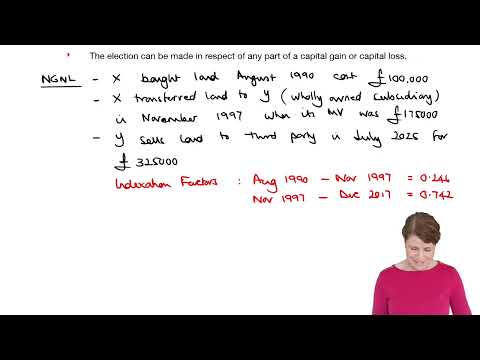
Gains group companies transfer assets between them without incurring a chargeable gain or allowable loss. This will be a no gain/no loss transfer and will be deemed to take place at a value equal to the cost of the asset to the transferor company plus the available indexation allowance - remember that indexation allowance runs only to December 2017 at latest.
Gains group companies can make an election such that any part of a capital gain or loss incurred by one company may be treated as arising in another company.
Members of a gains group are treated as a single entity for the purposes of roll over relief.
Where:
one company sells a qualifying asset, and
another company buys a qualifying asset within the qualifying time period.
the gain can be rolled over (subject to the normal rollover relief rules).
3.3 Advantages of Gains Group membership
The group’s capital losses can be better utilised.
Rollover relief is available on a group wide basis
Gains may be moved to a company with insufficient profits to cover its qualifying charitable donations or out of a company where its profits would be taxed in the marginal band or exceed the profit limits for purposes of making quarterly instalment payments.
3.4 Capital losses
An asset does not have to be moved between group companies in order to match capital losses and gains.
Companies in a gains group can make an election to deem any part of a current period gain or loss made by one group member to have been made by any other gains group member.
The advantages of the election:
By not having to actually transfer assets within a group means a saving in legal and administrative costs
The election can be made in respect of any part of a capital gain or capital loss.
The rules might be tested under MCQ in Section A and include any of the information above with a tick box or true/false answer or as follows:
Alternatively, a larger question may be asked in Section B or C.