
Environmental analysis


1 PESTEL
Now we are going to look at the environmental influences in organisations. We are first going to look at the macro-environmental influences, then influences specific to a particular market, and finally, influences specific to a particular organisation within that market.
The macro-environmental influences can be remembered by the acronym PESTEL.
It stands for:
Political
Economic
Social
Technological
Ecological:
Legal.
You may have known this previously as PEST, but now we split apart political and legal and there is an extra “E” for Ecological, which for many organisations is becoming a major concern. Note that it doesn’t much matter whether something like a tax rate is regarded as being political or economic: the important point is to have recognised a tax rate or a new tax as something which might affect the organisation.
Examples of PESTEL factors:
Political: elections and changes of government, war, European Union expansion, Brexit.
Economic: interest rates, tax rates, exchange rates, economic boom or recession
Social: nowadays the main social trend arises from changes in populations. In most western countries the birth rate has fallen and there is an increasing proportion of elderly people. This can affect recruitment but it can also affect the economies of companies that they have to support a larger number of retirees. It can of course affect the marketing of products. Products suited to older people may become more popular while those suited to younger people may become less popular.
Technological: technological changes often come out of the blue, but once they are invented there is really no turning back. Think how the internet has profoundly affected the fortunes of organisations like travel agents. Think how banks have responded to new technology (specifically The Internet) by closing branches and encouraging their clients to do more and more banking online.
Ecological: carbon emission restrictions/taxes, more stringent laws governing air and water solution, concern about the possible effects of global warming.
Legal: health and safety legislation, equality legislation, regulation of industries.
2 Drivers for change
Information technology
To understand the impact of the internet, you just need to consider the effect of the internet on the music business, film distribution, supermarket shopping and delivery and the enormous effect of Amazon on many retail sectors.
Industry convergence
Industry convergence means that industries which had historically been separate come together so that more diverse others products or services are now offered by the same supplier. Examples can be airlines which now offer car hire, hotels, and insurance.
Technology can form a big part in the convergence of industries. For example in the telecommunications industry there is considerable convergence between landline, mobiles, voice over internet telephone providers and television and film companies. There is increasing convergences of products which provide mobile phone access, WiFi access, music, photographs, diaries (think of the Apple iPhone which will do all of these things.
The international dimension
More and more organisations have global presence. Products and services are converging so that the same products can be found in many countries. This gives the producers great cost advantages, not only in purchasing raw materials but also to cover the research and development and marketing costs.
International companies can also manufacture their products where it is cheapest to do so. Note that when a company enjoys sales on a global basis it is also usually facing competition on a global basis, and many weaker companies find it difficult to compete in that fierce environment.
You will probably be aware that some people feel that large multi-national companies are bad for society. Anti-Globalisation protesters claim that these very large companies stifle and exploit local economies, reduce consumer choice, have an undue influence on how countries are run and are too concerned with making profit when they should give more attention to social and ecological issues.
3 Strategic drift
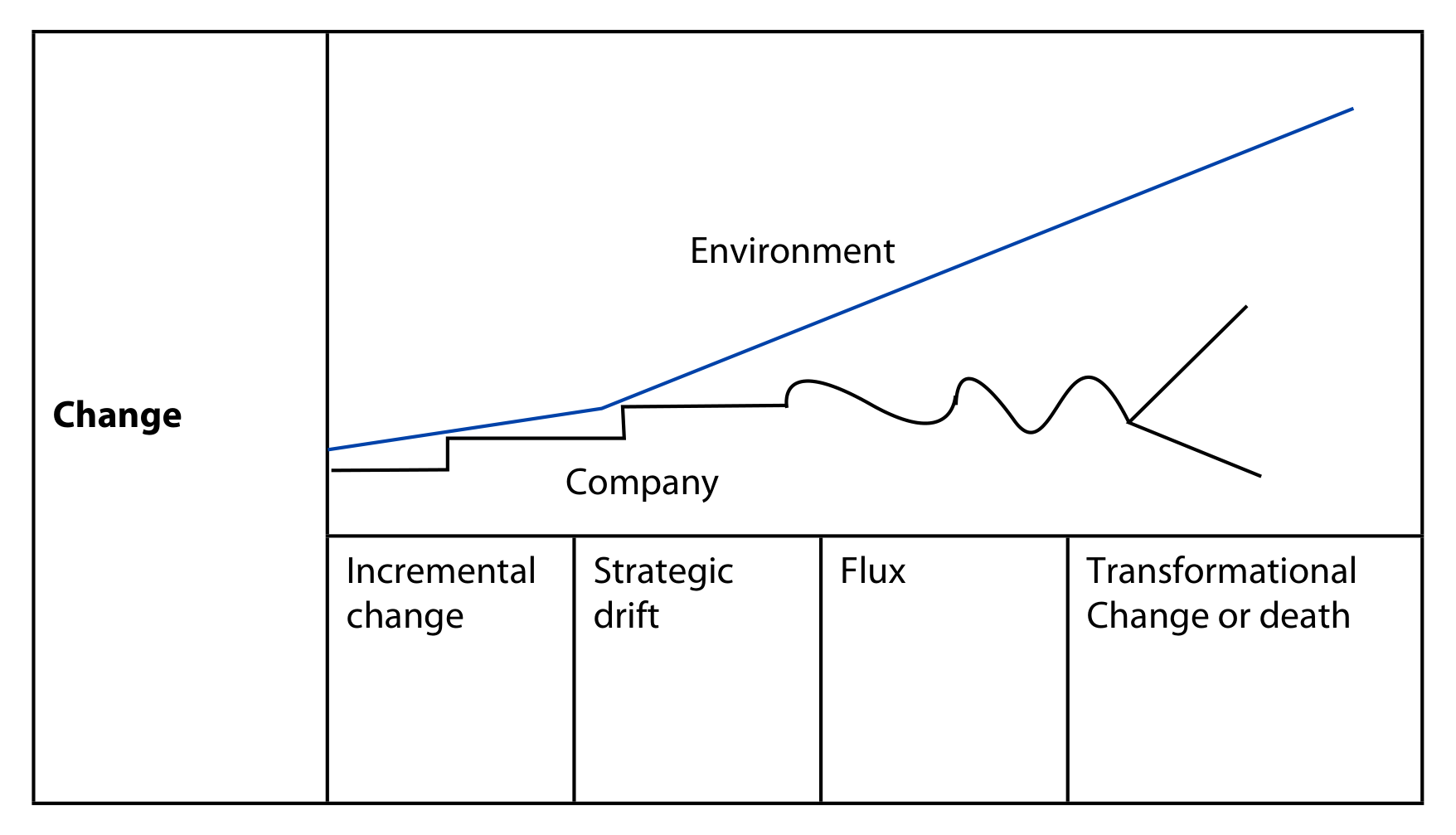
Strategic drift occurs when a company does not keep itself properly aligned with its environment and competitors, and so its strategy is no longer appropriate or relevant.
The process of strategic drift and its consequences can be illustrated using a number of stages:
During incremental change, the company manages to keep up with the environment and matches it fairly closely. Then, strategic drift sets in, either because the environment changes and the company doesn’t, or the company changes in an inappropriate way.
Flux occurs when the company recognises that something is wrong and various adjustments are made, often in a state of desperation and panic. Either the company will manage to move radically in the right direction to match the environment once again (transformation), or the company will fail (death).
For example, the PESTEL analysis above examined the macro-environment. If the company ignored or mis-interpreted these environmental changes then its strategy would be less successful. For example:
Political: Ignoring the spending priorities of a new government so that the wrong products or services are offered.
Economic: Ignoring an increase in the cost of energy and so not updating machinery to increase efficiency.
Social: Ignoring changes in consumer preferences or consumers’ concern for the environment.
Technology: Ignoring the importance of social media.
Environment: Ignoring increasing concern for the environment and the need to show sensitivity to those issues.
Legal: Failing to prepare for a new law that will soon bring new regulations into force that the company will have to comply with.
Of course, performing a PESTEL analysis does not guarantee survival as some major environmental changes can happen suddenly and unexpectedly. But these abrupt effects are not covered by the term ‘strategic drift’ which implies a slow divergence of the company and its environment.
4 Porter’s diamond – the competitive performance of nations
Still dealing with the international dimension, it is clear that many countries enjoy reputations for certain products and services. For example:
Germany is associated with good car making
Japan is strong with respect to micro-electronics and cameras.
France is strong with respect to wine.
The UK (at least until recently!) was associated with a strong financial services industry
Michael Porter began to wonder how countries can achieve such international reputations and he concluded that there were four influences.
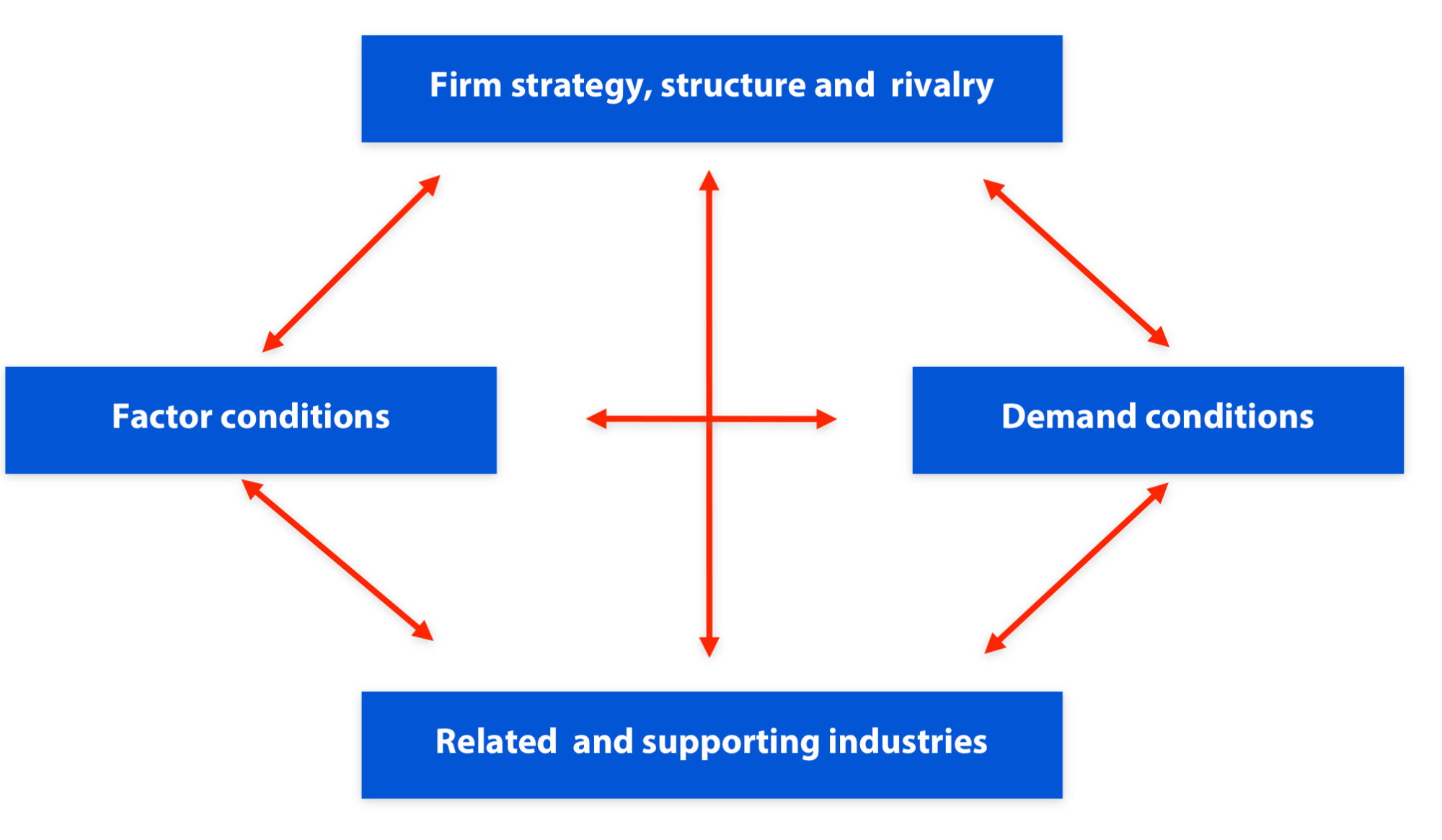
Factor conditions:
Some countries enjoy natural advantages. For example, France starts with an advantage in the wine industry because of its climate and soil. Finland, however, is never likely to be good at producing wine. Germany has an abundance of iron ore and coal, ready to be used in the car and other industries. Climate and natural resources are known as basic factors. In addition, countries can develop advanced factors such as their transport infrastructure, telecommunications, and educational system. Germany, for example, has a strong tradition in engineering training and education and this gives their car industry great assistance.
Demand conditions:
The first step in developing a global presence is to start at home and the impetus to do this is known as (home) demand conditions. So, it is argued that Germany produces good cars because initially the German people demanded good solid engineering. The UK had been a major trading and manufacturing nation until the mid-1900s and this led to the development of skilled financial services and law firms to support international commerce.
Firms’ strategy, structure and rivalry.
Concentrate on rivalry: having a monopoly in the home market is unlikely to give you a major world presence. To be world beating you have to be really good at home and this home excellence will allow you to compete against the best of the world. Germany is perhaps really good in making cars because it has within that country Volkswagen, Mercedes, BMW and Porsche, all of are good companies competing with one another, and this allows them to become world-class.
Related and supporting industries.
Successful industries often enjoy the benefits arising from a cluster of related and supporting industries. For example in the West Coast of America there are software firms, hardware firms and research institutes. Employees move around from one firm to another and a whole centre of expertise is developed. Similarly, in Scotland in the Scotch whisky industry, farmers can provide the grain, peat suppliers provide peat to give the spirit flavour. There are factories which produce or recondition the barrels and there are large, efficient bottling plants. Not only do these related and supporting industries form efficient clusters of industries, but also they work together so that the products become differentiated and uniquely good.
5 Scenario planning
Scenario planning looks at all the things that could happen (and there can be many permutations of future events) and from those builds viable scenarios: a number of believable, internally consistent futures. This greatly reduces the number of ‘universes’ that need to be considered and allows the organisation to focus on the relatively few most likely scenarios.
For example, out political horizon might suggest that either Government 1 or Government 2 will be elected within the next year. Our economic predictions might suggest that interest rates will be either 3% or 5%. However, if Government 1 favours high public expenditure then this make 5% interest rates much more likely as high interest rates must be offered to allow high government borrowing. If Government 2 favours austerity, then interest rated are likely to stay at 3%.
Therefore, the only two viable scenarios are:
Government 1; 5%
Government 2; 3%
Other permutations can be ignored because they are implausible.
5.1 Steps in scenario planning
Define the scope, for example: What time horizon? Which part of the business? Which country (for multi-national organisations)?
Identify which factors will most affect the organisation.
What are the plausible outcomes for each factor?
What are the plausible, internally consistent combinations of factors?
What are the effects of these scenarios on the organisation respond?
How should the organisation respond? For example, it could decide to retreat to an internet-only presence, it could move up-market/down-market, or it could withdraw from the market.
Go back and recheck assumptions and scenarios in the light of decision made as some decisions might affect these.
5.2 Advantages and disadvantages of scenario planning
Scenario planning can have the following advantages:
It challenges managers and other stakeholders to be more forward-looking when business planning.
It challenges assumptions about the future, and about the drivers and forces that influence its industry sector.
It forces managers to consider previously unimagined possibilities and tests the rational for current strategies.
It does not attempt to forecast the future – almost certainly a lost cause. Instead it results in several outcomes, each of which can have a planned response.
It encourages communication and planning within the company as scenario building requires inputs from many areas.
It can encourage the identification and evaluation of ‘weak signals’. Weak signals are small signs of changes that do not currently have much effect but which might be game-changing in the future. For example, early adopters of Facebook might have used it for purely personal use, but some might have foreseen the major effect it would have on marketing.
Scenario planning can have the following disadvantages:
It can be very time-consuming: identification of all the relevant variables, collection of data and the distillation to a few plausible, internally consistent scenarios.
It is important to use experts who can assess possible outcomes – and the cost of experts’ time can be considerable.
It is important not to eliminate all scenarios except the most likely one or the most attractive one. The point of scenario planning is to obtain a range of possibilities – both favourable and unfavourable - and to plan for those.