
The rational model in more detail


We return now to look at the rational model and to consider each of its elements in more detail.
1 The mission
An organisation’s mission is what it perceives its purpose to be. It could be an airline, a hospital, a chain of supermarkets, or a school, but all need to know why they exist and what they are for.
Nowadays it is relatively common for organisations to issue mission statements. These are short statements (no more than a page of A4) that set out the organisation’s purpose and its position. In addition, most mission statements have several paragraphs dealing with values, culture, and ethics.
2 Stakeholders
Stakeholders can be defined as anyone affected by the organisation. It’s important to know who your stakeholders are and what they want, because if the stakeholders are unwilling to cooperate you may find it difficult to put a strategy into action.
2.1 Stakeholders include:
Shareholders
Managers/directors
Customers
The government
Employees
Suppliers
Competitors
The local community
Shareholders are often regarded as dominant stakeholders because they own the company and they appoint managers. However, the interests of employees have to be looked at, as do those of suppliers, customers, the local people, government, and lenders.
The important thing to realise about most stakeholders is that what they want is often in conflict. For example shareholders want more profits, but employees want higher wages. Customers may want operations 24 hours a day, seven days a week, but employees might want to work only eight hours a day, five days a week. Customers want lower prices and higher quality; shareholders want lower costs so that the profits are higher.
Management therefore has to try and keep most people happy most of the time. To do this management has to enter into a series of negotiations with stakeholders. What’s the minimum pay rise that will attract and keep employees and stop from going on strike? What’s the minimum quality and maximum price that customers will be prepare to pay before they abandon us and go to our competitors? If the local people are being harmed or in some way inconvenienced by our operations, what can we do to try and keep them onside?
There are no easy answers to this. Management has to recognise the conflicts that exist between stakeholders and try to manage them as best they can. We will also find that stakeholders are important when we come to decide which strategies might be best. The strategies have to be those that the shareholders wanted to pursue, but they also have to be strategies which other stakeholders are willing to follow. For example there is no point in adopting a strategy which means that customers abandon you, or employees leave.
3 Mendelow’s matrix
About the only tool or model available for the analysis of stakeholders is Mendelow’s matrix. This sets out on one axis the power that the stakeholder can wield, and along the other axis the stakeholders’ interest, by which we mean how likely is it that the stakeholder will take action: how active or passive are they?
Two things lose marks on this matrix. First, a group’s power and interest must be judged in relation to the specific decision the question asks about, not in relation to the organisation’s day-to-day operations, and each group named in the question has to be assessed separately with a reason given for the level chosen. Second, the four responses go with the four boxes in one direction only: high power with low interest is keep satisfied, low power with high interest is keep informed, and reversing those two is a common error. Naming the box is not the same as saying how the group should be managed — add the practical action.
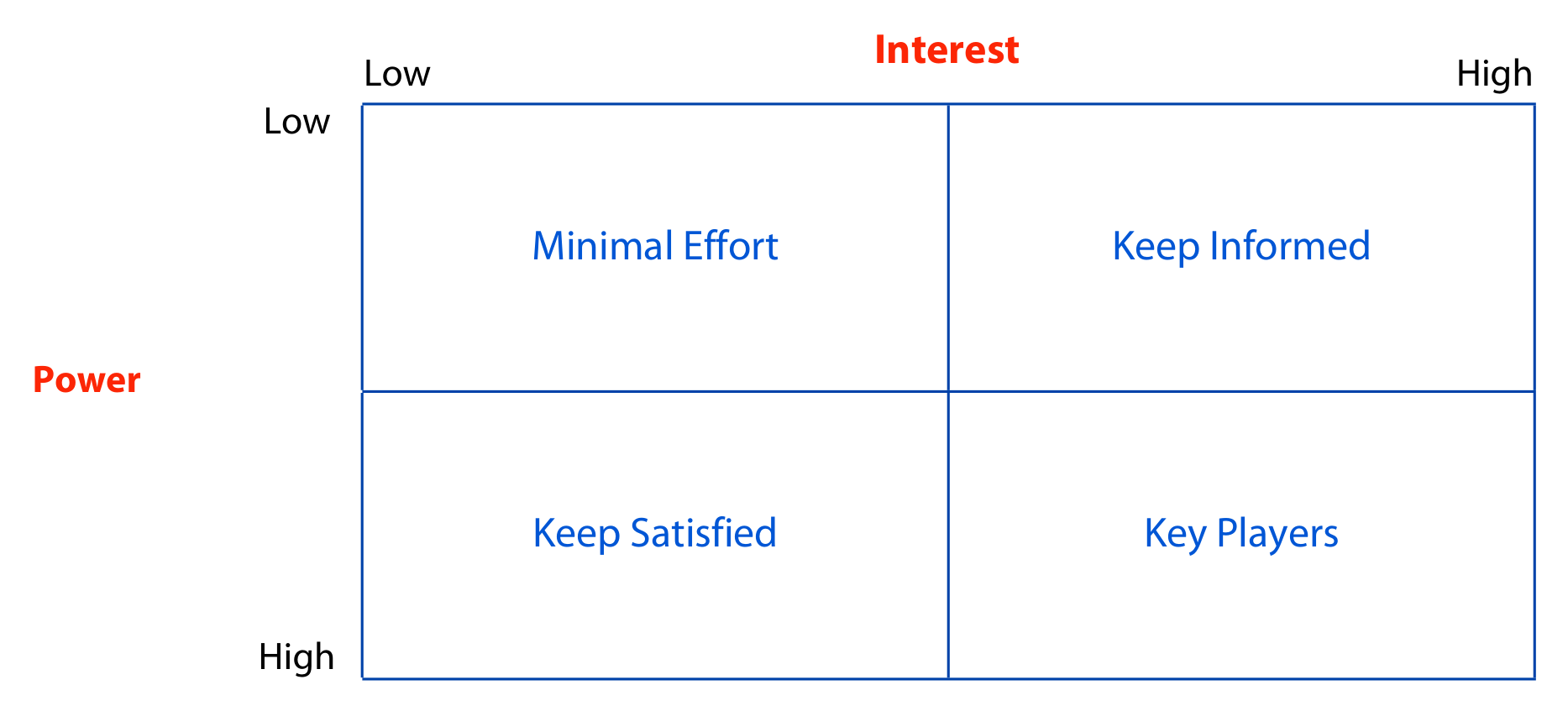
Key players: stakeholders who have high power and high interest are known as key players. Management really needs to keep those people happy. They have the power and they have the willingness to do something about it if they are upset. These stakeholders can stop any strategy in its tracks.
Keep satisfied: some stakeholders have high power but they are unlikely to take action even if management does something which they dislike. They may be unwilling to take action because of professional or ethical reasons. For example, medical staff in hospitals are very unlikely to take industrial action. Management doesn’t have to be quite as careful with these people as with the key players. However, they have to be kept satisfied otherwise they could be provoked to take action and turn into key players.
Keep informed: people with low power but high interest have to be kept informed. They can’t do much about events themselves but they might be able to influence key players to take action on their behalf.
Minimal effort: these stakeholders have low power and low interest. Management can almost ignore these people. After all, what are they going to do if they don’t like what’s happening?
In companies, shareholders should be key players (if they choose to be active enough in keeping the directors in line) but most people would accept that the company has responsibilities to there stakeholders too. For example:
Employees: health and safety, fair grievance procedures
Customers: products which are not dangerous
Government: paying taxes due
Suppliers: paying invoices.
The examples above all show responsibilities that are enforced by laws. However, more and more, people consider that companies should do more for a range of stakeholders more than is required by law. This approach is known as corporate social responsibility. A company’s responsibility towards society is also referred to as corporate citizenship.
To what extent should the interests of other stakeholders be taken into account? For example, certainly companies should be run within the law and certainly there are laws relating to minimum wages, maximum working weeks, and permitted levels of pollution. If companies adhere to those laws should they then go further? Should they pay people much in excess of the minimum? Should they reduce the hours that people have to work? Should they tighten up even further on the discharges made from the factory into the local river? Sustainability is also part of corporate social responsibility: sustainable development is development that meets the needs of the present without compromising the ability of future generations to meet their own needs.
Many observers argue that companies should go further than simply meet the minimum obligations as set by law. But this can be a difficult area. First of all, going further with these social responsibilities normally reduces the profit of a company. Profit is of itself a good thing; profit enables a company to exist more permanently, to put money into research and development, to give more stable employment. And of course, the higher the profit, the higher the taxes, and taxes are then spent by government for the good of society as a whole. Companies should certainly not be embarrassed about making profits.
Secondly it can be argued that instead of a company, say making charitable donations, shareholders if they get larger dividends can make those donations themselves, and furthermore, they can make those donations to causes they feel most deserving.
Thirdly, do directors have the legal authority to make non-essential payments? This is the directors using company assets which are ultimately the assets of the shareholders. People could argue that they have no right to give those away or to spend them needlessly.
Finally, who decides the beneficiaries? Are the beneficiaries simply the pet charities and interests of the directors? What exactly is a democratic relationship when it comes to deciding who benefits from the extra donations or the extra benefits distributed amongst non-shareholders?
Certainly, an element of corporate social responsibility can generate good publicity and apart from any ethical considerations, expenditure on good publicity can usually be justified.