
Competitor analysis - Porter’s five forces


1 Introduction
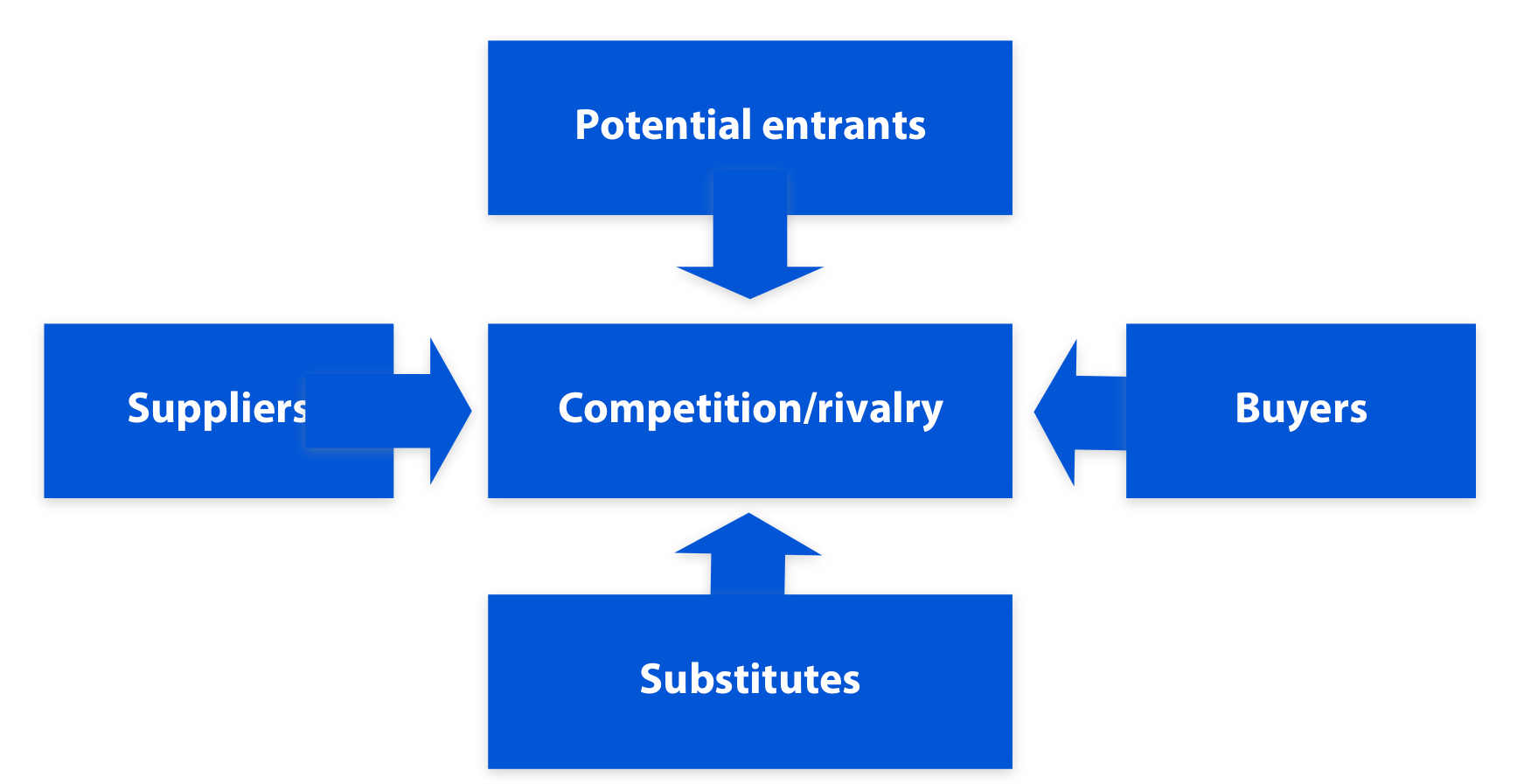
Porter’s five forces model is a very popular and useful framework. It is used to analyse industry attractiveness. Industry attractiveness refers to how easy a business will find it to make reasonable profits. By ‘reasonable profits, we mean profits large enough to compensate investors for their risks and also to make enough money to reinvest to keep the company successful. We should be looking for sustainable, long-term success.
2 Rivalry
Competition, or rivalry, can range from:
Perfect competition, where sellers have no choice as to the selling price that is charged - they have to charge the market price.
to
Monopoly, where sellers have much more choice as to what price to charge. Changes in price will normally alter demand, revenue and profits. But remember, just because you have a monopoly doesn’t mean you will make profits. You might be the monopoly supplier of something nobody wants.
By and large the nearer an industry gets to a monopoly the easier time its participants will have. Therefore, provided its legal, it could therefore be a useful strategy to take over a rival or to force it out of business by perhaps lowering prices temporarily. Governments tend to be wary of companies which establish powerful monopolies (Microsoft got into trouble over Internet Explorer which it included with its Windows operating system, making it very difficult for other browsers to compete). Most jurisdictions have anti-monopoly or anti-trust legislation.
3 Buyer pressure
If buyers are very powerful then they can exert pressure on prices, quality and delivery times. Selling almost all output to a few powerful buyers will be an uncomfortable situation. The more buyers you have, and the harder it is for them to switch between different suppliers the better. Businesses should try to build in switching costs, that is real costs or impediments that mean that buyers will prefer to stay with existing suppliers. Another way of trying to decrease buyer pressure is to try to enter long-term contracts with major customers. You might have to compromise on price, but get greater certainty of sales.
4 Supplier pressure
Supplier pressure. Similarly, when you are buying goods from suppliers, if you have to buy a special component from a monopoly supplier you will be in an uncomfortable position. That supplier can raise prices almost arbitrarily and you have to pay what they ask. Even worse, that supplier could be taken over by one of your competitors and then you will have no supplies at all. Ideally firms should try to multi-source, and if they get really worried about assurance of supply then they should think about setting up their own supply operation or perhaps taking over an existing supplier.
5 New/potential entrants
New/potential entrants. Potential entrants are sitting on the edge of the industry and may be attracted in if they can see that good profits can be made. New entrants are a nuisance because they will normally try to enter with a ‘splash’: special introductory offers and big promotions. Existing companies have to respond to defend their market share against newcomers. Anything which keeps out potential entrants is known as a barrier to entry. Barriers to entry include:
A legal monopoly within the business. This is rare, but is sometimes seen. For example, many postal services operate as monopolies.
Regulation and licence requirements can make it hard for potential entrants to get into some business sectors. For example, setting up as a bank is relatively difficult because of the various regulatory authorities that have to give their permission,
The need for high capital expenditure increases risk and the difficulty of raising finance.
Know-how. Some businesses are complex and acquiring the necessary skills and knowhow can deter new entrants.
Unique, patented processes. If you own a unique, valuable patent, no one else can use it and so your position is protected. Some pharmaceutical companies can make use of drug patents to secure their positions and to make huge profits during the patent’s lifetime.
6 Substitutes
Substitute products usually arise by the advance of technology. Often the appearance of substitutes will surprise a business and take it off-guard. For example, landline telephone companies thought that they were almost in a monopoly position because of the huge cost of entry to the market: digging up roads and laying landlines into our houses, apartments, and businesses would have been a considerable barrier to entry. However, then mobile telephones (cell phone technology) was invented and good telephone coverage could be achieved with much less expense.
There is not much a business can do here. Once technology is invented it can’t really be suppressed. Most old industries have to join the new industries to maintain their market share. So now, many conventional telephone companies also have mobile phone networks in an attempt to retain their overall market share in telecommunications.