
Change management


1 Balogun and Hope Hailey
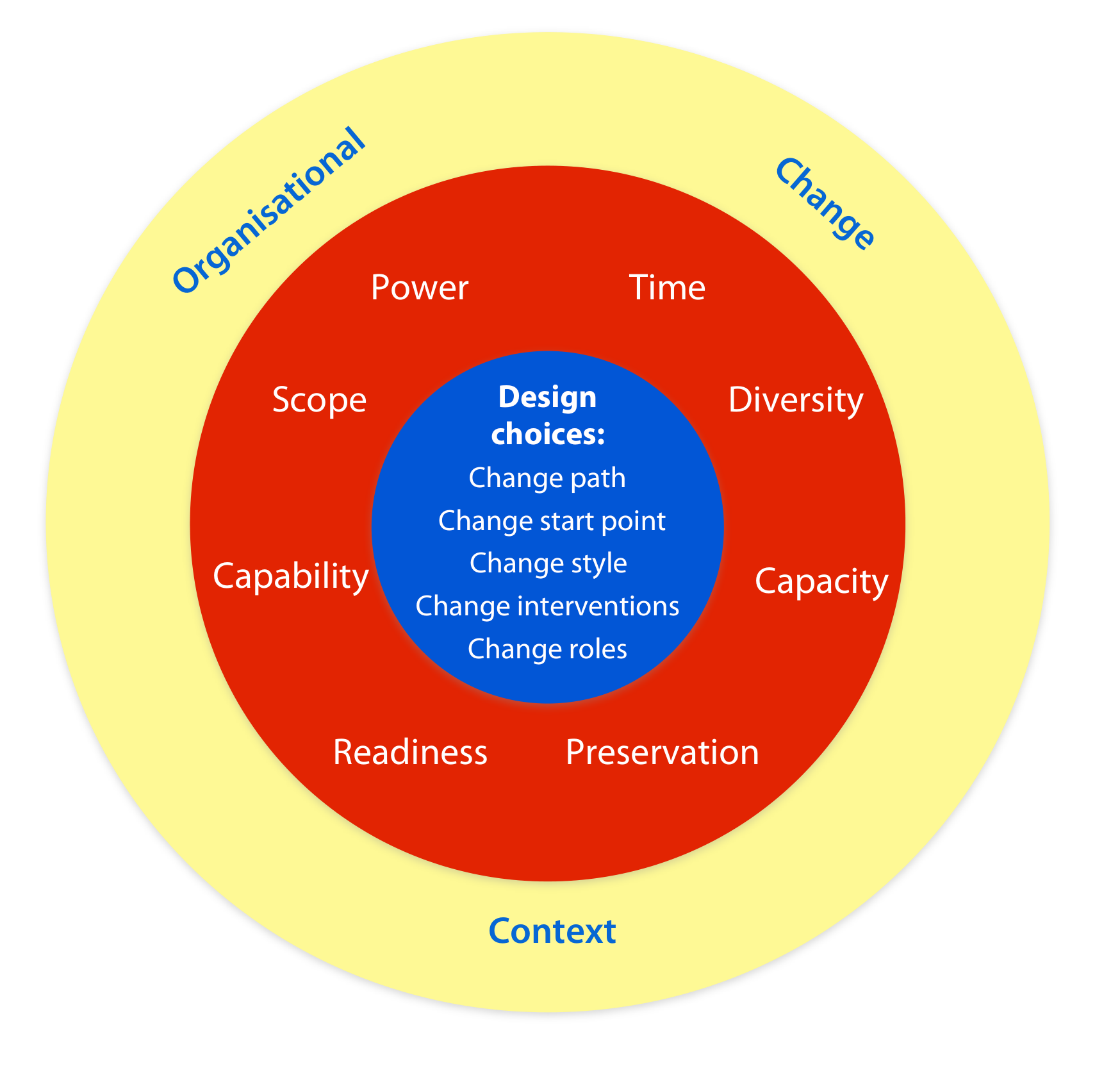
It’s usually assumed that there will be resistance to change. People may fear that they will lose their jobs, they may fear that their job will be worse, they may fear that they won’t be able to cope with a new role. You will see later ways in which resistance to change might be overcome. However, even if resistance is not strong, major change is likely to be a difficult time for an organisation. This diagram, the Balogun and Hope Hailey kaleidoscope, sets out certain variables that could be present in the change context and also sets out certain design choices that might then be possible.
1.1 Contextual features
First, we can look at the contextual features of the change, i.e. the variables that determine the nature of each change event.
Time What is the time span? Do we have a long time, or is it urgent? You can probably predict from this, that if a change is urgent, the change process is likely to be one where people tend to be told what to do rather than having long discussions about what should be done.
Scope How much of the organisation is affected? If most of it is affected then the change process is much more complex. If it is more restricted the change process would be much easier.
Preservation Which aspects of the organisation work well and therefore are to be retained? We must be careful not to damage those.
Diversity Some parts of the organisation may be keen to embrace change whereas others resist and are protective of their current position.
Capability Can we do the change or we need outside experts?
Capacity Do we have enough resources and time, money, and expertise or do we need to buy some in?
Readiness Are staff members aware of the need for change, committed to it, anxious for it and ready to embrace it?
Power. How much power does the change agent have? If that person has to keep referring upwards to get guidance, then to some extent their position and power is undermined.
1.2 Design choices
Having looked at the context (the environment) of the change and the variables determining this, we can now look at various design choices.
Change path. What are the time scales? What is the extent of the change? How do we know when an outcome has been achieved?
Change start point. Are we going to impose change top-down, or are we going to go to our employees and ask them to suggest what changes may be required?
Change style. Is it going to be very dictatorial or much more participative.
Change interventions. These can consist of educating people, communicating the need for change and cultural interventions. For example, team building or getting people to be more flexible and to be willing to work in a variety of project teams.
Change roles. Who is going to be responsible for carrying out the change. Are we going to bring in outside consultants? Are we going to have a project team with a project leader? Is it all going to be managed by, for example the managing director,
The design choices need to be made bearing in mind the contextual features that we discussed above.
2 Force field analysis
As mentioned earlier, the normal assumption is that change will be resisted by employees, and even if it’s not resisted very strongly there is likely to be a period where employees are nervous and there will be a certain amount of disruption. It’s important for companies to try and manage change so that disruption and resistance are both minimised. There are number of techniques that can help.
The first one shown here is Lewin’s Force Field Analysis.
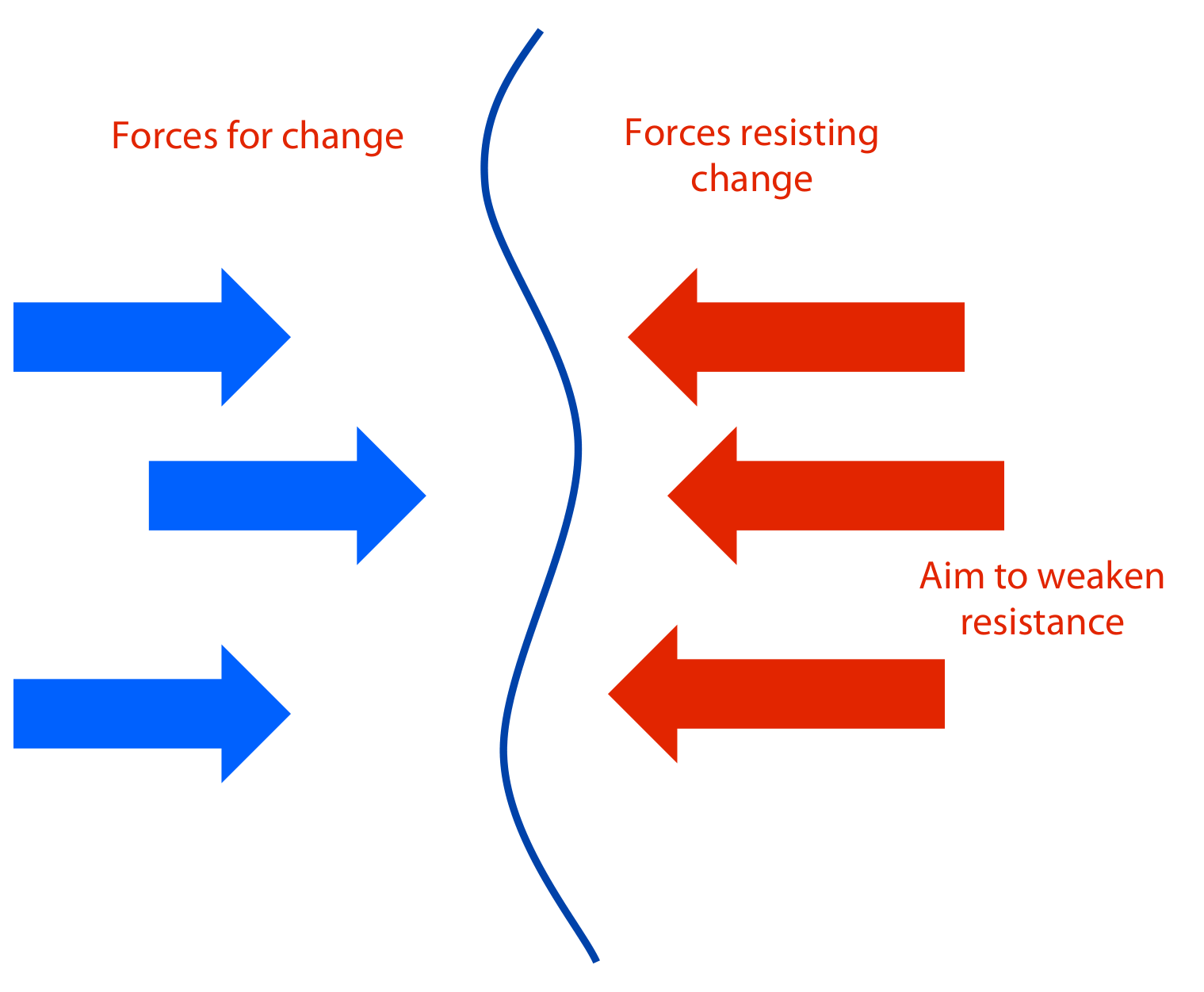
Lewin says that on one side there are forces for change. The assumption is that these changes will set up forces resisting them. It could be just individual employees who object or it could be more highly organised through a trade union or works council. The wrong approach, according to Lewin, is for management to push very hard one way because the chances are that the forces resisting change will just push equally hard the other way, and the whole conflict escalates so that there is a serious risk of industrial unrest and strikes and work-to-rules.
Lewin says that instead of taking on the resisting forces head-on, management should aim to weaken resistance to change. And how do you weaken resistance to change?
Well, the suggested ways are:
Communication. Often resistance to change is there because people simply don’t know what is happening. They fear for their jobs but perhaps there are no plans to make anyone redundant. If people are worried that they won’t be able to cope with the new system you can say that training will be provided for everyone. Communication should also include reasons why change is needed. You could say to people that if we don’t change we can’t compete, if we can’t compete there will a contraction of the business.
Participation. If you explain to people why change is needed and then ask them to make suggestions about the change in the structure of the company (a kind of bottom-up approach) it is subsequently quite difficult for them to object to suggestions that they have made themselves.
3 Lewin’s three step approach
Lewin’s second suggestion for managing change is his three-step process which effectively is very similar to his Force Field Analysis, though not using quite the same analogy. Here he says:
Keep the three models in this chapter apart in your mind, because they answer different questions. Unfreeze–change–refreeze is a process for carrying change through; it is not a leadership style, and it is not relevant to every requirement that mentions change. The contextual features at the start of the chapter are the internal, organisational variables to consider before change begins — time, scope, preservation, diversity, capability, capacity, readiness and power — and a question asking for those wants the answer organised around them, not around the proposed changes or their benefits, and not around external factors. Naming a stage or a feature earns little; say what it means for the organisation in the question.
First, management must first unfreeze the current situation. Explain to people why change is needed, get them ready for change. Ideally, get them ready to embrace change.
Secondly, you put through the changes. This can be a relatively long period where people will have to perhaps undergo retraining and restructuring.
Third, refreeze the situation. Let things settle down, have a period of calm where things refreeze and become stable in a new environment. Above all make sure that people don’t slip back into old patterns of behaviour.
4 Change agent
The third approach which management should consider is the use of a change agent, who will normally be an outside consultant. Consultants can be very expensive but there can be very considerable advantages in hiring one to oversee the entire change process:
They are skilled in the process of change. They know that people will be unsettled. They know the importance of communication and how useful it could be if people were allowed to participate in the change process by making suggestions.
A consultant might typically visit half a dozen different companies in a year. They therefore know the types of management structure which might be suitable. They know which processes could perhaps be successfully outsourced. They therefore bring enormous knowledge and expertise to the type of change that is needed, not just to the way in which the change should be affected.
They are perceived as being independent and fair. They come to the company with a “clean pair of hands”. They won’t be creating a good job for themselves. They won’t be getting even with rivals and people they don’t like within the company. They won’t be trying to preserve previous changes which they put through earlier in their management career.
Management knows that if the change process goes wrong, it could be extremely serious for the company and they may feel nervous about that. Therefore, they may want someone to effectively hold their hand and to give advice; it’s someone for management to transfer risk to. If after the event, management can say, “Look we went to one of the most respectable firms of consultants; we did everything we could to get this right. Okay, things aren’t perfect, but there is nothing more we could have done. We had the best advice that money could buy.”