
Classification of business process changes


1 Introduction
A business process can be defined as:
“An arrangement of resources that transforms inputs into outputs that satisfy customer needs whether those customers are internal or external.”
Organisations should never be content that their processes have been perfected. Apart from anything else, technology changes and customers will demand different products or services and inevitably processes must change.
1.1 There are three levels at which processes can change:
Automation. This can be regarded as taking place at an operational level. Existing processes are automated and they are therefore made somewhat more efficient, perhaps more reliable, faster, and more cost-effective. For example, a supermarket system keeps track of inventory volumes as items are scanned at checkout. An order is then sent to suppliers when inventory falls below the reorder level.
Rationalisation. This is sometimes called process redesign. This is at a more the tactical level and can involve, for example, removing bottlenecks. An example of potential bottleneck could be seen in a supermarket environment where frequent reordering of inventories is required. A bottleneck could simply be the time it takes for suppliers to produce and send out new orders. This will restrict the speed at which inventory can be replenished. One way of removing the bottleneck and rationalising the process is for the supplier to monitor stock at the supermarket and to automatically start the dispatch process when it can be seen that the stock is approaching the reorder level.
Process re-engineering. At the highest strategic level, business process re-engineering is encountered. This looks at much more radical changes taking place within the organisation. It’s sometimes said that moving to just-in-time inventory is business process re-engineering. Radical changes to production and ordering are required so that the organisation no longer has to rely on inventories.
The distinction between automation, rationalisation, and business process reengineering are not hard and fast. There is a continuum, but at the more sophisticated strategic end radical changes may be what are required to keep the business competitive and to successfully add value to what it’s doing.
2 Redesign patterns
2.1 There are four basic redesign patterns.
Re-engineering. This pattern relates to a fundamental rethinking starting from a zero base and building up the process from scratch. The object is to obtain major fundamental improvements in the process.
Simplification. Here it’s recognised that as time passes most processes gather elements of duplication and redundancy. Although the process may be well thought out at the start, it can grow in a rather disorganised way so that considerable inefficiencies can be created.
Value-added analysis. Remove all non-value adding activities. A value adding activity is one for which the customer is willing to pay, one which physically changes the output in some way, for example, a manufacturing or chemical process. The activity has to be performed correctly on the first attempt: there is no value-added and having to rework products.
Analysis of gaps and disconnects Check flows of information and products between departments. Poor communication between the various functions in the business is liable to result in non-value-added activity.
Processes can be mapped on swim-lane diagrams so that they can be studied.
3 Swim lane diagrams
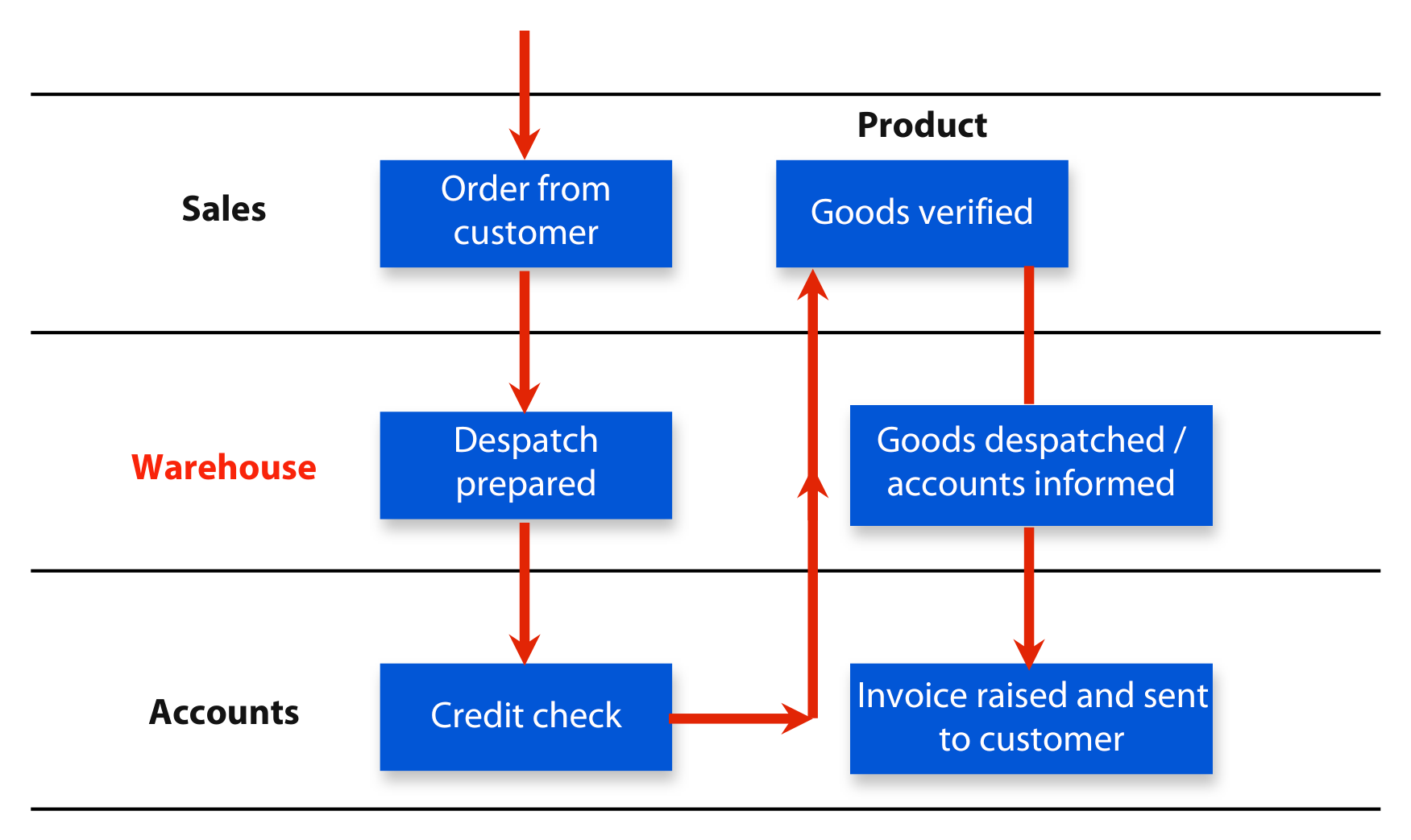
The examiner could present a system and ask you to suggest improvements. In addition to narrative, a swim-lane diagram is often attached to back up the description.
Here is a simple one. You won’t have to draw one, and they are easy to understand.
Look for
Processes happening in an illogical order
Pointless processes
Pointless transfers between departments of goods, documents or information.
Here:
An obvious fault is that credit control approval happens after the despatch is prepared.
It is not clear if the goods travel to the accounts department
It is not clear why the goods have to travel back to sales then back to the warehouse for despatch. Can’t someone in the warehouse check them?
4 Scope and nature of change
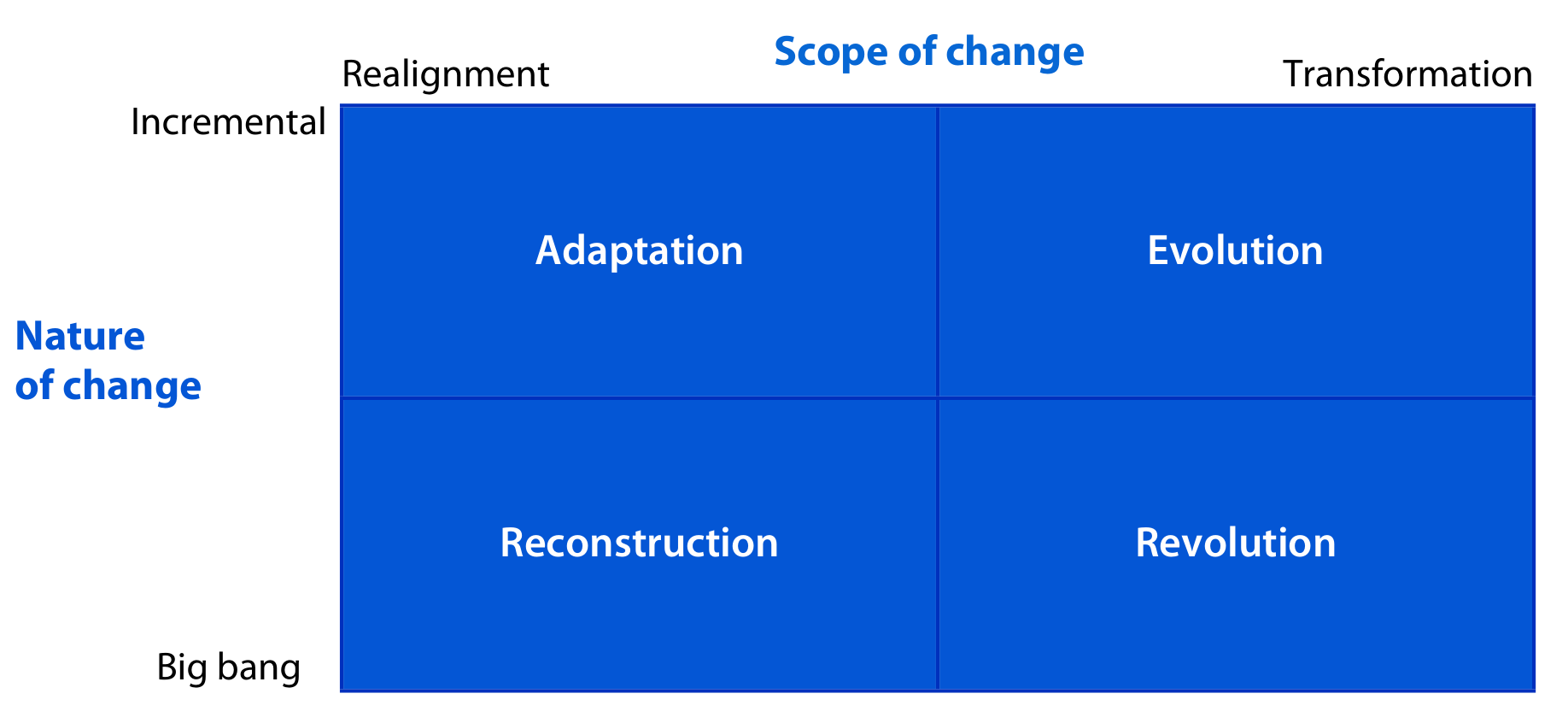
The scope of change relates to the size of the change and how fundamental it is. For example, if every department were being affected the scope would be transformational (large). Similarly, if the fundamental nature of the business was being changed (such as moving from being a cost leader to a differentiator), the scope would again be transformational.
The nature of the change deals with its speed.
You can remember the top two quadrants from biological terms. Adaptation means slow, small changes. Evolution means slow large changes. Because the changes are incremental, these types of change are relatively low risk as the change process can be halted or reversed if it’s not going well.
Revolution is obviously a large, fast change. There is a high risk of things going wrong.
Reconstruction is a fast change of limited consequences. Obviously, its speed means that things can go wrong, but as the extent of the change is limited, any damage should be limited to relatively few stakeholders and it should be relatively easy to put it right again.